Multipack fastener control with AI — one screw missing from the kit is a phone call from the customer.
A multipack fastener kit almost always fails on quantity, mix or the wrong coating, and the classic system (scale + checklist) works 99% of the time. iLEAN Edge sees the kit before it is sealed, counts every screw by geometry and cross-references it with the batch BOM that Connect has read from the ERP. The person signs — the line does not restart on its own.
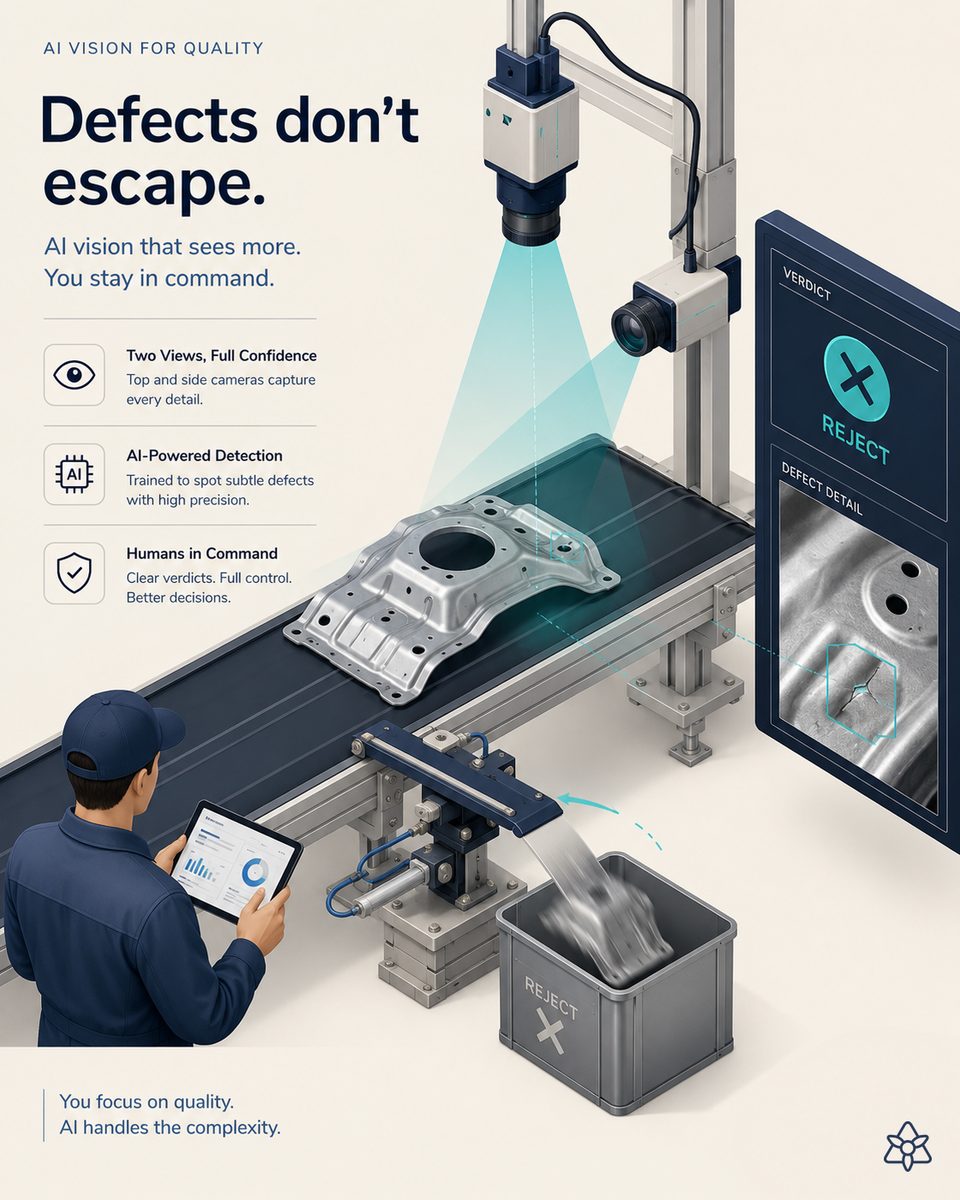
The kit that looks well made until the OEM opens it.
The multipack of fasteners that leaves your plant is not a part: it is ten different screws, each with its own part number, its own metric thread, its own coating, its own tightening torque specified in the OEM's manual. And all of them in the same tray, ready to go straight to the customer's assembly bench.
- Quantity — the scale counts grams. One M8 too many, one M6 too few, and the weight almost adds up. The operator signs. The kit ships.
- Mix — two similar part numbers in adjacent bins, the SKU was changed in an Excel sheet that never reached packing, and the bowl feeder's agitator vibrates just enough for the wrong part to get through.
- Coating — a zinc plated and a Geomet screw of the same metric thread weigh almost the same. The scale cannot tell them apart. The PPAP can, and so can the OEM.
The quality manager knows it. So does the operator. And even so, on a shift with three active SKUs and the conveyor running, the classic system works 99% of the time. That 1% is the customer's 8D — and a well-managed 8D is two people's work for two weeks.
iLEAN does not replace the scale — it seals the cracks the scale leaves exposed.
The problem is not a lack of information: it is information living in islands (ERP with the BOM, MES with the production order, Excel with the new SKU record, a photo of the tray nowhere at all) that, at a SKU changeover, does not reach the decision maker in time. iLEAN acts as the putty that fills those gaps, without asking you to change your ERP, your MES, or the bowl feeder.
Edge sees the tray before sealing. Connect reads the BOM wherever it lives — ERP, MES, a forgotten Excel. The agent cross-references it with the PPAP and, if something does not add up, holds the kit. The person signs — never the other way round.
The three iLEAN pieces applied to multipack fastener control:
- Edge — a machine vision terminal (CNN) over the kit tray. It counts every screw by geometry (length, head, thread pitch, coating) and triggers the actuator (light stack, ejector) if it does not match the BOM. It works with no network. If the plant loses WiFi, Edge keeps counting and holding.
- Connect — captures the batch BOM whether it comes from the ERP, the MES, or an SKU change sheet from the R&D manager. And it captures what arrives from outside (the OEM's email with the new part number, the supplier's WhatsApp about a coating change) at second zero, without anyone forwarding anything.
- Agent — cross-references the BOM, the line history, the image of the kit and the PPAP. If there is a deviation, it does not wait until the end of the shift: it holds the kit and assembles the file — photo, batch, shift, operator. The person validates and signs; the line does not restart on its own.
Manual multipack vs. multipack cross-checked with iLEAN
| Aspect | Scale + checklist | With iLEAN Edge + Connect + Agent |
|---|---|---|
| Part counting | Approximate weight, cannot tell a mix apart | Counting by geometry, one by one |
| M6/M8/M10 mix | Caught only if the weight falls out of range | Caught by geometry even when the weight adds up |
| Coating (zinc plated vs Geomet) | Cannot tell them apart | Tells them apart by gloss and texture |
| SKU changeover | Excel sheet + shift lead's signature | New BOM pushed to Edge in seconds |
| Error detection | OEM 8D claim | Before sealing, in line, in milliseconds |
| PPAP/IATF file | Rebuilt by hand, weeks | File per batch, automatic, with a photo of the kit |
Impact estimate for your plant — to be validated with your numbers.
The block below is an estimate to be validated with the specific data of your plant. We put it forward so the committee has an order of magnitude; we refine it during the diagnostic.
- Tier-1 fastener plant supplying a premium OEM, 1-2 multipack packing lines, 6-10 active SKUs with a variable BOM and overlapping coatings.
- Edge pilot on one line (camera over the tray + actuator + integration with the batch BOM from the ERP/MES). First value expected within a few weeks.
- Indicative payback between 4 and 9 months, depending on the number of 8Ds over the past years and the average cost of an 8D (RMA, 100% re-sorting, reverse freight, damage with the OEM).
- Expected reduction of multipack incidents of ≥30% in the first quarter, and ≥90% by the sixth month according to the catalog Pareto. The hard lever is a single 8D avoided and the removal of the fixed cost of the re-sorter.
And the industry number: 25 PPM
The automotive quality standard is on the order of 25 parts per million defective [1]. One badly built tray in every 40,000 puts you out of range. The scale cannot get there; vision can. And even so, what is critical is never decided alone: iLEAN holds the kit and the person signs. The three safety rings exist precisely for this.
On the reliability of AI in this kind of task: hallucination is a problem of free generation, not of anchored tasks. In tasks where the AI merely recontextualizes a piece of data (reading the tray and comparing it with the BOM), the best models brought error below 1.5% [2].
[1] 25 PPM standard in automotive quality — Symestic.
[2] OpenAI paper “Why Language Models Hallucinate”, 2025 — on the reliability of AI in anchored tasks.
What people ask about multipack fastener control with AI
Why does a multipack fastener kit fail in automotive?
Almost always because of three causes that coexist: a change of screw part number was never communicated to packing, the counting scale counts grams and one stray M8 weighs about the same as two M6, and the packing operator has three SKUs running at once. The classic system (scale + checklist) works 99% of the time; that 1% is what ends up as an OEM 8D.
How does iLEAN Edge verify the quantity and the mix of the multipack?
Edge is a vision-equipped terminal (CNN) over the packing conveyor or over the kit tray. It reads the tray before it is sealed, counts every screw by geometry (length, head, coating) and cross-references it with the batch BOM that Connect has read from the ERP. If a part is missing or there is an M6 where an M8 should be, it triggers the actuator (light stack, ejector) in milliseconds — before sealing, not after.
Does it work for fasteners with similar coatings (zinc plated vs Geomet)?
Yes. The CNN is trained on samples from your own plant — Edge sees differences in gloss, texture and color of the coating that the scale cannot tell apart. This is one of the cases where vision clearly beats weight, because two screws of the same metric thread with different coatings weigh almost the same but are different part numbers in the eyes of the PPAP.
How does it integrate with PPAP and IATF 16949 traceability?
An agent assembles the file per batch — a photo of the verified kit, the batch BOM, time, line, the operator who signed, the result of every check. The record is available for audit without anyone rebuilding it by hand. If the OEM opens an 8D, the agent hands you the batch, the shift and the image of the kit in seconds, not in weeks.
How much does an Edge pilot for multipack fasteners cost?
The order of magnitude of an Edge pilot on a fastener packing line is close to that of any industrial Edge pilot: terminals + cameras + actuator + integration with ERP/MES, plus an annual license. A reasonable payback to present to the committee is a matter of several months — the hard lever is a single 8D return avoided and the removal of the fixed cost of the re-sorter. We ask for your data and send you the estimated ROI in 48h.
More cases in automotive
- Lithium battery recycling control with AI — a damaged cell that reaches shredding still charged is the plant's nightmare; sorting it by eye is a gamble.iLEAN identifies every pack at intake, detects visible damage, diverts anything unsafe to quarantine and…
- OEE on a multi-model car line — one aggregate number does not tell you where productivity is leaking.iLEAN measures OEE in plants running N models on the same line and breaks losses down by model, shift…
- Multifunction steering wheel control with AI — five worlds in a single part, and no cross-check in time.iLEAN combines Edge vision on the multifunction steering wheel, an electrical test of every button and…
- OEM CSR digitized with AI — your customer publishes a new revision, nobody reads it end to end, and finding the gap at the audit is too late.iLEAN digitizes every OEM's CSR: it extracts requirements from the PDFs, cross-checks them against your…
- OEM injection molded part control with AI — the sink mark the eye does not catch until the OEM assembles it.How iLEAN verifies geometry, sink marks and flash on the OEM injection molded part in line with Edge and…
- Predictive maintenance for the paint booth and the curing oven — the one bottleneck that, when it stops, stops the whole plant.iLEAN detects paint booth and oven drift — filters, fans, zone temperatures — and proposes when to…
Tell us your case and in 48h we'll send you the estimated ROI of this AI project for your fastener line.
We work on your plant's real data, not ours. Diagnostic with no commitment.
Request estimated ROI in 48h See automotive