Multifunction steering wheel control with AI — five worlds in a single part, and no cross-check in time.
A multifunction steering wheel combines leather, foam, airbag, physical controls, capacitive controls and a CAN bus — each with its own supplier and its own quality system. iLEAN cross-references Edge vision on the assembly, the electrical test of every button and the airbag module torque, and holds the unit before it ships when something does not add up. The person signs.
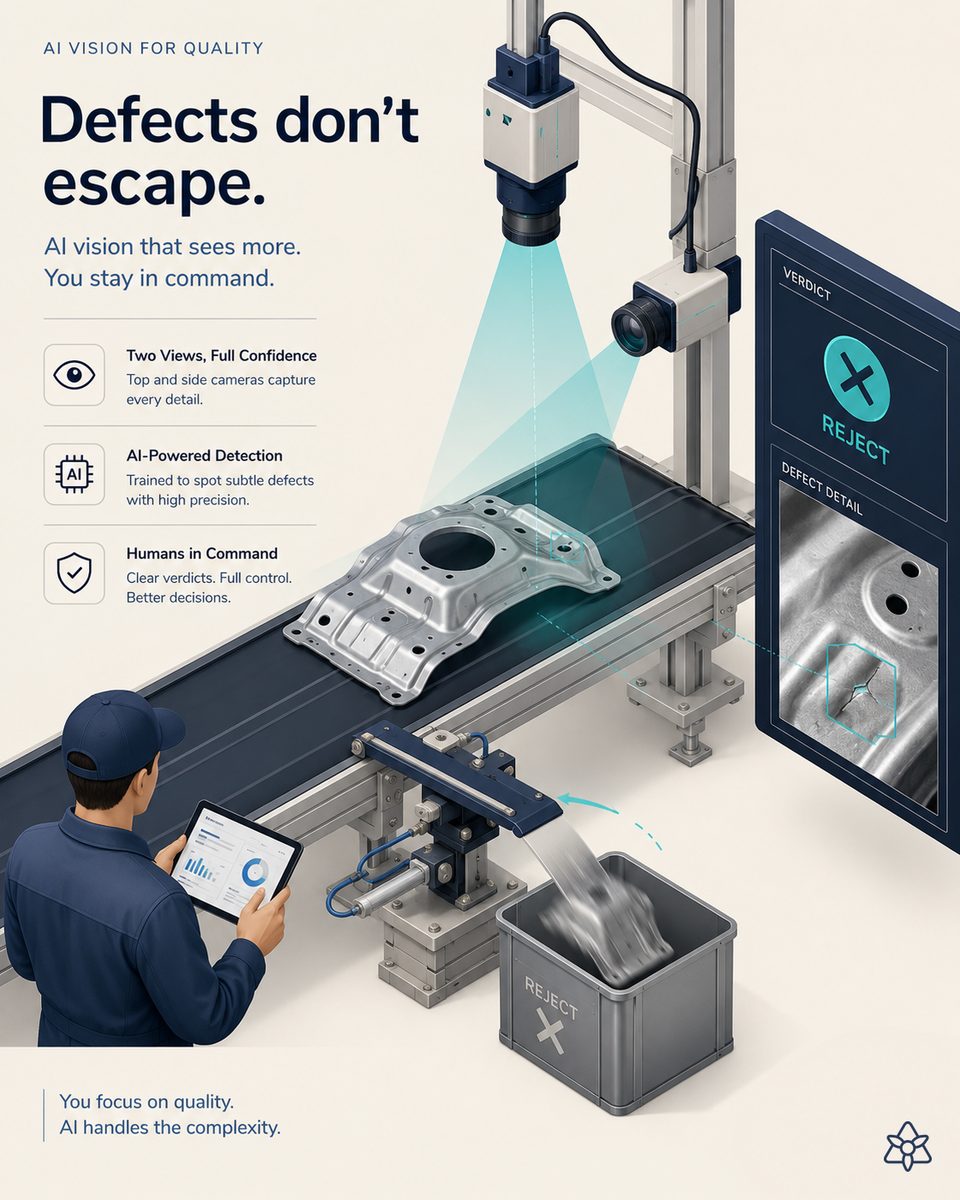
Five different worlds, five quality systems, one single steering wheel.
The modern multifunction steering wheel is the most complex part of the interior — and every subsystem lives in its own quality system:
- The leather or synthetic on the rim — stitched by hand or by machine, a critical cosmetic defect that the OEM rejects on appearance.
- The foam over the metal armature — hardness, uniformity, color. One bad mix and you feel it in the first month.
- The driver airbag module — bolted to the hub with critical torque and angle, with its own IATF and UNECE standards.
- The physical and capacitive controls — each with its own electrical test per model and trim level. The CAN/LIN test validates that the cruise control button appears as such in the ECU.
- The CAN/LIN connector to the ECU — specific pinout, identification frame, validation against the test bench.
The quality manager knows it. The operator has their test bench, their smart nutrunner and their model card. The classic system works when the line is running at steady state — and the defects concentrate at the multi-model SKU changeover, exactly when a Sport steering wheel in gray leather gets mixed in with a Comfort in beige leather and nobody notices until the OEM rejects it at receiving.
iLEAN does not replace the test bench — it puts the five worlds in the same sentence.
The multifunction steering wheel problem is not a lack of benches: it is information in islands (electrical test bench result, airbag module torque, image of the leather, foam hardness, model recipe). At the critical moment — the steering wheel leaving the line — those five sources are not cross-referenced. iLEAN acts as the putty that fills those gaps without touching the bench or the nutrunner.
Edge sees the leather, the controls and the mounted airbag. Connect reads the test bench, the airbag torque and the model recipe. The agent cross-references and holds. The person signs — never the other way round.
The three iLEAN pieces applied to multifunction steering wheel control:
- Edge — a machine vision terminal (CNN) over the critical stations: image of the stitched leather (stains, loose threads, color), of the airbag module aligned to the hub, of the controls on the rim (play, marking, trim cover). It triggers the actuator (light stack, diverter) in milliseconds if something does not add up. It works with no network: if the plant loses WiFi, Edge keeps reading and holding units.
- Connect — captures the CAN/LIN frames from the electrical test bench (which button responded, which frame was emitted), the torque and angle from the airbag module nutrunner, the model recipe from the ERP/MES and the module serial number from the laser marking. What arrives from outside (an email from the leather supplier about a batch under suspicion for color) enters at second zero.
- Agent — cross-references the image of the leather, the test bench result, the airbag module torque, the steering wheel serial number, the destination VIN and the model recipe. If something does not add up — a Sport steering wheel with beige leather from an SKU error, a button with no CAN response, a torque outside the window — it holds the unit and alerts the quality manager. The person validates and signs; the line does not restart on its own.
Test bench + human eye vs. in-line control with iLEAN
| Aspect | Today (bench + checklist + human eye) | With iLEAN Edge + Connect + Agent |
|---|---|---|
| Cosmetic leather defects | End-of-shift visual inspection, subjective | CNN vision on the stitched rim, before the trim cover |
| Electrical test of the controls | Result on the bench PC, not linked | CAN/LIN frames captured and linked to the serial number |
| Airbag module torque | Recorded in the nutrunner, not linked to the VIN | Captured by Connect and linked to the destination VIN |
| Multi-model SKU changeover | Paper card, risk of mixing during the transition | Edge validates color/trim against the model recipe |
| Batch-to-VIN link | Rebuild it if there is a PRR, weeks | File per unit, automatic, ready for PPAP/8D |
| Operation with no network | n/a | Edge keeps running on the light from the panel |
Impact estimate for your plant — to be validated with your numbers.
The block below is an estimate to be validated with the specific data of your plant. We put it forward so the committee has an order of magnitude; we refine it during the diagnostic.
- Multi-model multifunction steering wheel assembly line, with a leather sewing machine, an airbag module nutrunner and a CAN/LIN electrical test bench at the end.
- Edge pilot on one line (camera over the leather + camera over the controls + integration with the test bench and the nutrunner). First value expected within a few weeks.
- Indicative payback between 4 and 9 months, depending on the frequency of OEM PRRs and of units blocked at the OEM's plant over the past years.
- The hard lever is a single sorting campaign avoided at the OEM from a multi-model SKU mix-up, plus the aggregate cost of cosmetic PRRs.
And the quality manager's reasonable doubt
“What if the AI confuses gray leather with beige when the booth lighting changes?” — hallucination is a problem of free generation, not of anchored tasks. In tasks where the AI simply compares a color measured in a calibrated booth with a model reference, the best models brought error below 1.5% [1]. And even so, what is critical is never decided alone: iLEAN holds the unit and the person signs. The automotive quality standard on the order of 25 PPM [2] cannot be held with sampling: it is held with vision on every part.
[1] OpenAI paper “Why Language Models Hallucinate”, 2025 — on the reliability of AI in anchored tasks.
[2] Symestic — automotive quality standard on the order of 25 PPM.
What people ask about multifunction steering wheel control with AI
What makes controlling a multifunction steering wheel special compared with other interior components?
That five different worlds converge in a single part: leather/synthetic hand-stitched (critical cosmetic defect), foam with a specific hardness (feel), an airbag module with torque and angle monitoring (active safety), physical and capacitive controls with an electrical test per button, and a CAN/LIN bus to the ECU. Each world has its own supplier, its own quality system and its own defect pattern. The quality manager cross-references five islands by hand — and the multi-model SKU changeover is precisely the most vulnerable moment.
Which defects can be detected with vision + AI in steering wheel assembly?
Leather defects (stains, loose threads, uneven stitching, color outside the model's tolerance), foam defects (voids, non-uniform hardness from poor mixing), play in the controls on the rim (mechanical looseness the customer notices within a few months), alignment of the airbag module with the hub, laser marking of the steering wheel and the link to the VIN. iLEAN Edge sees these defects on the finished steering wheel in a single pass; Connect captures the data from the electrical test bench and from the airbag module torque.
How is the electrical test of every button validated without a proprietary bench per model?
iLEAN Connect captures the CAN/LIN frames the test bench already generates — whether from the bench's modern bus or from the old PC where the validation script runs. The agent cross-references that result with the model recipe (which control version each trim level carries) and with the Edge image of the steering wheel. If the test throws a timeout on the cruise control button and the image shows the capacitive module is marked as Sport, the agent holds the unit before it ships and alerts the quality manager on their own channel.
What about the critical torque of the airbag module inside the steering wheel?
The driver airbag module is bolted to the steering wheel hub with critical torque and angle. iLEAN Connect captures the torque recorded by the smart nutrunner, links it to the steering wheel serial number and to the destination VIN, and the agent cross-references it with the acceptance window. If the torque falls outside, the trim cover is not fitted: the unit stays held at the station. iLEAN's three safety rings guarantee that in passive safety the critical decision is only ever executed by a person.
How much does a multifunction steering wheel control pilot with iLEAN cost?
The order of magnitude of an Edge pilot on a multifunction steering wheel line is similar to that of any Edge pilot on interior components: vision terminals + integration with the electrical test bench, the airbag module nutrunner and the leather sewing machine + an annual license. A reasonable payback to present to the committee is a matter of several months — the hard lever is the cost of an OEM PRR for a cosmetic defect + the cost of a single unit blocked at the OEM's plant for an electrical defect. We ask for your plant's data and send you the estimated ROI in 48h, with your numbers.
More cases in automotive
- LED headlamp control with AI — the OEM does not send back one unit, it sends back the whole batch.iLEAN applies Edge vision to LED headlamps — beam uniformity, scatter, color and micro-cracks in the…
- Lithium battery recycling control with AI — a damaged cell that reaches shredding still charged is the plant's nightmare; sorting it by eye is a gamble.iLEAN identifies every pack at intake, detects visible damage, diverts anything unsafe to quarantine and…
- OEE on a multi-model car line — one aggregate number does not tell you where productivity is leaking.iLEAN measures OEE in plants running N models on the same line and breaks losses down by model, shift…
- Multipack fastener control with AI — one screw missing from the kit is a phone call from the customer.How iLEAN counts and verifies every screw in the multipack kit in line with Edge vision and agents —…
- OEM CSR digitized with AI — your customer publishes a new revision, nobody reads it end to end, and finding the gap at the audit is too late.iLEAN digitizes every OEM's CSR: it extracts requirements from the PDFs, cross-checks them against your…
- OEM injection molded part control with AI — the sink mark the eye does not catch until the OEM assembles it.How iLEAN verifies geometry, sink marks and flash on the OEM injection molded part in line with Edge and…
Tell us your case and in 48h we'll send you the estimated ROI of this AI project for your steering wheel line.
We work on your plant's real data, not ours. Diagnostic with no commitment.
Request estimated ROI in 48h See automotive