LED headlamp control with AI — the OEM does not send back one unit, it sends back the whole batch.
A defective LED headlamp is invisible at 50 km/h: it shows up at the OEM's incoming inspection or, worse, at the end customer. iLEAN Edge measures illumination uniformity, beam scatter, LED binning and micro-cracks in the lens in line, cross-references them with the batch recipe and holds the unit before final assembly. The person signs.
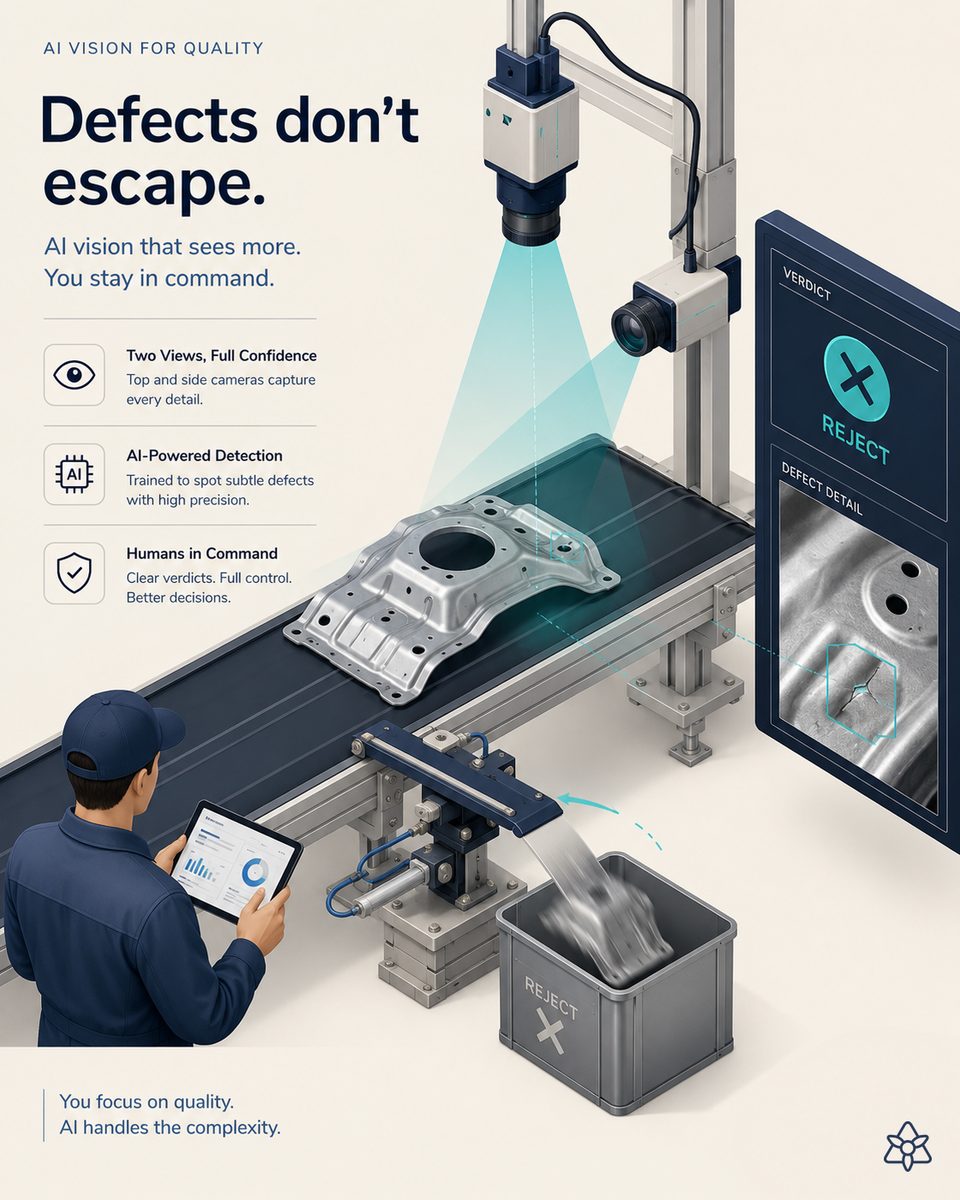
An LED headlamp is precision optics, and almost all of the control lives in sampling.
A modern LED headlamp (full-LED, matrix, adaptive) combines five critical parameters that are almost never inspected on 100% of units in line:
- LED binning — the supplier ships LEDs sorted by intensity, color and forward voltage. Mix bins inside the same module and the beam loses uniformity.
- Reflow soldering of the SMDs — poor thermal contact with the heat sink and the LED drifts in color or dies on the first temperature cycle.
- Injection of the polycarbonate lens — micro-cracks, bubbles and mold marks that a tired eye at 6 p.m. does not see.
- Alignment of the collimating optics — tenths of a millimeter decide whether the beam falls inside the photometric envelope of the UNECE regulation or outside it.
- Housing sealing — moisture inside the headlamp = condensation months later, warranty claim open.
The quality manager knows it. The homologation bench is slow and sample-based. Human visual inspection is subjective and gets tired. The classic system works for the vast majority of headlamps — and the OEM rejection lands on the one that slips through. One rejected batch costs the equivalent of weeks of line output.
iLEAN does not replace the homologation chamber — it puts a 100% in-line control next to it.
The LED headlamp problem is not a lack of equipment: it is information split into islands (supplier binning in a PDF, reflow oven parameters on its own PC, lens dimensional data in another system, a human eye at end of line). At the critical moment — right before final assembly — those five sources are never cross-referenced. iLEAN acts as the putty that fills those gaps without asking you to change the homologation chamber or the injection press.
Edge sees the lit headlamp inside the light booth. Connect reads the supplier binning, the oven parameters and the model recipe. The agent cross-references them with the UNECE regulation and holds. The person signs — never the other way round.
The three iLEAN pieces applied to LED headlamp control:
- Edge — a terminal with multispectral vision (CNN) looking at the lit headlamp inside a compact controlled light booth. It measures uniformity, scatter, color per LED, micro-cracks in the lens and thermal hot spots in a single pass. It fires the actuator (stack light, diverter) in milliseconds. It works with no network: if the plant loses WiFi, Edge keeps measuring and holding units.
- Connect — captures the declared binning of the LED batch from the supplier's CoC (a PDF by email), the reflow oven parameters (temperature profile per board), the dimensional data from the lens injection press and the model recipe from the ERP/MES. Whatever arrives from outside (a supplier email warning that a bin is unavailable) enters at second zero.
- Agent — cross-references declared binning against measured binning, the oven profile against the LED's thermal signature, the lens micro-cracks against the mold signature, and the photometric result against the model's UNECE envelope. If something does not add up, it holds the unit before final assembly and alerts the quality manager on their own channel. The person validates and signs; the line does not restart on its own.
Visual inspection + sampling vs. 100% in-line control with iLEAN
| Aspect | Today (operator + homologation sampling) | With iLEAN Edge + Connect + Agent |
|---|---|---|
| Photometric control coverage | 1-in-N sampling on the homologation bench | 100% in an in-line Edge light booth |
| LED binning | Trust in the supplier's CoC, no verification | Declared binning cross-checked with measured spectrum per unit |
| Micro-cracks in the lens | Tired human eye at the end of the shift | CNN vision on the lens, sub-millimeter marks detectable |
| Thermal hot spots | Not detected until the accelerated aging bench | Thermal signature in line with the first voltage applied |
| When the rejection is caught | The OEM rejects the batch at goods-in, full sorting | Before final assembly, unit by unit |
| File for PPAP/8D | Rebuilt by hand, weeks | Per-unit dossier, automatic, with a photo of the beam |
Impact estimate for your plant — to be validated with your numbers.
The block below is an estimate to be validated with the specific data of your plant. We put it forward so the committee has an order of magnitude; we refine it during the diagnostic.
- Full-LED headlamp line with a reflow oven for SMDs, a polycarbonate lens injection press and a photometric homologation bench at the end.
- Edge pilot on one line (compact light booth + multispectral camera + integration with the supplier's binning CoC). First value expected within a few weeks.
- Indicative payback between 4 and 9 months, depending on the frequency of OEM rejections over recent years and the average cost of sorting plus delivery delay.
- The hard lever is a single batch kept out of sorting: the cost of one OEM rejection for photometric deviation pays for the pilot and the rollout.
And the quality manager's reasonable doubt
“What if the AI gets it wrong and lets an out-of-envelope unit through?” — hallucination is a problem of free generation, not of anchored tasks. In tasks where the AI merely compares a measured spectrum against a declared envelope, the best models brought error below 1.5% [1]. And even so, what is critical is never decided alone: iLEAN holds the unit and the person signs. The automotive quality standard, in the order of 25 PPM [2], cannot be held with sampling: it is held with vision on every part.
[1] OpenAI paper “Why Language Models Hallucinate”, 2025 — on the reliability of AI in anchored tasks.
[2] Symestic — automotive quality standard in the order of 25 PPM.
What people ask about LED headlamp control with AI
What critical defects can vision + AI detect in an LED headlamp?
The ones a tired human eye lets through and the OEM rejects: beam scatter outside the pattern (poor alignment of the collimating lens), non-uniform illumination between LEDs in the same module, color drift from mixed binning, micro-cracks and bubbles in the polycarbonate lens, hot spots from poor thermal contact between LED and heat sink, reflow oven marks on the PCB. iLEAN Edge sees all six defects at once on the lit headlamp inside the controlled light chamber.
Why does the OEM reject an entire batch over one out-of-pattern headlamp?
Because an LED headlamp is a photometric system homologated part by part under UNECE regulations (ECE R48/R112/R123 depending on the function). The OEM cannot accept a headlamp that falls outside the photometric envelope declared at homologation: if a single batch drifts, the OEM blocks it at goods-in and the Tier 1 pays for the full sorting operation plus the cost of missing the delivery date. The trap: the defect is invisible in production without the right light chamber, and the homologation bench is slow and sample-based.
How is the supplier's LED binning cross-referenced with the assembled unit?
iLEAN Connect captures the declared binning of the LED batch from the supplier's delivery note or CoC — even if it arrives by email or as a PDF attachment — and cross-references it with the spectral reading Edge takes on the lit headlamp. If the declared binning does not match what is measured (mixed bins in the same module, drift above the OEM threshold), the agent holds the unit before final assembly and alerts the quality manager on their own channel.
Do you need a dedicated light chamber to inspect 100% in line?
Not always. 100% in-line inspection with iLEAN Edge runs in a compact controlled light booth (typically integrable into the end-of-line station you already have), with a multispectral camera and a calibrated pattern. The homologation chamber stays in place for validation sampling. What changes is that you stop entrusting a 1-in-N sample with a critical parameter the OEM measures on 100% of units at goods-in.
How much does an LED headlamp control pilot with iLEAN cost?
The order of magnitude of an Edge pilot on an LED headlamp line is close to that of any Edge pilot in automotive: vision terminals + controlled light booth + integration with the reflow oven, the lens injection press and the ERP holding the supplier's binning + annual license. A reasonable payback to present to the committee is several months — the hard lever is a single batch kept out of sorting plus the cost of one OEM rejection. We ask for your plant's data and send you the estimated ROI in 48h, with your numbers, not ours.
More cases in automotive
- ISO 26262 with AI — ASIL evidence kept alive, not rebuilt the night before the TÜV audit.iLEAN traces every component by ASIL level and keeps FMEDA evidence live. Your ISO 26262 audit is ready…
- Digital jidoka in robotic welding — a missing weld is not an incident, it is a call from the OEM.Every weld spot inspected by iLEAN Vision. Missing welds or poor weld quality caught before the next…
- Kaizen with AI suggestions in automotive — the operator suggests through their own channel, the Agent prioritizes.iLEAN Connect captures the operator's suggestion by voice, photo or WhatsApp, and the agent prioritizes…
- Lithium battery recycling control with AI — a damaged cell that reaches shredding still charged is the plant's nightmare; sorting it by eye is a gamble.iLEAN identifies every pack at intake, detects visible damage, diverts anything unsafe to quarantine and…
- OEE on a multi-model car line — one aggregate number does not tell you where productivity is leaking.iLEAN measures OEE in plants running N models on the same line and breaks losses down by model, shift…
- Multifunction steering wheel control with AI — five worlds in a single part, and no cross-check in time.iLEAN combines Edge vision on the multifunction steering wheel, an electrical test of every button and…
Tell us your case and in 48h we'll send you the estimated ROI of this AI project for your LED headlamp line.
We work on your plant's real data, not ours. Diagnostic with no commitment.
Request estimated ROI in 48h See automotive