Kaizen with AI suggestions in automotive — the operator suggests through their own channel, the Agent prioritizes.
Kaizen dies if the operator's suggestion requires filling in a form at the end of the shift. iLEAN captures it by voice, photo or WhatsApp at second zero, prioritizes it by estimated ROI and hands it to the continuous improvement manager already filtered. The person decides; the operator sees that their idea got through.
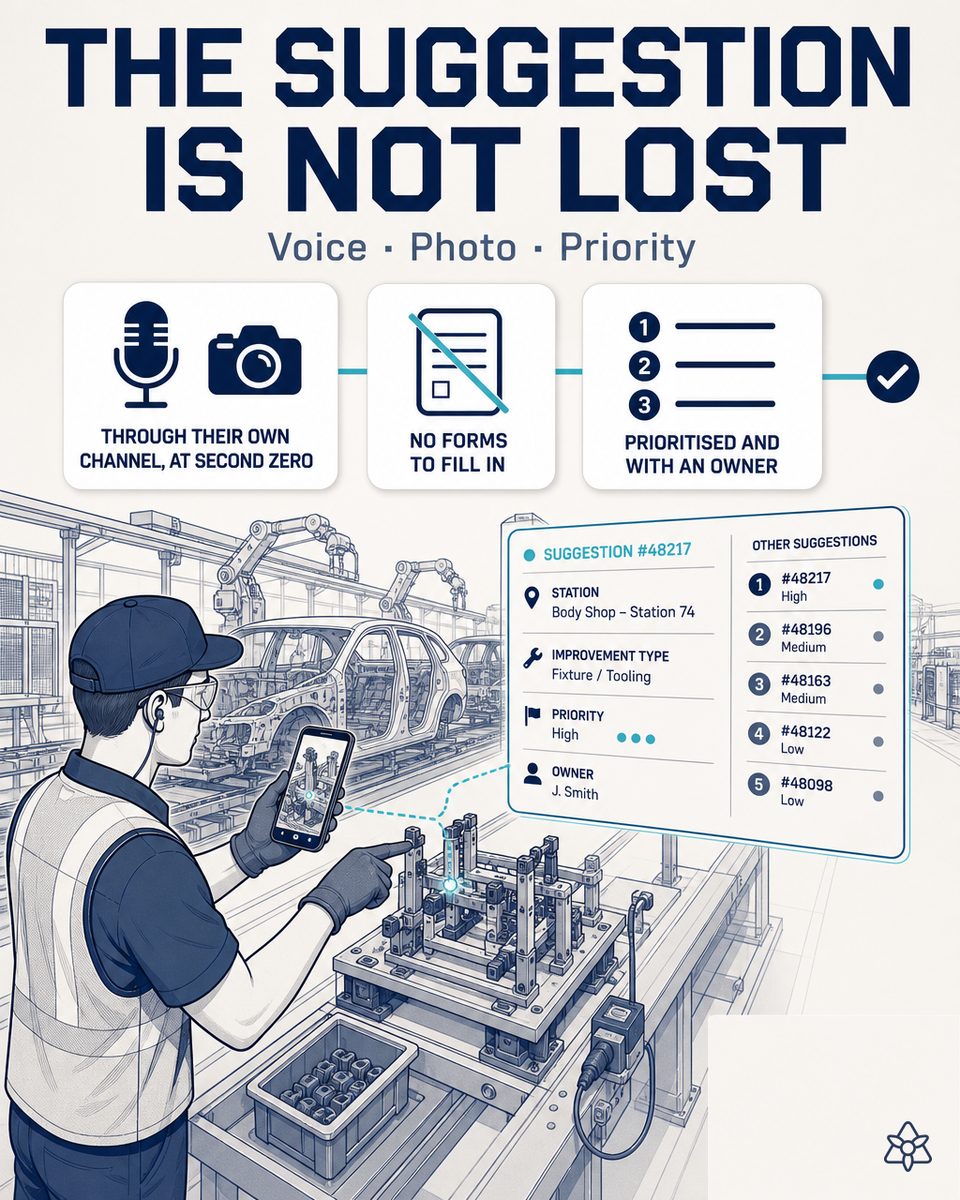
The suggestion the operator has in their head that never reaches paper.
Anyone who has spent time in a tier-1 plant knows it: the best kaizen suggestions belong to the operator who has been at the same workstation for three years and tells a colleague about it during the break, not to the ones that get written on a form at the end of the shift. The formal program demands seven fields, a dropdown and a signature, and the suggestion dies before it crosses the corridor.
- The operator suggests wherever they can — to the shift lead at the handover, by WhatsApp to a colleague, muttering in front of the machine. Almost never in the continuous improvement system.
- The continuous improvement manager receives noise — by the time it arrives, the inbox is saturated with badly categorized, duplicated suggestions with no context about the KPI they affect.
- The loop never closes — the operator never finds out whether their idea was evaluated, discarded or implemented on line 3. Next time, they suggest less.
The formal kaizen program works — for the 10% of operators who are comfortable with paperwork. The remaining 90% have gold in their heads and nobody collects it. The loss does not show up in any metric: it is what never arrived.
iLEAN does not add another form — it removes the ones you already have.
The problem is not that operators do not want to suggest things: it is that the channel is in the wrong place. iLEAN acts as the putty that fills the crack between what the operator says and what the continuous improvement system receives, without forcing anyone to install an app, without asking you to change the formal kaizen program, and without ignoring what is already there.
Connect receives suggestions through the operator's own channel (voice, photo, WhatsApp). The Agent categorizes, prioritizes and estimates ROI. Writer sends the status of the suggestion back to the operator through the same channel. The person signs — always.
The three iLEAN pieces applied to kaizen in automotive:
- iLEAN Connect — it is not the phone app. It is the system that receives suggestions through every channel that already exists: an earpiece on the line (full duplex, the operator dictates while working, and it does not listen until they activate it), the plant number's WhatsApp, a photo sent from a phone or a shared tablet, a voice message, an email. Whatever arrives enters the system at second zero, with no forms.
- iLEAN Agent — transcribes what came in by voice, categorizes it (safety, quality, OEE, ergonomics, scrap), detects duplicates, cross-references it with the line's live KPIs and estimates an indicative ROI. It hands it to the continuous improvement manager prioritized, not dumped in an undifferentiated inbox.
- iLEAN Writer — closes the loop. When the manager decides what happens to the suggestion, Writer replies to the operator through the same channel they used: “your idea about the tooling on press 4 is approved and being implemented, thank you”. The operator sees that their voice got through, and next time they suggest more, not less.
Formal kaizen vs. kaizen with iLEAN
| Aspect | Traditional kaizen program | With iLEAN Connect + Agent + Writer |
|---|---|---|
| Capture channel | Form, suggestion box, MES module | Voice, photo, WhatsApp, earpiece |
| Effort for the operator | 5-10 min at the end of the shift | 10 seconds at the moment of the idea |
| Prioritization in the inbox | Manual, in order of arrival | By estimated ROI and KPI affected |
| Duplicates | Spotted by eye, sometimes never | Grouped automatically against the history |
| Closing the loop with the operator | “Nobody ever told me anything” | A reply through the channel of the suggestion |
| Dossier for the IATF 16949 audit | Rebuild the cycle by hand | Native traceability per suggestion |
Impact estimate for your plant — to be validated with your numbers.
The block below is an estimate to be validated with the specific data of your plant. We put it forward so the committee has an order of magnitude; we refine it during the diagnostic.
- Plant with 300-800 operators, a formal kaizen program with a low participation rate (typically 0.5-2 suggestions per operator per year) and an overloaded continuous improvement manager.
- Connect + Agent pilot on one line or area (multi-channel capture + prioritization + closing the loop back to the operator). First value expected within a few weeks.
- Expected increase in captured suggestions: ≥30% in the first 6 months, above all from operators who did not take part before.
- Indicative payback between 4 and 9 months, depending on the weight of the kaizen program in your IATF 16949 and the average value of an implemented kaizen in your plant (scrap savings, OEE improvement, better ergonomics with fewer sick days).
And the continuous improvement manager's reasonable doubt
“What if the Agent prioritizes badly and ridiculous kaizen slip into the pipeline?” — hallucination is a problem of free generation, not of anchored tasks. When the AI simply transcribes, categorizes and cross-references against existing KPIs (recontextualizing the data), the best models brought error below 1.5% [1]. And even so, the Agent proposes; the continuous improvement manager signs. The pipeline is closed by a person, not by a machine.
[1] OpenAI paper “Why Language Models Hallucinate”, 2025 — on the reliability of AI in anchored tasks.
What people ask about kaizen with AI suggestions in automotive
How does iLEAN capture a suggestion without making the operator install an app?
iLEAN Connect is not the phone app — the app is just one of its doors. Connect takes the suggestion in through the channel the operator already uses: a full-duplex earpiece on the line (they dictate the suggestion while working, and it does not listen until the person activates it), a photo of the workstation sent by WhatsApp to the plant number, a voice message from a phone, or a shared tablet in the area. Whatever arrives through any of those channels enters the system at second zero, without the operator filling in a form or waiting until the end of the shift. If phones are banned in the plant, the area tablet is enough.
Who prioritizes the kaizen suggestions received?
The iLEAN Agent pre-processes every suggestion: it transcribes it (if it came in by voice), categorizes it (safety, quality, OEE, ergonomics, scrap), cross-references it with the line's KPIs and the history of similar suggestions, and estimates an indicative ROI. It then hands it to the continuous improvement manager or the area manager already prioritized, instead of dumping it in a chaotic inbox. The human decides what enters the implementation pipeline — the Agent does not approve kaizen on its own. It fights the problem (suggestions that die), not the person (an overloaded continuous improvement manager).
What happens to kaizen already implemented or in progress?
iLEAN neither replaces nor ignores them. Connect reads the current suggestion system (spreadsheets, internal ticketing, digitized sticky notes, the MES continuous improvement module) and brings them into a single unified pipeline. The Agent can detect duplicate suggestions (“another operator on line 2 asked for this a quarter ago”), pick up kaizen that stalled halfway, and give status visibility back to the operator who suggested it — closing the feedback loop with no extra paperwork.
Does AI kaizen work in a multilingual plant?
Yes. A typical tier-1 automotive plant mixes Spanish, the technical English of OEM corporate, and the operator's local language (Catalan, Galician, Basque, Portuguese, French or Polish depending on geography). Connect transcribes and normalizes the suggestion into the language of the manager who is going to read it, keeping the original. The operator suggests in their natural language; the line supervisor receives it in theirs; the dossier for OEM corporate goes out in English. Zero linguistic friction.
What measurable impact should you expect in a year?
Estimate to be validated with your numbers: in a tier-1 plant that today receives 0.5-2 kaizen suggestions per operator per year (typical of formal programs that require a form), after 6-12 months with Connect you see a rise of ≥30% in captured suggestions, above all from operators who did not take part before because “I don't have the time in my day to fill in the paperwork”. The measurable impact is not the volume but the implementation rate: the Agent filters noise and prioritizes, so the continuous improvement manager can close more kaizen with the same team. Indicative payback between 4 and 9 months depending on the weight of the kaizen program in your IATF 16949.
More cases in automotive
- ISO 21434 + UNECE R155 compliance with AI — from the TARA to SOP, without rebuilding the file for every audit.iLEAN traces TARA, cyber controls and ISO 21434 evidence from design through series production. UNECE…
- ISO 26262 with AI — ASIL evidence kept alive, not rebuilt the night before the TÜV audit.iLEAN traces every component by ASIL level and keeps FMEDA evidence live. Your ISO 26262 audit is ready…
- Digital jidoka in robotic welding — a missing weld is not an incident, it is a call from the OEM.Every weld spot inspected by iLEAN Vision. Missing welds or poor weld quality caught before the next…
- LED headlamp control with AI — the OEM does not send back one unit, it sends back the whole batch.iLEAN applies Edge vision to LED headlamps — beam uniformity, scatter, color and micro-cracks in the…
- Lithium battery recycling control with AI — a damaged cell that reaches shredding still charged is the plant's nightmare; sorting it by eye is a gamble.iLEAN identifies every pack at intake, detects visible damage, diverts anything unsafe to quarantine and…
- OEE on a multi-model car line — one aggregate number does not tell you where productivity is leaking.iLEAN measures OEE in plants running N models on the same line and breaks losses down by model, shift…
Tell us your case and in 48h we'll send you the estimated ROI of AI kaizen for your automotive plant.
We work on your plant's real data, not ours. Diagnostic with no commitment.
Request estimated ROI in 48h See automotive