Lithium battery recycling control with AI — a damaged cell that reaches shredding still charged is the plant's nightmare; sorting it by eye is a gamble.
Intake receives packs of dozens of models, in unknown condition and sometimes still holding charge. iLEAN identifies every pack and its visible damage on 100% of arrivals with Edge vision, stitches the voltage measurement with Connect and uses JIDOKA AI to divert anything unsafe to quarantine. The person decides what goes back into the process.
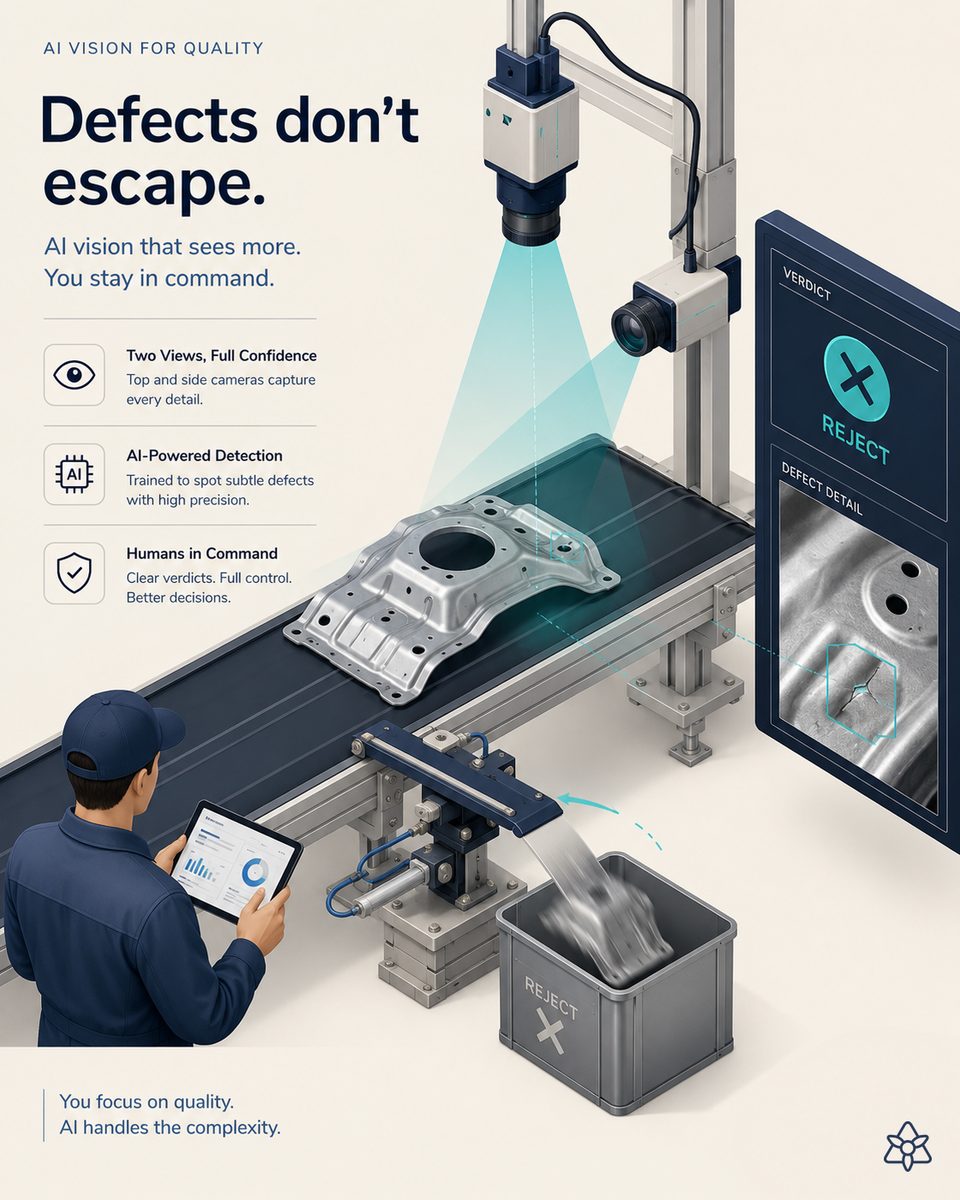
Dozens of models, unknown condition — and the sorting is done by hand on the dock.
Recycling plant managers describe it the same way everywhere: every truck brings packs of dozens of different models, mixed together, with no history. Some come from crashes, others from end of life, others from warranty returns. Some are swollen, some corroded, and nearly all carry an unknown residual charge. And the first decision — what is this pack and what do we do with it — is made by an operator looking at it, with a half-worn label and whatever experience is on shift that day.
Three things happen at once in a real recycling plant, and all three hang off the same bottleneck:
- Identification at intake is manual — every pack model has its own disassembly sheet, its own chemistry, its own risk. Getting the model wrong means starting everything downstream on the wrong foot, and with dozens of part numbers and staff turnover, models do get confused.
- The real thermal risk is not visible from the outside — a damaged cell still holding charge that enters disassembly or shredding is the scenario that keeps the site awake at night. Sampling-based visual inspection and a measurement written on a separate sheet do not close it.
- Per-pack traceability is documented by hand — the EU battery passport requires a file per pack, and today that file is reconstructed from loose photos, measurement sheets and shift memory. Every environmental audit becomes a week of archaeology.
The outcome is always the same: intake sets the pace for the whole plant, the safety criterion changes from one shift to the next, and the scare — the pack that should not have passed and did — is handled after the fact. The knowledge that prevents the incident lives in the head of the veteran operator on the dock; the day they rotate or leave, it leaves with them.
iLEAN does not replace your intake process — it gives it eyes, measurement and a single criterion.
The battery recycling problem is not one of willingness: the plant knows what should be checked on every pack. The problem is doing it on 100% of arrivals, at truck pace, with the same criterion across every shift and leaving a record of every decision. iLEAN acts as the putty that joins the intake camera, the electrical measurement, the safety rule and the regulatory file, without asking you to change the layout or the disassembly process.
Edge identifies the model and visible damage of every pack at intake. Connect stitches the measured voltage to its identifier. JIDOKA AI diverts to quarantine whatever does not meet the criteria. Agents keep the file. The person decides what goes back into the process.
The four iLEAN pieces applied to recycling control:
- Edge — vision running locally on the cameras in the receiving area. It identifies the pack model (geometry, connectors, visible labeling) and the visible signs of damage — swelling, corrosion, deformation, electrolyte residue — on 100% of arrivals, not by sampling. It runs locally: if the plant loses the network, Edge keeps sorting and recording. What is critical does not depend on WiFi.
- Connect — captures the voltage and state measurement of every pack from the measuring equipment and stitches it to its identifier, with no intermediate sheets and no transcription. The electrical condition stops living on a separate piece of paper and becomes part of the routing criterion for the pack.
- JIDOKA AI — applies the plant's safety criterion automatically: any pack that does not meet the conditions for the next process (residual charge above threshold, critical visible damage, model with no validated sheet) is diverted to quarantine on the spot, without depending on the judgment of the shift. Fail-safe rule: when in doubt, quarantine. Reinstatement is signed by a person.
- Agents — maintain the file per pack for the EU battery passport and for environmental audits: identification, condition on arrival with images, measurements, routing decision and destination. The dossier is generated as a by-product of the process, not as administrative work afterwards.
Classic manual intake vs. intake with iLEAN
| Aspect | Manual sorting + logsheets | With iLEAN Edge + Connect + JIDOKA AI + Agents |
|---|---|---|
| Pack model identification | By eye, depending on the shift's experience | Edge vision on 100%, cross-referenced with the disassembly sheet |
| Visible damage detection | Sampling inspection, variable criterion | Swelling, corrosion and deformation detected on every pack |
| Voltage and state measurement | Noted on a separate sheet, never stitched to the pack | Connect stitches it to the pack identifier |
| Diversion to quarantine | Each operator's judgment, after the fact | JIDOKA AI, single automatic criterion, fail-safe |
| File for the EU battery passport | Rebuilt by hand for every audit | Agents, automatic file per pack |
| Intake capacity per shift | Limited by manual sorting | The intake bottleneck opens up |
Impact estimate for your plant — to be validated with your numbers.
The block below is an estimate to be validated with the specific data of your plant. We put it forward so the committee has an order of magnitude; we refine it during the diagnostic.
- Lithium battery recycling plant with manual intake, dozens of different pack models, unknown condition on arrival and a regulatory file documented by hand.
- Pilot: Edge vision in the receiving area + Connect on the measuring equipment + JIDOKA AI with the plant's safety criteria. First value expected within a few weeks: identification on 100% of arrivals and the first automatic diversions to quarantine land before the system is fully tuned against history.
- Thermal incidents caused by misclassification drastically reduced once 100% of packs go through vision plus measurement before the next process — estimate to be validated with your history of incidents and near misses.
- Intake capacity per shift increased: sorting stops being the bottleneck at the front door — estimate to be validated with your current times per pack.
- Indicative payback between 5 and 12 months — estimate to be validated. The hard levers: the thermal incident that does not happen, the extra packs processed per shift and the hours of regulatory documentation that disappear.
- A recurring benefit that does not enter the ROI but carries weight: the per-pack file becomes a permanent capability of the plant for the EU battery passport, rather than a heroic effort before every audit.
And the site manager's reasonable doubt
"What if the AI misclassifies a damaged pack and lets it through to shredding?" — the design is precisely the opposite: JIDOKA AI is fail-safe, and when in doubt it diverts to quarantine, never into the standard flow. Hallucination is a problem of free generation, not of anchored tasks: in tasks where the AI classifies real images and measurements against defined criteria, the best models brought error below 1.5%[1]. And even so, what is critical goes to the safety rings — the system only diverts toward the safe side, and returning a pack from quarantine to the process is signed by a person. Never the other way round.
[1] OpenAI paper "Why Language Models Hallucinate", 2025 — on the reliability of AI in anchored tasks.
What people ask about lithium battery recycling control with AI
How does it identify the pack model?
With vision at intake, on 100% of packs — not by sampling. iLEAN Edge processes the cameras in the receiving area locally and identifies the model by housing geometry, connector layout and visible labeling, cross-referencing it with the plant's library of disassembly sheets. A pack that does not match any known sheet does not enter the standard flow: it is flagged for review and for creating a new sheet. The key point is that identification stops depending on the experience of whoever is on shift — the criterion is the same on the morning shift and on the night shift.
What damage does it detect at intake?
The visible signs that announce risk: module swelling, housing deformation, terminal corrosion, electrolyte residue and overheating marks. What the camera cannot see — internal damage in a cell that looks normal — is covered by the electrical side: iLEAN Connect captures the voltage and state measurement of every pack and stitches it to its identifier. The safety criterion is combined: a pack with a flawless housing but anomalous voltage does not move to the next process either.
How does it decide what goes to quarantine?
With the safety criteria the plant defines, applied automatically by JIDOKA AI: residual charge above the threshold acceptable for disassembly or shredding, visible damage classified as critical, a model with no validated process sheet, or an ambiguous combination of signals. The design rule is fail-safe: when in doubt, the pack is diverted to quarantine, never into the standard flow. Returning a pack from quarantine to the process is always signed by a person — the system diverts on its own, but it never reinstates on its own.
Does it serve the EU battery passport?
Yes — it is one of the reasons plants ask for it. iLEAN Agents maintain a file per pack from intake onward: model identification, condition documented on arrival (images included), electrical measurements, routing decision and traceability through to the output fractions. That file is the documentary basis for the EU battery passport and for environmental audits, generated as a by-product of the process itself — not as separate administrative work. The final reporting format is adjusted to the applicable regulation together with your compliance lead.
How much does it reduce thermal risk?
It depends on the starting point — a plant with expert manual inspection and low throughput does not have the same room as one with staff turnover and growing volume. What changes the order of magnitude is moving from sorting by sampling and experience to having 100% of packs go through vision plus electrical measurement before touching the next process: thermal incidents caused by misclassification fall drastically, as an estimate to be validated with your history of incidents and near misses. Indicative payback for the whole package sits between 5 and 12 months — also an estimate to be validated. We send you the estimated ROI in 48h with the real data from your receiving area.
More cases in automotive
- Digital jidoka in robotic welding — a missing weld is not an incident, it is a call from the OEM.Every weld spot inspected by iLEAN Vision. Missing welds or poor weld quality caught before the next…
- Kaizen with AI suggestions in automotive — the operator suggests through their own channel, the Agent prioritizes.iLEAN Connect captures the operator's suggestion by voice, photo or WhatsApp, and the agent prioritizes…
- LED headlamp control with AI — the OEM does not send back one unit, it sends back the whole batch.iLEAN applies Edge vision to LED headlamps — beam uniformity, scatter, color and micro-cracks in the…
- OEE on a multi-model car line — one aggregate number does not tell you where productivity is leaking.iLEAN measures OEE in plants running N models on the same line and breaks losses down by model, shift…
- Multifunction steering wheel control with AI — five worlds in a single part, and no cross-check in time.iLEAN combines Edge vision on the multifunction steering wheel, an electrical test of every button and…
- Multipack fastener control with AI — one screw missing from the kit is a phone call from the customer.How iLEAN counts and verifies every screw in the multipack kit in line with Edge vision and agents —…
Tell us your case and in 48h we'll send you the estimated ROI of this AI project for your battery recycling plant.
We work on your plant's real data, not ours. Diagnostic with no commitment.
Request estimated ROI in 48h See automotive