Digital jidoka in robotic welding — a missing weld is not an incident, it is a call from the OEM.
A missing weld in BIW can reach the end customer. Digital jidoka with iLEAN verifies every spot inside the robot cell, cross-references it with the PLC's electrical curve and stops or diverts the part before the next station. The person signs — the cycle does not restart on its own.
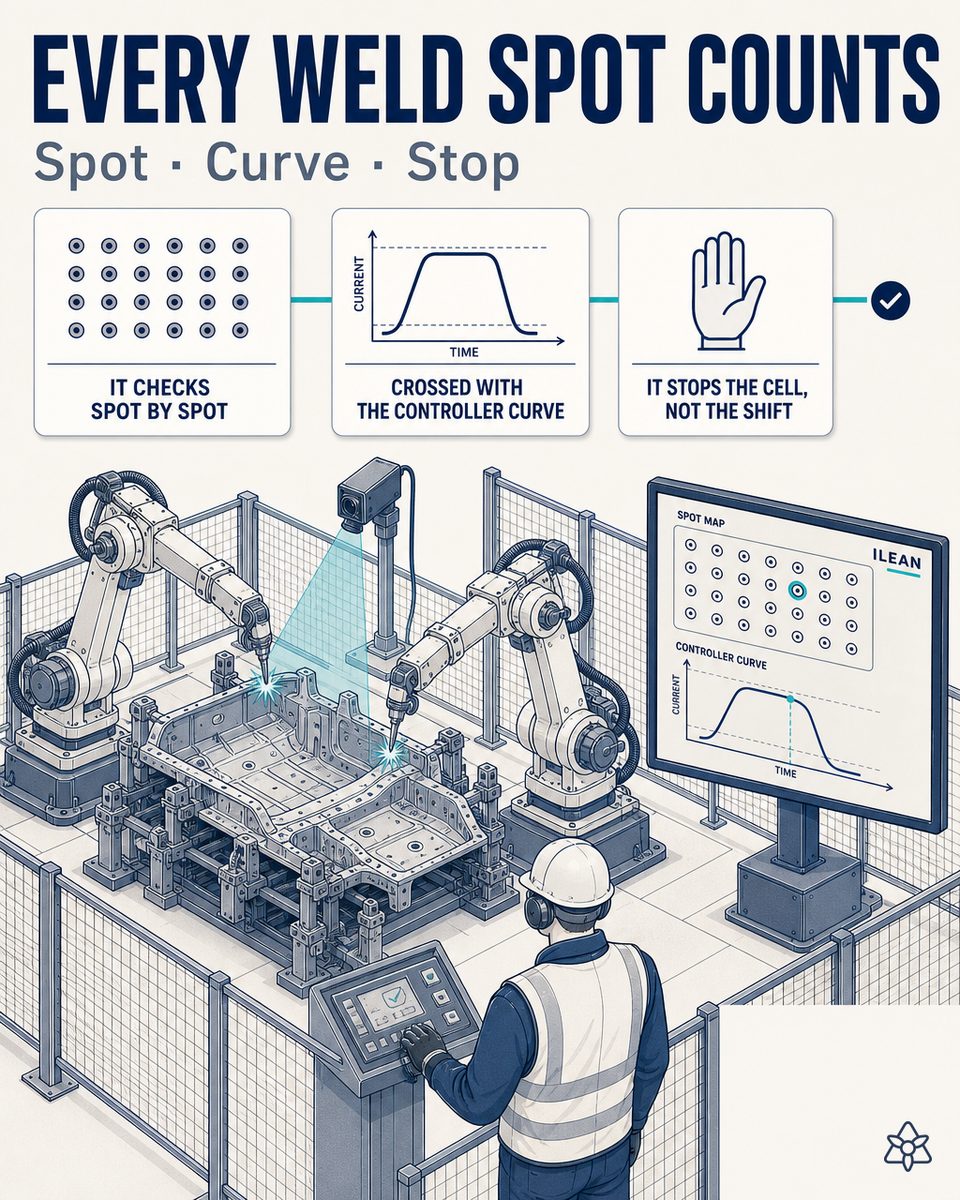
The spot that never happened and nobody saw.
A spot welding cell in BIW can lay down tens of thousands of spots a day. Classic inspection works by sampling (a couple of parts per shift with ultrasound or destructive peel testing) and by operator (the person who looks at the part at the next station). Both leave an enormous gap:
- Sampling does not cover the variability — a worn electrode or a change in sheet thickness can start producing cold welds between two samples, and nobody finds out until hours later.
- The operator at the next station is not an inspector — they are assembling, bolting, welding their own part. A cold spot or a missing spot in a hard-to-see area slips past them without any intent.
- The robot's electrical curve says one thing and the physical result says another — the PLC records “weld OK” because current, time and force were in range, but the sheets were not properly clamped and the spot did not penetrate.
By the time that spot reaches the end customer it is no longer a defect: it is a call from the OEM, a part containment, a PPAP under review and a PPM figure going through the roof. And the OEM does not demand perfection — it demands something in the order of 25 PPM [2]. Getting there with sampling and the operator's eye is a bet you lose on some shift.
iLEAN does not replace the robot or the PLC — it seals the gap between what the PLC knows and what the part shows.
The welding cell already has its recipe in the robot PLC, its MES above it and, almost always, a control sheet in some shared folder. The problem is not a lack of information — it is that this information lives in islands and nobody cross-references it in real time against the physical part. iLEAN acts as the putty that fills that gap, without touching the robot, without touching the PLC, without asking you to change the MES.
Edge sees every spot as it leaves the cell. Connect reads the electrical curve from the robot PLC. The agent cross-references geometry with parameters and, if something does not add up, stops the cell or diverts the part. The person signs — never the other way round.
The three iLEAN pieces applied to jidoka in robotic chassis welding:
- Edge + Vision — a terminal with machine vision (CNN) inside the cell itself. It sees every weld spot the moment it is released: it measures geometry (diameter, roundness), detects splash (material expulsion), and flags spots missing against the welding recipe. It works with no network. If the plant loses WiFi, Edge keeps inspecting and firing OK/NOK to the PLC via a dry contact. What is critical cannot depend on connectivity.
- Connect — captures the electrical curve from the robot PLC (current, time, electrode force) over whatever bus your OT uses, and also captures the welding recipe from the MES or SCADA. It does not ask you to move to OPC UA if your cell only speaks Profinet — it connects however it can and packages the data.
- Agent — cross-references geometry (from Edge) with the electrical curve (from Connect) and with the recipe of the model in progress. If geometry is poor and the curve was OK, it infers a cold weld from badly clamped sheets and labels it as such for the person in charge. If a spot is missing, it holds the part and opens the incident with the photo, the curve and the model reference. It does not send an email at 10pm — it acts on the line.
Sampling inspection vs. digital jidoka with iLEAN
| Aspect | Classic sampling + the operator's eye | With iLEAN Edge + Vision + Agent |
|---|---|---|
| Spot coverage | 1-2 parts per shift (ultrasound / destructive) | 100% of spots, 100% of parts |
| Reaction to a worn electrode | Whenever it shows up in the next sample | On the next part, before the next station |
| Cold weld with an OK electrical curve | It gets through; the OEM finds it | Geometry + curve cross-referenced; the agent raises it |
| Missing spot | The eye of the assembler at the next station | Edge sees the absence and holds the part |
| Model changeover on a multi-variant line | Manual control setup, blind window | The agent reconfigures inspection from the MES recipe |
| File for a PPAP / IATF 16949 audit | Rebuilt by hand, days of work | Per-part dossier with the spot photo and curve, automatic |
Impact estimate for your plant — to be validated with your numbers.
The block below is an estimate to be validated with the specific data of your plant. We put it forward so the committee has an order of magnitude; we refine it during the deep dive.
- BIW tier-1 with 2-3 spot welding cells on chassis parts (rails, reinforcements, brackets), a multi-model line, and an OEM requirement in the region of 25 PPM.
- Edge pilot on one cell (camera over the exit + OK/NOK actuator to the PLC + MES integration for the model recipe). First value expected within a few weeks.
- Indicative payback between 4 and 9 months, depending on how often the OEM has imposed containments in recent years and the average cost of rework on the line (stopping the robot cell, restarting the cycle, rescheduling the next station).
- The hard lever is a single containment avoided at the OEM: mass sorting, reverse logistics, contractual penalties, damage to the PPAP matrix. One containment pays for the pilot.
And the quality manager's reasonable doubt
“What if the AI mistakes a good spot for a bad one and stops the line for nothing?” — hallucination is a problem of free generation, not of anchored tasks. Visual inspection of a weld spot cross-referenced with its electrical curve is a textbook anchored task; on that kind of task the best models brought error below 1.5% [1]. And even so, what is critical is never decided alone: iLEAN holds the part and the person signs. The three safety rings exist precisely for this.
[1] OpenAI paper “Why Language Models Hallucinate”, 2025 — on the reliability of AI in anchored tasks.
[2] Automotive quality standard in the order of 25 PPM (parts per million) — source: Symestic.
What people ask about digital jidoka in robotic chassis welding
What is digital jidoka compared with classic jidoka?
Classic jidoka (Toyota) is the intelligent line stop triggered when a person or a sensor detects an anomaly: the machine stops by itself, the person validates, and nothing restarts until the root cause is clear. Digital jidoka is the same principle applied with AI vision and agents: inspection no longer depends on an operator looking at the exact right moment, nor on a fixed sensor catching that specific failure mode. iLEAN Edge sees every weld spot the moment it comes out, the agent cross-references it with the welding recipe from the robot PLC, and if something does not add up it stops the cell or flags the part for diversion. The person signs — the line does not restart on its own.
Does it integrate with the robot PLC (KUKA, Fanuc, ABB)?
Yes. iLEAN Connect captures welding data from the robot PLC through whatever route your OT allows: OPC UA if the cell is modern, Modbus/Profinet if it is a bit older, or intermediate capture if the cell is isolated. Edge is installed inside the cell without reprogramming the robot — it observes the result (the part with its spots) and returns an OK/NOK to the PLC via a dry contact or via whatever bus you have. The robot does not change brand or program; iLEAN adapts to your OT, not the other way round.
Does it detect indirect welding defects (cold weld, splash, lack of penetration)?
Yes. Edge sees the geometry of the spot (diameter, roundness, material expulsion) and, cross-referenced by the agent with the electrical parameters the PLC records (current, time, electrode force), it raises the three typical modes: cold weld (correct parameters but poor geometry — sheets not properly clamped), splash (material expulsion — excess current or electrode wear), lack of penetration (a small imprint on the outer sheet). Whatever the camera cannot see, the agent infers from the cross-reference with the PLC's electrical curve.
Does it work on multi-model lines and high-variability BIW?
Yes. The part recipe comes from the MES or the robot PLC at the start of the cycle, and the agent reconfigures Edge inspection in real time (which spots to expect, in which position, with which geometric tolerance) before the part enters the cell. On BIW lines with dozens of variants, that avoids manual setup per model and eliminates the classic problem of inspection going out of date after an SKU change.
How much does FTQ rise and how much do escapes to the end customer fall?
In automotive, the floor an OEM demands from a tier-1 supplier is in the order of 25 PPM of line defects — parts per million [2]. A well-implemented digital jidoka moves two levers at once: it raises FTQ (because the part is recovered before the next station, so you do not pile up more expensive scrap by adding value to it) and it lowers escapes to the end customer (because no spot goes through unverified, not just the sampled ones). The exact number depends on your OEM, your BIW and the baseline we measure during the deep dive — we ask for your plant's data and send you the estimated ROI in 48h, with your numbers.
More cases in automotive
- Instrument cluster control with AI — the end-of-line test samples seconds; the fine cosmetic defect reaches the OEM.iLEAN verifies 100% of the cluster display sequence — pixels, brightness, icons, clips — and matches the…
- ISO 21434 + UNECE R155 compliance with AI — from the TARA to SOP, without rebuilding the file for every audit.iLEAN traces TARA, cyber controls and ISO 21434 evidence from design through series production. UNECE…
- ISO 26262 with AI — ASIL evidence kept alive, not rebuilt the night before the TÜV audit.iLEAN traces every component by ASIL level and keeps FMEDA evidence live. Your ISO 26262 audit is ready…
- Kaizen with AI suggestions in automotive — the operator suggests through their own channel, the Agent prioritizes.iLEAN Connect captures the operator's suggestion by voice, photo or WhatsApp, and the agent prioritizes…
- LED headlamp control with AI — the OEM does not send back one unit, it sends back the whole batch.iLEAN applies Edge vision to LED headlamps — beam uniformity, scatter, color and micro-cracks in the…
- Lithium battery recycling control with AI — a damaged cell that reaches shredding still charged is the plant's nightmare; sorting it by eye is a gamble.iLEAN identifies every pack at intake, detects visible damage, diverts anything unsafe to quarantine and…
Tell us your case and in 48h we'll send you the estimated ROI of this AI project for your welding cell.
We work on your plant's real data, not ours. Diagnostic with no commitment.
Request estimated ROI in 48h See automotive