Instrument cluster control with AI — the end-of-line test samples seconds; the fine cosmetic defect reaches the OEM.
A digital cluster combines a display, electronics and mechanical assembly — and the functional test only samples. iLEAN verifies 100% of the display sequence and the closing of every clip with Edge, and matches the firmware variant to the OEM order with Connect before flashing. The person decides what to hold.
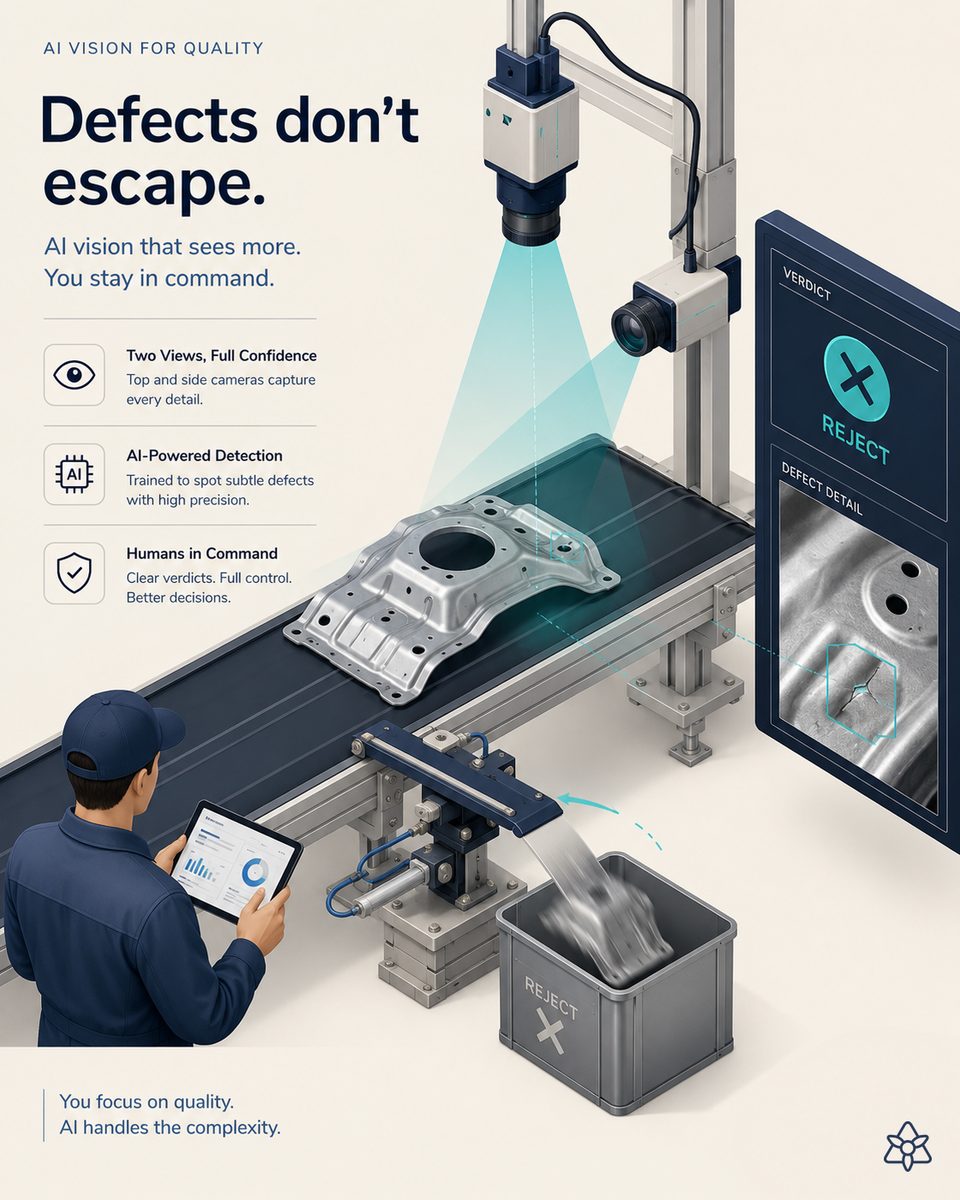
The cluster passes the functional test — and the OEM finds the speck under the glass.
The quality manager on a cluster line tells the same story in every plant: the panel passed the end-of-line test, communications OK, actuators OK, the display sample the test plays back looked fine. And weeks later the OEM claim arrives: a speck under the glass, a brightness gradient you only see driving at night, an icon that lights up in a shifted color. The defect did not fail a single electrical parameter — it was cosmetic, fine, and it got through.
Three things happen at once on an instrument cluster line, and almost nobody covers them together:
- The functional test samples, it does not verify — it plays back a few seconds of a display sequence that runs for minutes. Dead pixels outside the sample, brightness uniformity, the icon that must light up exactly right in each variant are left without 100% verification.
- The fine cosmetic defect gets past the operator at takt — the speck under the glass, the uneven brightness, the clip that only half closed. The human eye at takt cannot sustain it shift after shift; the veteran catches it more often, but not always.
- The firmware variant is checked by hand — market, language, option package. A cluster flashed with another market's variant is functionally perfect and commercially useless, and it is discovered late.
The result is always the same: the OEM finds the escape, the plant pays for the claim and the sorting, and the discussion with the display supplier — did the defect come in the display or did assembly create it? — stays at the level of opinions because there is no evidence per batch.
iLEAN does not replace the end-of-line test — it covers what the test cannot see.
The cluster problem is not a lack of testing: the line already has a functional test, serial number traceability and a flashing station. The problem is that each control covers its own island — the test samples the display, the operator looks at takt, the variant is matched by hand. iLEAN acts as the putty that binds together 100% verification of the sequence, the closing of every clip, the OEM order and the history per display batch, without asking you to change the test or the flashing station.
Edge verifies the full sequence pixel by pixel and the closing of every clip. Connect matches serial number, OEM order and firmware before flashing. JIDOKA AI holds on drift. The person decides.
The four iLEAN pieces applied to instrument cluster control:
- Edge — local vision over the end-of-line station: it captures the full cluster power-up sequence and compares it pixel by pixel against the reference pattern for each variant — dead pixels, brightness uniformity, every icon in its exact color and position — in seconds, on 100% of the parts. At the assembly station it cross-references acoustic signature and image to verify that every clip actually closes, not that it looks closed. It runs locally: if the plant loses the network, Edge keeps capturing, comparing and holding. What is critical does not depend on WiFi.
- Connect — stitches the cluster serial number to the OEM production order (market, language, options) and to the firmware variant the station is about to flash. If they do not match, nothing is flashed. Matching stops being a manual check and becomes an upfront block with a record per serial number.
- JIDOKA AI — if the defect rate drifts (same defect repeated, same area of the glass, same shift), it holds the flow and raises the alarm before the batch ships to the OEM. It never acts alone on anything critical: it proposes the hold, the line manager decides.
- Agents — they correlate the cosmetic defect detected by Edge with the display supplier's batch, the fixture, the shift and the variant. When the speck or the brightness gradient concentrates in one received batch, the agent assembles the evidence — images, serial numbers, dates — for the claim to the supplier.
Classic cluster control vs. control with iLEAN
| Aspect | Functional test + inspection at takt | With iLEAN Edge + Connect |
|---|---|---|
| Display sequence | A few seconds sampled in the test | 100% of the sequence, pixel by pixel |
| Fine cosmetic defect (speck, uneven brightness) | The operator's eye at takt | Vision against a pattern, in seconds |
| Clip closing | Visual inspection and feel | Acoustic signature + image for every closure |
| Firmware/language variant per market | Manual check against the order | Serial number matched to the OEM order before flashing |
| Defect rate drift | Discovered in the container or at the OEM | JIDOKA AI holds the flow and raises the alarm |
| Claim to the display supplier | No evidence per batch, opinions | Defect correlated with the display batch, with images |
Impact estimate for your plant — to be validated with your numbers.
The block below is an estimate to be validated with the specific data of your plant. We put it forward so the committee has an order of magnitude; we refine it during the diagnostic.
- Instrument panel/cluster line with an end-of-line functional test, visual inspection at takt, a station that flashes market variants, and OEM claims for cosmetic defects documented over the past months.
- Edge pilot over the end-of-line station + Connect stitched to the OEM order. First value expected within a few weeks: 100% verification of the sequence and variant blocking work from day one, before JIDOKA AI and the Agents fine-tune with the history.
- Expected reduction of cosmetic defect escapes to the OEM of ≥30% in the first months — estimate to be validated with your claims data.
- Target of zero wrong firmware variants with serial number ↔ OEM order matching before flashing, with a record per serial number for audit.
- Indicative payback between 5 and 12 months, estimate to be validated. The hard lever: every cluster that does not reach the OEM defective avoids a claim, sorting and emergency freight — the three costs that hurt most in PPM.
- Recurring benefit that does not go into the ROI but carries weight: the evidence-backed claim to the display supplier — correlated images, serial numbers and batches — recovers cost that today stays with the plant for lack of data.
And the quality manager's reasonable doubt
“What if vision flags false defects and holds good parts at takt?” — the iLEAN system never scraps on its own. Edge compares against a pattern and proposes; JIDOKA AI holds on drift; the person confirms or releases. Hallucination is a problem of free generation, not of anchored tasks: in tasks where the AI compares a captured sequence against a reference pattern and a history, the best models brought error below 1.5%[1]. And even so, what is critical goes to the safety rings — the agents live in the outer ring, they propose inward, and holding or releasing a part is signed by a person. Never the other way round.
[1] OpenAI paper “Why Language Models Hallucinate”, 2025 — on the reliability of AI in anchored tasks.
What people ask about instrument cluster control with AI
Which display defects does it detect?
The three types the end-of-line functional test does not cover 100%: pixel defects (dead, stuck, subpixels with a shifted color), brightness uniformity (blotches, gradients, mura that the customer really does notice driving at night) and defects under the glass (specks, bubbles, lamination residue). iLEAN Edge captures the full cluster power-up sequence and compares it pixel by pixel against the reference pattern for each variant: every icon that must light up, in the exact color and position, and none that should not. The value is not in the camera — it is in verifying 100% of the sequence in seconds, not a sample.
How does it check that the clips are fully closed?
With two cross-referenced signals: acoustic signature and vision. A clip that seats properly sounds different from one that only half seats — Edge captures the audio at the assembly station and compares the signature of each closure against the learned pattern for that fixture and that part number. Vision completes the picture: profile of the closed housing, gaps, material flash. The half-closed clip is the defect that ages worst: it passes the electrical test, it passes visual inspection at takt, and it comes back as rattle or as a warranty teardown. Catching it at the station, with the cluster still in the fixture, costs seconds; catching it at the OEM costs a claim.
How does it prevent flashing the wrong variant?
With iLEAN Connect stitching together three pieces of data that are checked by hand today: the cluster serial number, the OEM production order (market, language, option package) and the firmware variant the station is about to flash. If the three do not match, the station does not flash — the block comes first, it is not an inspection afterwards. A cluster with the language or units of another market is the most disproportionately expensive defect on the line: functionally perfect, commercially useless, and usually discovered late. With verification stitched to the serial number the target is zero wrong variants, and which firmware went onto each serial number stays on record for audit.
Does it replace the end-of-line functional test?
No — it completes it where the test cannot reach. The existing functional test does its job well: power, communications, actuators. Its limit is sampling: it plays back a few seconds of a display sequence that runs for minutes, and the fine cosmetic defect (a speck under the glass, a brightness gradient) does not move any electrical parameter. iLEAN Edge mounts over the existing station, captures the full sequence and verifies 100% of it in parallel with the test, without lengthening the cycle. And JIDOKA AI adds what no unit test has: if the defect rate drifts — same defect repeated, same area of the glass — it holds the flow and raises the alarm before the whole batch ships to the OEM.
How much do defect escapes to the OEM go down?
It depends on the starting point — a line with reinforced visual inspection and a well-maintained functional test does not have the same headroom as one that rests on the operator's eye at takt. As a defensible floor, a reduction of cosmetic defect escapes to the OEM of ≥30% in the first months is an estimate to be validated with your own claims data. There are two more levers that do not show up in the escape rate: zero wrong firmware variants with verification stitched to the serial number, and the evidence-backed claim to the display supplier — when the Agents correlate the cosmetic defect with the display batch received, the conversation with the supplier moves from opinions to data. Indicative payback between 5 and 12 months, estimate to be validated. We send you the estimated ROI in 48h with your numbers.
More cases in automotive
- AI fuel tank control — a leak is not an incident, it is a recall.How iLEAN combines Edge vision, leak testing and traceability to catch leaks, weld defects and valve…
- IATF 16949 with AI — a five-star audit with no last-minute sprint.iLEAN keeps IATF evidence live and meets the specific CSR of every OEM you supply. A five-star audit…
- Predictive maintenance on KUKA / Fanuc / ABB robots — one broken gearbox stops the entire line.iLEAN monitors vibration, current and temperature on every robot axis. Gearbox failures predicted weeks…
- ISO 21434 + UNECE R155 compliance with AI — from the TARA to SOP, without rebuilding the file for every audit.iLEAN traces TARA, cyber controls and ISO 21434 evidence from design through series production. UNECE…
- ISO 26262 with AI — ASIL evidence kept alive, not rebuilt the night before the TÜV audit.iLEAN traces every component by ASIL level and keeps FMEDA evidence live. Your ISO 26262 audit is ready…
- Digital jidoka in robotic welding — a missing weld is not an incident, it is a call from the OEM.Every weld spot inspected by iLEAN Vision. Missing welds or poor weld quality caught before the next…
Tell us your case and in 48h we'll send you the estimated ROI of this AI project for your cluster line.
We work on your plant's real data, not ours. Diagnostic with no commitment.
Request estimated ROI in 48h See automotive