Predictive maintenance on KUKA / Fanuc / ABB robots — one broken gearbox stops the entire line.
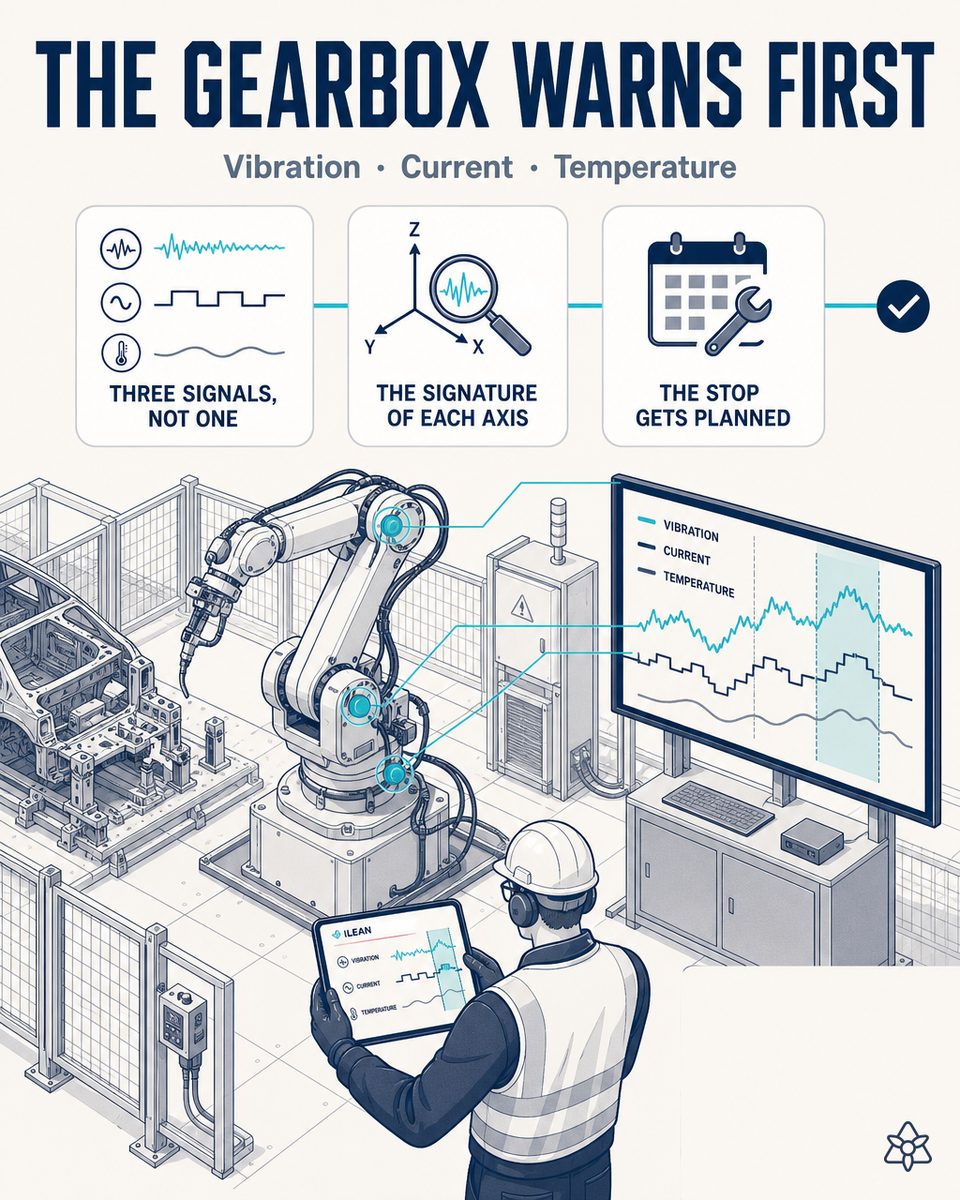
A robot cycloidal gearbox that breaks with no warning stops the whole welding line, for hours or for shifts. iLEAN combines vibration, current and temperature on every axis with your own plant's failure history to predict the gearbox failure weeks ahead and move the intervention into the next planned shutdown. The person signs the work order.
“Fix it when it breaks” does not hold up across a fleet of 50 robots.
On a body-in-white welding line with a mixed KUKA, Fanuc and ABB fleet, the maintenance manager lives with three uncomfortable realities:
- Preventive maintenance by running hours — you replace gearboxes that still have life left and you leave others on the line that are already on the edge. Planning by calendar or by service hours is a blunt instrument for such a critical part.
- Controller data nobody cross-references — KUKA, Fanuc and ABB already deliver current per axis, estimated torque and servomotor temperature through their protocols, but that data lives inside each controller and nobody turns it into a long time series you can actually compare.
- CMMS history that goes to waste — SAP PM, Maximo or the in-house CMMS records every gearbox change, every corrective job, every stoppage. Gold-standard training data — and isolated from the controller data.
When the cycloidal gearbox on an axis 3 fails with no warning mid-shift, the entire line stops. The part costs a few thousand; the stoppage costs orders of magnitude more. And the next-day conversation with the plant manager always circles the same idea: “we should have seen this coming”. And, technically, almost always you could have.
iLEAN does not change your robots — it puts the controller signal and the CMMS history into a single series.
The problem is not a lack of data; it is that controller data and CMMS data live on separate islands and nobody cross-references them in a time series you can learn from. iLEAN acts as the putty that fills that gap, without asking you to change robot brand or CMMS.
Edge captures vibration, current and temperature per axis. Connect imports the CMMS history. The Brain builds your fleet's degradation signature and the agent prepares the work order. The person signs — never the other way round.
The three iLEAN pieces applied to robot predictive maintenance:
- Edge — a terminal that captures the controller signal (KUKA, Fanuc, ABB) over OPC UA / RobotWebServices / FOCAS, at its native rate. If the Pareto calls for more resolution, it adds low-cost triaxial accelerometers at the wrist and the base, synchronized with the log. It works with no network — capture continues even if the plant loses WiFi.
- Connect — imports the CMMS history (SAP PM, IBM Maximo, Infor EAM) and cross-references it with the signal. And it captures what arrives from outside (a vendor bulletin flagging a gearbox batch, an integrator's recommendation) at second zero.
- Agents + Brain — they train the degradation signature specific to your fleet (your cycle, your payloads, your weld guns), detect deviations weeks in advance and prepare the pre-filled work order for the next planned shutdown. The maintenance manager signs — iLEAN does not open work orders on its own.
Hours-based preventive + corrective vs. predictive with iLEAN
| Aspect | Hours-based preventive + corrective | With iLEAN Edge + Connect + Agents + Brain |
|---|---|---|
| Replacement decision | Calendar or catastrophe | Degradation signature specific to each axis |
| Warning ahead of failure | Zero days in many cases | Weeks in most cases |
| Multi-brand (KUKA/Fanuc/ABB) | Three consoles, three protocols | A single agent across all three controllers |
| CMMS history | Archived, unused | Trains your fleet's own signature |
| Work order | Opened by hand, after the failure | Pre-filled by the agent, signed by a human, planned window |
| Operation with no network | n/a | Edge keeps capturing and recording locally |
Impact estimate for your plant — to be validated with your numbers.
The block below is an estimate to be validated with the specific data of your plant. We put it forward so the committee has an order of magnitude; we refine it during the immersion diagnostic.
- Welding or handling line with 30-80 mixed KUKA + Fanuc + ABB robots and a CMMS already up and running (SAP PM, Maximo, Infor EAM or in-house).
- An Edge + Connect pilot on a cell of 6-10 robots with the heaviest gearbox failure history. First value expected within a few weeks: a unified time series and a per-axis health dashboard.
- Indicative payback between 4 and 9 months, depending on the number of corrective gearbox stoppages per year, the line's hourly cost and how much premature preventive replacement weighs.
- Hard lever: a ≥ 30% reduction in unplanned stoppages with “robot gearbox” as the root cause in the first year (estimate to be validated). A single long stoppage avoided pays for the pilot.
The standard, and the CAIO's reasonable doubt
The industry measures product quality in the order of 25 PPM [1]; in robot availability, the equivalent rule is to move correctives into planned work. The CAIO's reasonable doubt (“what if the model hallucinates about the state of the gearbox?”) is defused: the AI here invents nothing — it classifies a signal against your fleet's real history. In tasks anchored to controller data and CMMS history, the best models bring error below 1.5% [2]. And even so, what is critical is not decided alone: iLEAN proposes the work order, the maintenance manager signs it.
[1] The 25 PPM automotive quality standard — Symestic.
[2] OpenAI paper “Why Language Models Hallucinate”, 2025 — on the reliability of AI in anchored tasks.
What people ask about industrial robot predictive maintenance
Does it work with KUKA, Fanuc and ABB in the same plant?
Yes. iLEAN Connect reads from the three main controllers using their native protocols: KUKA through KUKA.OPC UA / KUKA.RobotInterface, Fanuc through R-30iB / FOCAS / OPC UA, ABB through RobotWebServices / Robot Application Builder. What matters is that the degradation model is trained on the common signals (current per axis, estimated torque, servomotor temperature, vibration where there is an accelerometer) — not on the brand. In a plant with a mixed fleet (typical on body-in-white welding lines) the same agent covers all three brands and learns the failure modes specific to each gearbox family.
Do we need to install extra sensors on the robot?
To get started, almost never. KUKA, Fanuc and ABB controllers already deliver current per axis, estimated torque and servomotor temperature — and with that alone the iLEAN model already detects most gearbox degradation with a useful margin. If your failure Pareto calls for more resolution (typically: early detection of fatigue in a cycloidal gearbox), iLEAN Edge can add low-cost triaxial accelerometers (ICP) at the wrist and the base, synchronized with the controller log. We start with what you already have; an extra sensor is justified case by case, not by default.
Does it learn from the plant's own failure history?
Yes — and that is the lever that separates a serious system from a pretty dashboard. iLEAN Connect imports the CMMS history (corrective work orders, gearbox replacements, vendor interventions), cross-references it with the controller's signal history in the months before each failure, and the Brain builds the degradation signature specific to your fleet. That in-house signature performs far better than a generic model — because your work cycle, your weld guns and your payloads look nothing like another plant's.
Does it integrate with the CMMS already in use (SAP PM, IBM Maximo, Infor EAM, in-house CMMS)?
Yes. iLEAN Connect reads from and writes to the standard CMMS platforms (SAP PM, IBM Maximo, Infor EAM, Ultimo) via API or through an intermediate integration. When the Brain detects a deviation that warrants intervention, the agent prepares the pre-filled work order (robot, axis, symptom, optimal intervention date inside the next planned shutdown) and leaves it for the maintenance manager to sign. iLEAN does not open work orders without a person validating them — that decision belongs to maintenance, not to the system.
How much can unplanned downtime be reduced?
In fleets of welding and sheet-metal handling robots, the biggest cost is not the part (a gearbox costs a few thousand) — it is the unplanned line stoppage (tens of thousands per hour, six figures in some plants). The reasonable goal is to move the corrective intervention into a planned one inside a scheduled maintenance window. The order of magnitude to put in front of the committee is a ≥ 30% reduction in unplanned stoppages with “robot gearbox” as the root cause in the first year (estimate to be validated against your history). A single long stoppage avoided pays for the system.
More cases in automotive
- Exhaust and catalyst control with AI — clean welds, exact weight and Euro 6/7 with no surprises.How iLEAN cross-checks Edge vision on exhaust welds, catalyst precious-metal weight and VIN traceability…
- AI fuel tank control — a leak is not an incident, it is a recall.How iLEAN combines Edge vision, leak testing and traceability to catch leaks, weld defects and valve…
- IATF 16949 with AI — a five-star audit with no last-minute sprint.iLEAN keeps IATF evidence live and meets the specific CSR of every OEM you supply. A five-star audit…
- Instrument cluster control with AI — the end-of-line test samples seconds; the fine cosmetic defect reaches the OEM.iLEAN verifies 100% of the cluster display sequence — pixels, brightness, icons, clips — and matches the…
- ISO 21434 + UNECE R155 compliance with AI — from the TARA to SOP, without rebuilding the file for every audit.iLEAN traces TARA, cyber controls and ISO 21434 evidence from design through series production. UNECE…
- ISO 26262 with AI — ASIL evidence kept alive, not rebuilt the night before the TÜV audit.iLEAN traces every component by ASIL level and keeps FMEDA evidence live. Your ISO 26262 audit is ready…
Tell us your case and in 48h we'll send you the estimated ROI of this AI project for your robot fleet.
We work on your plant's real data, not ours. Diagnostic with no commitment.
Request estimated ROI in 48h See automotive