AI fuel tank control — a leak is not an incident, it is a recall.
The fuel tank crosses three different physics — HDPE blow molding, insert welding and leak testing — that today live in three separate systems. iLEAN Edge sees the weld bead on the line, Connect cross-references the blow molding curve with the leak test, and the agents hold the tank that does not add up before it is loaded onto the truck. The person signs.
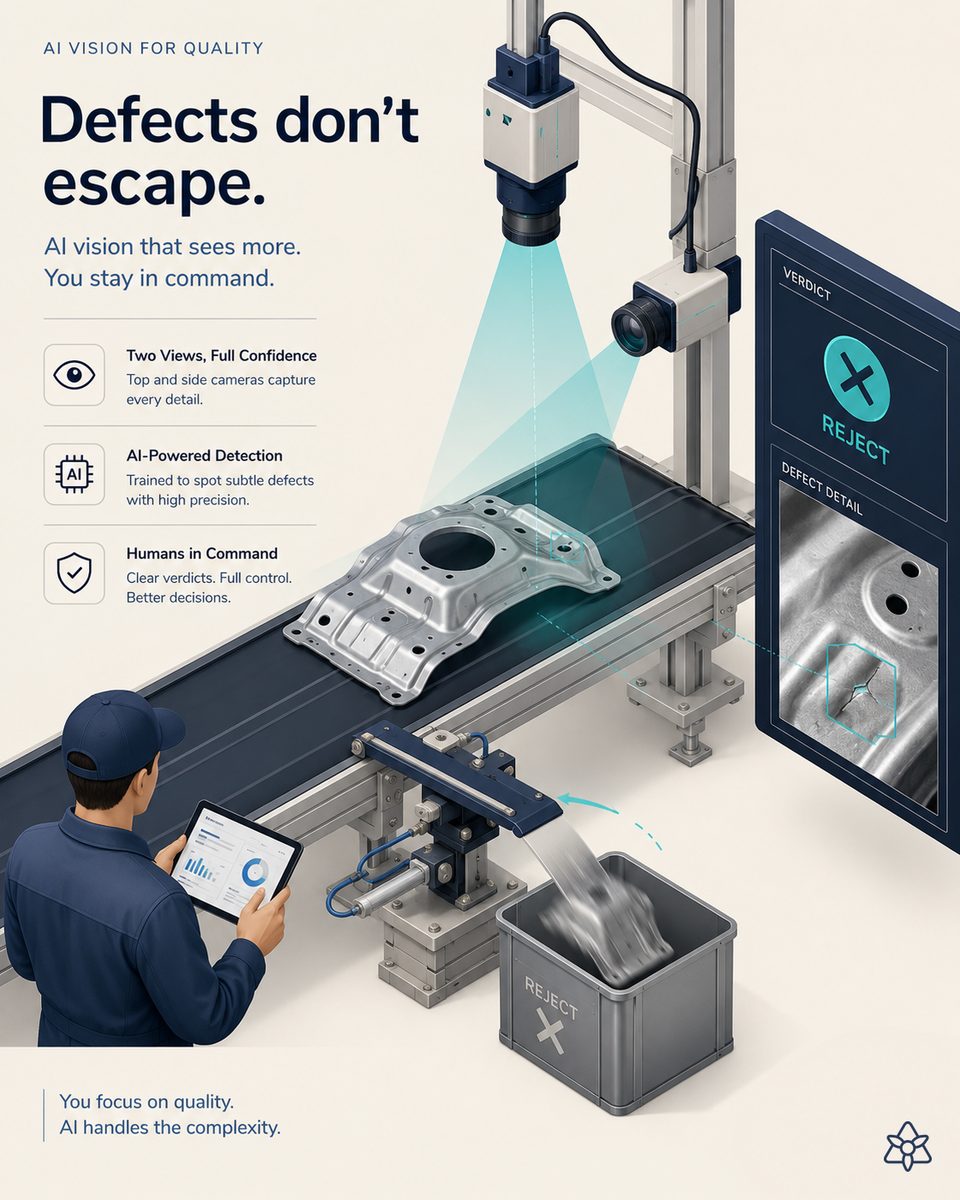
The tank that passes every test and still reaches the OEM defective.
A modern fuel tank is a multilayer HDPE part blown in a mold, with a parison weld bead, a welded insert for the pump, an EVAP valve, a rollover valve and a leak test at end of line. When an OEM rejects a batch, it is almost never because the helium test was skipped: it is because the test was done properly but the part had a microcrack right on the weld bead that the bench did not detect at the defined pressure.
The three realities of the tank live in islands:
- The blow molder — temperature, pressure and cycle time curves, in the machine builder's own SCADA. The veteran on shift glances at it out of the corner of their eye.
- The weld bead and the insert — visual inspection by eye, sometimes with a stand-alone camera without intelligent reading.
- The leak test bench — a helium or pressure-decay log on an old PC, exported to CSV at the end of the shift.
The quality manager wants to cross-reference the three for every serial number. They cannot: there is no system that brings them together in real time. When the OEM returns a batch, everyone realizes the cause had been there since Thursday's night shift — but by then it was too late.
iLEAN does not replace your blow molder or your helium bench — it seals the cracks between them.
The problem is not a lack of information: every machine has it. It is information in islands that is never cross-referenced in time. iLEAN acts as the putty between the blow molder, the weld bead inspection, the leak test bench and the ERP/MES — without asking you to change a single piece of equipment.
Edge sees the weld bead before the insert. Connect reads the blow molder curve whether it comes from the SCADA or from the old PC. The agent cross-references it with the helium log and, if something does not add up, holds the tank before the truck.
The three iLEAN pieces applied to fuel tank control:
- Edge — a terminal with machine vision (CNN) at the blow molder exit. It inspects the parting-line weld bead and the insert geometry in milliseconds and fires the light stack/ejector if it detects porosity, flash or displacement. It works without a network.
- Connect — captures the blow molding curve from the machine builder's SCADA (even if it is an old, isolated PC), the leak bench log and the HDPE batch from the ERP. And it captures whatever arrives from outside (a recipe change from the polymer supplier, an OEM alert about a PPAP) at second zero.
- Agent — cross-references the blow molding curve, the Edge inspection of the weld bead, the helium log and the raw material batch. If the combination enters a pre-failure pattern, it holds the part and alerts the shift lead with a specific suggestion — before the next tank comes out defective. The person validates and signs; the line does not restart on its own.
Classic control vs. cross-referenced control with iLEAN
| Aspect | Classic control | With iLEAN Edge + Connect + Agent |
|---|---|---|
| Blow molding curve | Machine builder's SCADA, watched by the operator | Captured at second zero, cross-referenced with the rest |
| Weld bead and insert | Visual inspection, sometimes a mute camera | CNN on every part, ejection in milliseconds |
| Leak test bench | CSV log at the end of the shift | Log integrated in real time with curve and image |
| Traceability by serial number | Rebuilt by hand on Friday | Automatic dossier per part (PPAP-ready) |
| Root cause of a micro-leak | A meeting the following week | Pre-failure pattern flagged to the shift lead |
| Operation without a network | n/a | Edge keeps inspecting on the panel's own light |
Impact estimate for your plant — to be validated with your numbers.
The block below is an estimate to be validated with the specific data of your plant. We put it forward so the committee has an order of magnitude; we refine it during the diagnostic.
- Tier 1 plant with 2 multilayer HDPE blow molders, a helium leak bench and a pressure-decay test at end of line, under an OEM requirement of IATF 16949 / PPAP level 3.
- Edge pilot on one blow molder (cameras over the weld bead and the insert + actuator + integration with the blow molder SCADA and the leak bench). First value expected within a few weeks.
- Reduction in scrap from weld bead or insert defects of the order of 30% or more, depending on the starting PPM and the maturity of the control plan.
- Indicative payback between 4 and 9 months, with the cost of a single leak-driven recall (reverse logistics, rework, OEM penalty, brand damage) as the hard lever. One recall pays for the pilot.
And the quality manager's reasonable doubt
“What if the AI gets it wrong and lets a tank with a microcrack through?” — hallucination is a problem of free generation, not of anchored tasks. In tasks where the AI merely recontextualizes a piece of data from one system to another (reading the weld bead, comparing the curve, cross-referencing the helium log), the best models brought error below 1.5%[2]. And even so, what is critical is never decided alone: iLEAN holds the tank and the person signs. The three safety rings exist precisely for this.
[1] Automotive quality standard of the order of 25 PPM — Symestic.
[2] OpenAI paper “Why Language Models Hallucinate”, 2025 — on the reliability of AI in anchored tasks.
What people ask about AI control of the fuel tank
What defects typically show up in an HDPE fuel tank and how are they caught in line?
Three defects come back again and again: a crack in the weld along the mold parting line (parison welding), a micro-leak at the pump insert or the vent valve insert, and wrong placement of the EVAP valve or the rollover valve. Today they are caught after the fact with a leak test (helium or pressure decay), and the root cause is chased in a meeting the following week. With iLEAN Edge, CNN vision inspects the weld bead and the insert in milliseconds, the agent cross-references the blow molder curve and the leak test, and the tank that does not add up is pulled aside before shipment to the OEM. The person signs — the line does not restart on its own.
Is AI any use when the problem is a micro-leak that is hard to hear?
Physical detection (helium, hydrogen, pressure decay) is still the judge, but most micro-leaks are a root-cause story: a blow molding parameter that has drifted, a change of HDPE batch, a mold temperature outside the window. iLEAN Connect captures the blow molder curve, the raw material batch from the ERP and the leak bench log, and the agents spot the correlation a human cannot track 24/7. When the curve enters a pre-failure pattern, the agent alerts the shift lead with a specific suggestion — before the next tank comes out defective.
What does the OEM require in PPAP / IATF 16949 for a fuel tank?
Under IATF 16949 and PPAP level 3-4, the OEM requires traceability by serial number, a leak test record per unit, control of raw material changes (with IMDS for environmental compliance) and a signed control plan. The quality standard sits around 25 PPM. iLEAN Connect generates the dossier per serial number (blow molding curve + photo of the weld bead + leak test log + raw material batch) automatically, not in a spreadsheet report someone rebuilds on Friday.
Does iLEAN Edge work if the plant network goes down?
Yes. Edge is a physical terminal installed on the line itself, with its CNN trained to inspect the weld and the inserts. As long as it has power, it keeps inspecting and firing the actuator (light stack, ejector) in milliseconds, even if the plant loses WiFi or the connection to the ERP. Traceability syncs when the network comes back. What is critical cannot depend on there being a network.
How much does an Edge pilot for a fuel tank line cost?
The order of magnitude is in line with any Edge pilot in Tier 1 automotive: an initial investment covering vision terminals + actuator + integration with the blow molder and the leak test bench, plus the annual license. A reasonable payback runs to a few months — the hard lever is the cost of a single leak-driven recall (reverse logistics, rework, OEM penalty, brand damage). We ask for your plant's data and send you the estimated ROI in 48h, with your numbers.
Related: catalytic converter and exhaust pipe · radiator / heat exchanger · water pump.
More cases in automotive
- AI manufacturing control of the on-board charger (OBC) — out-of-torque tightening does not fail at EOL; it fails months later, in the field.The OBC passes EOL and fails in the field months later. iLEAN ties torque and angle to the serial,…
- EV traction inverter control with AI — the weld the final electrical test cannot see is the one that gets whole populations blocked in the field.iLEAN verifies 100% of the EV inverter busbar welds and stitches the SiC/IGBT module genealogy so a…
- Exhaust and catalyst control with AI — clean welds, exact weight and Euro 6/7 with no surprises.How iLEAN cross-checks Edge vision on exhaust welds, catalyst precious-metal weight and VIN traceability…
- IATF 16949 with AI — a five-star audit with no last-minute sprint.iLEAN keeps IATF evidence live and meets the specific CSR of every OEM you supply. A five-star audit…
- Predictive maintenance on KUKA / Fanuc / ABB robots — one broken gearbox stops the entire line.iLEAN monitors vibration, current and temperature on every robot axis. Gearbox failures predicted weeks…
- Instrument cluster control with AI — the end-of-line test samples seconds; the fine cosmetic defect reaches the OEM.iLEAN verifies 100% of the cluster display sequence — pixels, brightness, icons, clips — and matches the…
Tell us your case and in 48h we'll send you the estimated ROI of this AI project for your fuel tank line.
We work on your plant's real data, not ours. Diagnostic with no commitment.
Request estimated ROI in 48h See automotive