EV traction inverter control with AI — the weld the final electrical test cannot see is the one that gets whole populations blocked in the field.
The inverter concentrates critical busbar and power module welds that the EOL test does not verify on 100% of units. iLEAN inspects every weld bead with Edge vision and stitches the genealogy module by module with Connect. JIDOKA AI holds on drift; the Agents scope a field incident down to the exact units. The person decides what is released.
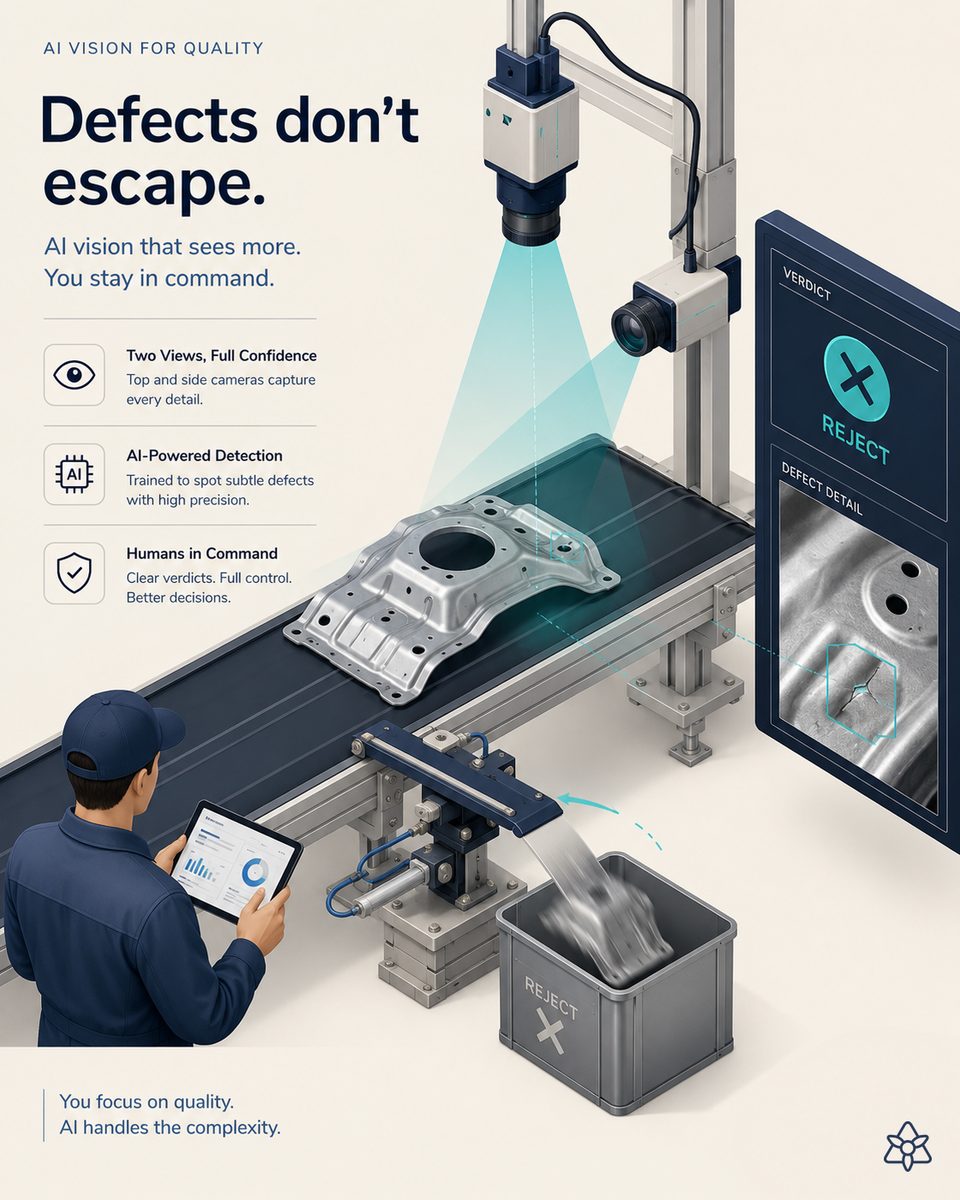
The final electrical test approves inverters with welds that will fail in the field.
The quality manager on an inverter line knows it even if they do not always say it out loud: the EOL test measures continuity, insulation, dielectric strength, switching — and a marginal busbar weld passes every one of them. A bead with borderline penetration or with spatter conducts perfectly on test day; it fails months later, with thermal cycling and vibration, in a high voltage vehicle out on the road.
Three things happen at once on a real inverter line and hardly any plant has them solved together:
- Weld quality is not 100% verifiable at final test — the EOL confirms that the inverter works today, not that every busbar bead and every power module (SiC/IGBT) joint will survive the life of the vehicle. Sample-based visual inspection lets the rest through unlooked at.
- Module↔inverter traceability lives in spreadsheets — the OEM requires knowing which power module serial goes inside each inverter, and that genealogy is maintained with loose scans and manual typing. Every keystroke is a transposed serial waiting for the audit.
- A high voltage field failure forces you to scope with a blunt instrument — with no fine genealogy, the only defensible answer for the customer is to block everything built between two dates. Whole populations held, reverse logistics, weeks of engineering rebuilding paperwork.
The result is always the same: a defect born in one specific bead at one specific station ends up costing a massive scoping exercise, and the knowledge of “which units are genuinely suspect” does not exist in any system — it has to be rebuilt by hand, late and with a margin of error.
iLEAN does not replace the MES or the EOL test — it stitches what today lives on islands.
The inverter's problem is not a lack of data: the welding station has its parameters, the EOL test has its measurements, the modules carry their serial. The problem is that none of it is stitched together unit by unit, and the missing piece — 100% visual verification of the bead — does not exist. iLEAN acts as the putty that joins welding, serials and test under each inverter's serial, without asking you to change the MES or the test bench.
Edge inspects every weld right after the process. Connect stitches serials and EOL test with no typing. JIDOKA AI holds on drift. Agents maintain the genealogy that scopes an incident in hours.
The four iLEAN pieces applied to the traction inverter:
- Edge — machine vision at the station, inspecting every busbar weld on 100% of units right after the process: bead geometry, continuity, spatter, pores. It works locally: if the plant loses its network, Edge keeps inspecting, recording and holding. What is critical does not depend on WiFi.
- Connect — stitches every power module serial to the inverter serial automatically, with the scan built into the station flow (not an extra step, no typing), and captures the EOL test results, hanging them off the same serial. The traceability spreadsheet disappears because it is no longer needed.
- JIDOKA AI — when bead geometry starts to drift (even though each unit is still within individual tolerance), it holds the affected units at the station instead of letting them move on to final test. It proposes the likely cause; the person decides whether to rework, adjust or release.
- Agents — keep the genealogy alive: module → inverter → welding evidence → EOL result → date and shift. When a field incident hits, they generate the exact list of affected units and the customer dossier in hours, not weeks.
Classic inverter control vs. control with iLEAN
| Aspect | EOL test + traceability spreadsheets | With iLEAN Edge + Connect + Agents |
|---|---|---|
| Busbar weld verification | Visual sampling, the rest goes through unlooked at | 100% vision after the process, evidence per serial |
| Module ↔ inverter traceability | Loose scan + typing into a spreadsheet | Stitched automatically in the flow, no typing |
| EOL test results | On the bench, disconnected from the serial | Captured and hung off the genealogy |
| Welding process drift | Discovered at test or in the field | JIDOKA AI holds at the station |
| Scoping a field incident | Weeks, massive blocked population | Hours, exact list of affected serials |
| Dossier for OEM / IATF audit | Rebuilding spreadsheets and paperwork by hand | Cross-referenced genealogy, automatic |
Impact estimate for your plant — to be validated with your numbers.
The block below is an estimate to be validated with the specific data of your plant. We put it forward so the committee has an order of magnitude; we refine it during the diagnostic.
- EV traction inverter assembly line with laser busbar welding, SiC/IGBT power modules carrying their own serial, an EOL test at end of line and module↔inverter traceability kept today in spreadsheets.
- Edge vision pilot at the welding station + Connect stitching serials and EOL test. First value expected within a few weeks: the automatic genealogy and the 100% inspection work from day one; the process drift pattern sharpens later, with history behind it.
- Scoping a field incident in hours instead of weeks, with an exact list of serials — the blocked population goes from “everything built between two dates” to the units genuinely affected.
- Busbar welding verified on 100% of units, with visual evidence linked to every serial, defensible in front of the OEM both in audit and in an incident.
- Indicative payback between 5 and 12 months, estimate to be validated. The hard lever: a single field scoping exercise done properly — a minimal population instead of a massive one — can pay for the whole project.
- A recurring benefit that does not enter the ROI but carries weight: the fine genealogy stays as a permanent capability of the plant, not as a spreadsheet that depends on whoever maintains it.
And the quality manager's reasonable doubt
“What if vision flags a good bead as bad and holds units that were fine?” — the iLEAN system does not decide the release on its own. JIDOKA AI holds and proposes; the line manager reviews the evidence and signs. Hallucination is a problem of free generation, not of anchored tasks: in tasks where the AI compares bead images against a pattern and cross-references serials with test results, the best models brought error below 1.5%[1]. And even so, what is critical goes to the safety rings — the AI lives in the outer ring, proposes inward, and the release of a held unit is signed by a person. Never the other way round.
[1] OpenAI paper “Why Language Models Hallucinate”, 2025 — on the reliability of AI in anchored tasks.
What people ask about EV inverter control with AI
What does vision inspect on each weld?
The laser welds on the busbars and the joints of the power modules, right after the process: weld bead geometry (width, continuity, apparent penetration), spatter (droplets that can end up causing a high voltage short) and surface defects such as pores or undercut. iLEAN Edge does it on 100% of units, in line — not on a sample in the lab. Every image stays linked to the inverter serial, so that a later failure can be reviewed against the visual evidence of its specific welds.
How is the genealogy stitched together without typing?
The scan is built into the station flow, not into a separate step: when the power module is presented, iLEAN Connect captures its serial (DMC code or label) and automatically associates it with the serial of the inverter in progress. The operator types nothing — manual typing is exactly where spreadsheets with transposed serials are born. Connect also captures the EOL test result (electrical measurements, curves, verdict) and hangs it off the same serial. The module → inverter → test result genealogy builds itself, unit by unit.
What does JIDOKA AI do when welding drifts?
It holds before the defect multiplies. If the weld bead geometry starts moving away from the pattern — width dropping, spatter rising — even though each individual unit is still within tolerance, JIDOKA AI flags the process drift and holds the affected units at the station instead of letting them move on to final test. It is the classic jidoka principle applied to power welding: stop at the point of the defect, do not discover it downstream. The decision to rework, adjust the laser or release is taken by the person.
How is a field incident scoped?
With the fine genealogy the Agents maintain: which power module serial went inside which inverter, with what welding evidence and what EOL test result, on what date and shift. When a high voltage field alert arrives, the question “which other units carry modules from that batch or went through that drift?” is answered in hours, with an exact list of serials — not in weeks rebuilding spreadsheets. The blocked population is the smallest one you can defend in front of the customer, not everything built between two dates as a precaution.
What payback does it have?
Indicatively between 5 and 12 months, as an estimate to be validated with the real data of your line. The levers: the cost of a field scoping exercise (every unit blocked unnecessarily is logistics, replacement and wear on the customer relationship), the scrap and rework avoided by holding weld drift at the station, and the engineering hours that today go into rebuilding traceability by hand for every audit or incident. We send you the estimated ROI in 48h with your numbers: volume, product mix and your last scoping exercise.
More cases in automotive
- TPM on a high-takt engine line with AI — the 8 pillars working at once, not in silos.iLEAN runs the 8 TPM pillars on an engine line: from autonomous maintenance to predictive, all connected.
- EV battery second life with AI — a misclassified module is not scrap, it is a loss event.How iLEAN cross-references BMS history, visual pack inspection and second-life criteria to sort reusable…
- AI manufacturing control of the on-board charger (OBC) — out-of-torque tightening does not fail at EOL; it fails months later, in the field.The OBC passes EOL and fails in the field months later. iLEAN ties torque and angle to the serial,…
- Exhaust and catalyst control with AI — clean welds, exact weight and Euro 6/7 with no surprises.How iLEAN cross-checks Edge vision on exhaust welds, catalyst precious-metal weight and VIN traceability…
- AI fuel tank control — a leak is not an incident, it is a recall.How iLEAN combines Edge vision, leak testing and traceability to catch leaks, weld defects and valve…
- IATF 16949 with AI — a five-star audit with no last-minute sprint.iLEAN keeps IATF evidence live and meets the specific CSR of every OEM you supply. A five-star audit…
Tell us your case and in 48h we'll send you the estimated ROI of this AI project for your EV inverter line.
We work on your plant's real data, not ours. Diagnostic with no commitment.
Request estimated ROI in 48h See automotive