TPM on a high-takt engine line with AI — the 8 pillars working at once, not in silos.
Real TPM demands all 8 pillars (autonomous, planned, predictive, focused improvement…) working at the same time. iLEAN connects them across the engine line and measures MTBF/MTTR continuously, not in next month's report. The person decides every intervention — the system stops missing the early signals.
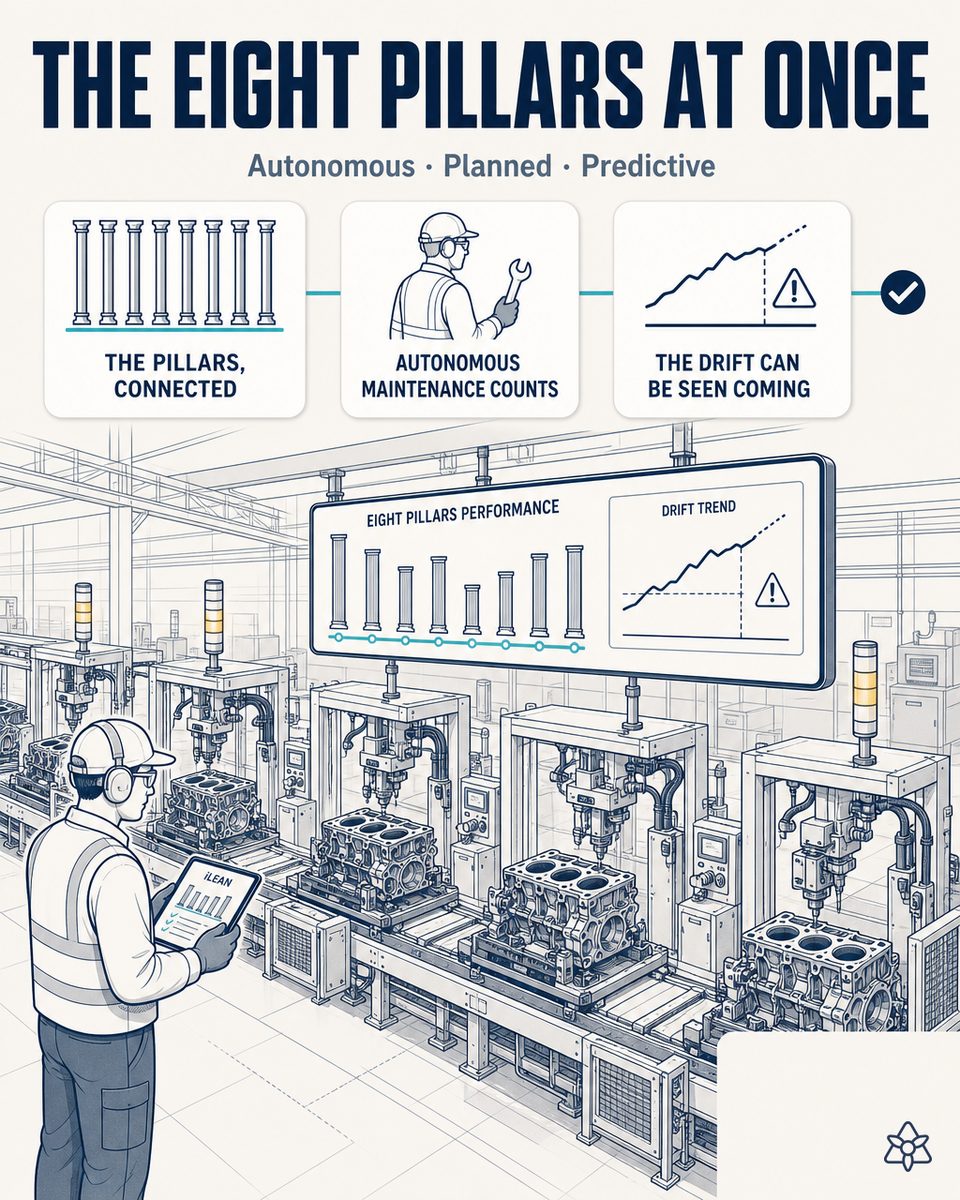
Eight TPM pillars, eight systems that never talk to each other.
The TPM manager on a high-takt engine line knows the board by heart: autonomous maintenance runs on the operator's paper checklist, planned maintenance lives in the CMMS, predictive is a vibration sensor with its own software, focused improvement gets discussed in a weekly meeting, and training is noted down on yet another sheet. On paper, the 8 pillars are all there. In daily operation, each one lives on its own island.
- The operator spots an anomaly — a knock in the spindle, a new vibration on the lathe — and has no way to link it with the breakdown history in the CMMS without stopping to go look for it.
- Predictive raises an alarm from the vibration sensor — and it is never cross-referenced with the shift load or with the oil batch changed last week.
- Planned maintenance triggers the intervention — and nobody knows whether the quality of the last batch was already starting to degrade before the stoppage.
The result on a high-takt engine line: unplanned stoppages that predictive "saw coming" in one system but nobody cross-referenced with the data in another; MTBF the committee only learns about two weeks late; MTTR broken down by eye in the maintenance meeting. Classic TPM works — and even so it leaves 20% of the performance on the table because information was not cross-referenced in time.
iLEAN does not invent a ninth pillar — it connects the 8 you already have.
TPM is not the problem. The problem is that the 8 pillars do not share one picture of the line at the moment it is useful. iLEAN acts as the putty that fills the cracks between the operator in autonomous maintenance, the CMMS in planned maintenance, the vibration sensor in predictive and the focused-improvement lead, without asking you to change any of them.
Edge sees the line the way a veteran operator does. The Agent cross-references the pillars in real time. Brain computes live MTBF and MTTR. The person decides the intervention — the line never stops on a decision made by the AI.
The three iLEAN pieces applied to TPM on an engine line:
- iLEAN Edge — a terminal on the line with vision (CNN) + vibration/acoustic reading. It sees what the veteran operator sees (a change in spindle noise, drift in the lathe's pitch, an incipient leak) and logs every event. It works with no network: if the plant loses WiFi, Edge keeps capturing and holding. What is critical does not depend on WiFi.
- iLEAN Agent — cross-references the Edge signal with the CMMS (last planned maintenance, spare parts on hand), with predictive (vibration sensor history), with the quality batch (rising defects that point to a worn tool) and with the shift load. It detects degradation before the line stops and proposes the intervention to the maintenance manager. It proposes; the person signs.
- iLEAN Brain — computes MTBF, MTTR, OEE and availability continuously per machine, cell and line. It breaks MTTR down (diagnosis, part, repair) — without that breakdown you cannot tell where to attack. The TPM committee sees live KPIs instead of monthly retrospectives.
Classic TPM vs. TPM with iLEAN on an engine line
| Aspect | Classic TPM (8 pillars in silos) | With iLEAN Edge + Agent + Brain |
|---|---|---|
| Autonomous maintenance | Operator's paper checklist | Screen + earpiece, with the anomaly cross-referenced |
| Predictive | Isolated vibration sensor | Cross-referenced with quality, load and CMMS |
| MTBF/MTTR | Monthly report after the fact | Live, broken down into components |
| Degradation detection | When the alarm goes off | The trend before the alarm goes off |
| Old equipment (brownfield) | "It cannot be integrated" | Connect reads it however it can (local PC, photo) |
| Weekly TPM meeting | Reviewing the week's history | Deciding on the current state of the line |
Impact estimate for your plant — to be validated with your numbers.
The block below is an estimate to be validated with the specific data of your plant. We put it forward so the committee has an order of magnitude; we refine it during the diagnostic.
- High-takt engine line (machining + assembly + test), mixed brownfield (equipment 5-25 years old), classic TPM already in place but with unplanned stoppages on the rise.
- Edge + Agent + Brain pilot on the critical cell of the line (typically the crankshaft lathe, the block machining center or leak test). First value expected within a few weeks.
- Expected reduction in unplanned stoppages: ≥30% at 6-12 months, above all those that predictive "saw coming" but never cross-referenced with other systems.
- Indicative payback between 4 and 9 months, dominated by the cost per hour of downtime on the engine line (high at high takt) and by the parts that cannot be recovered when the machine breaks instead of stopping in time.
And the maintenance manager's reasonable doubt
"What if the AI proposes a stoppage we do not need and cuts my takt?" — hallucination is a problem of free generation, not of anchored tasks. When the AI simply cross-references real signals from the Edge, from the CMMS, from the vibration sensor and from the quality history (pure recontextualization), the best models brought error below 1.5% [1]. And even so, the Agent proposes; the person signs. The line does not stop on a decision made by the AI — it stops when the manager authorizes it, with the cross-reference already done.
[1] OpenAI paper "Why Language Models Hallucinate", 2025 — on the reliability of AI in anchored tasks.
What people ask about TPM on an engine line with AI
How does iLEAN fit with classic 8-pillar TPM?
iLEAN does not replace TPM, nor does it invent a ninth pillar — it connects it. Classic TPM has the 8 pillars well defined (autonomous maintenance, planned maintenance, focused improvement, training, quality maintenance, early equipment management, safety/environment, TPM in the office) but each one usually lives in its own system: autonomous in the operator's checklists, planned in the CMMS, predictive in an isolated vibration sensor. iLEAN cross-references the data from all 8 pillars into a single picture of the line, and lets each pillar owner keep deciding. Assist and simplify, not replace.
Who does autonomous maintenance when there is AI?
The operator does, as always — and that is why it works. Autonomous maintenance rests on the person at the station spotting micro-stops, oil leaks, abnormal spindle noise or vibration on the crankshaft lathe before the machine breaks. iLEAN Edge gives them a second pair of eyes (vision + vibration) over the engine line, alerts them through the earpiece when something departs from the pattern, and serves the TPM checklist on their screen instead of on paper. Autonomy stays with the person — the AI reduces the "I never had time to catch it" that kills the autonomous pillar on a high-takt line. The tool works for them, not on them.
Can you see MTBF and MTTR in real time?
Yes. Brain computes MTBF, MTTR, OEE and availability per machine, cell and line continuously, not in a monthly report. The maintenance manager sees the curve live and, most usefully, sees the components of MTTR (diagnosis time, part time, repair time) broken out separately — because without that breakdown you cannot tell where to attack. The Agent raises a flag when the MTBF of a critical piece of equipment starts to degrade, before it turns into an unplanned stoppage.
Does TPM with iLEAN work in a brownfield plant (old equipment)?
It is designed precisely for that. The typical engine line has a 25-year-old crankshaft lathe living alongside a new machining center and a decade-old leak test machine. iLEAN Connect reads the old machine in whatever way is possible: if it has an isolated local PC, a direct connection; if it has an analog panel, a photo taken by the operator that becomes data. It does not force you to replace the crankshaft lathe before you can do serious TPM. Putty fills the cracks; it does not demolish.
What typical impact on availability should we expect?
An estimate to be validated with your numbers: on a high-takt engine line where availability today runs around 80-85% (typical with well-implemented classic TPM), after 6-12 months with Edge + Agent + Brain you see a reduction in unplanned stoppages of ≥30%, mostly because predictive maintenance stops living in an isolated sensor and starts being cross-referenced with breakdown history, quality data and shift load. Indicative payback is between 4 and 9 months, depending on the current cost per hour of downtime on your engine line (at high takt it is the dominant lever).
More cases in automotive
- Permanent-magnet motor control with AI — a rotor defect does not stop the motor from being assembled; it shows up as vibration at the EOL test, when it is already too late.iLEAN inspects magnet insertion at 100%, ties magnetization and balancing to the rotor serial and…
- AI control of electrical connectors and pins — a bent pin passes the inspection desk and shows up at the test bench.How iLEAN verifies pin geometry, sequence and crimping of automotive electrical connectors in line with…
- Poka-yoke in engine assembly with AI vision — the right part at every station, without a sensor per variant.iLEAN Vision verifies the right part at every engine assembly station. Variant errors caught before the…
- EV battery second life with AI — a misclassified module is not scrap, it is a loss event.How iLEAN cross-references BMS history, visual pack inspection and second-life criteria to sort reusable…
- AI manufacturing control of the on-board charger (OBC) — out-of-torque tightening does not fail at EOL; it fails months later, in the field.The OBC passes EOL and fails in the field months later. iLEAN ties torque and angle to the serial,…
- EV traction inverter control with AI — the weld the final electrical test cannot see is the one that gets whole populations blocked in the field.iLEAN verifies 100% of the EV inverter busbar welds and stitches the SiC/IGBT module genealogy so a…
Tell us your case and in 48h we'll send you the estimated ROI of TPM with AI for your engine line.
We work on your plant's real data, not ours. Diagnostic with no commitment.
Request estimated ROI in 48h See automotive