AI control of electrical connectors and pins — a bent pin passes the inspection desk and shows up at the test bench.
The automotive electrical connector fails through pin geometry, sequence, crimping or the wrong part number after a variant changeover. The end-of-line electrical test sees it late — and sometimes does not see it at all (a bent pin that still makes contact). iLEAN Edge sees every cavity before final assembly and cross-references the BOM with the image. The person signs — the carrier does not move on by itself.
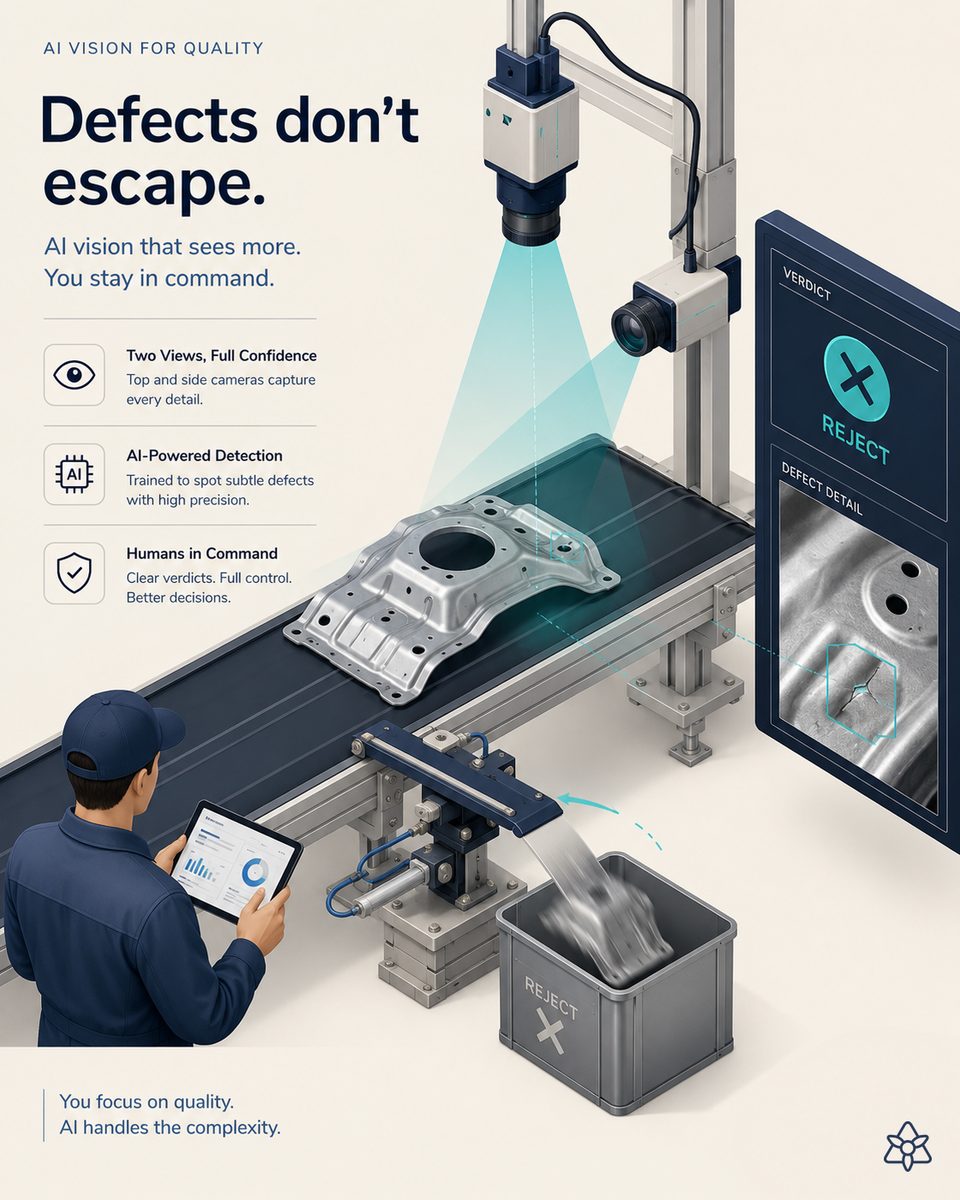
The defect the test bench never gets to see in time.
The electrical connector is the part that generates the most PPM in many Tier-1 plants — and the reason is not electrical complexity, it is geometry:
- Bent pin — the insertion hits the pin at a 2° angle. The connector still closes. The electrical bench makes contact. But months later, with vibration and temperature, the contact opens. Customer call.
- Empty cavity — a pin that was never inserted. The operator does not see it because there are 32 cavities, two of them spares, and the electrical bench does not test those cavities.
- Crimping outside the window — crimp height is off by 5 microns. The applicator let it through. The electrical bench sees continuity. The day the wire moves, contact is lost.
- Connector changed for a variant — the new SKU was set up in a spreadsheet that never reached the line, and the bowl feeder was still loaded with the previous part number.
The operator knows it. So does the quality manager. And even so, the classic system (visual + electrical bench) works 99% of the time. That 1% is the OEM's 8D — and in safety electronics, that 8D carries weight.
iLEAN does not replace the electrical bench — it offloads the defects it should never have to see.
The problem is not a lack of technology: it is that the defect is seen too late, once time and work are already invested. And that the information the control needs (BOM, variant, crimping window) lives in islands and never reaches the camera in time. iLEAN acts as the putty between the line, the ERP and the test bench.
Edge sees every cavity before final assembly. Connect reads the BOM and the crimping window wherever they live. The agent cross-references with the batch variant and, if something does not add up, holds the part. The person signs — never the other way round.
The three iLEAN pieces applied to electrical connector control:
- Edge — a terminal with machine vision (CNN) and optics calibrated to the family (micro-connector, HV traction, etc.). It segments every cavity, measures pin height and alignment, verifies presence. It fires the actuator in milliseconds. It works without a network.
- Connect — captures the BOM and the crimping window whether they come from the ERP, from the MES, or from the setup sheet for the new SKU. And it captures whatever arrives from outside (an email from the OEM with a spec change, a WhatsApp from the pin supplier with a dimensional change) at second zero.
- Agent — cross-references the BOM, the line's history, the image of the connector and the crimping window. If there is a deviation, it holds the part and assembles the file — photo, batch, shift, operator. The person validates and signs; the carrier does not move on by itself.
Visual inspection + electrical bench vs. cross-referenced control with iLEAN
| Aspect | Visual + electrical bench | With iLEAN Edge + Connect + Agent |
|---|---|---|
| Pin bent <3° | Passes if there is continuity | Caught by geometry >0.3 mm |
| Empty spare cavity | Not tested by the bench | Verified by image |
| Crimping outside the window | Passes if the applicator does not flag it | Verified against the batch window |
| Variant changeover | Setup in a spreadsheet + the operator's memory | New BOM pushed to the Edge in seconds |
| Error detection | End-of-line electrical bench (late) | Before assembly, in milliseconds |
| PPAP/IATF file | Rebuilt by hand, weeks | Per-batch dossier, automatic, with a photo of the pins |
Impact estimate for your plant — to be validated with your numbers.
The block below is an estimate to be validated with the specific data of your plant. We put it forward so the committee has an order of magnitude; we refine it during the diagnostic.
- Tier-1 electrical connector plant (ECU, EV, HV), 1-2 priority families carrying most of the accumulated PPM.
- Edge pilot on the carrier ahead of final assembly (camera + calibrated optics + actuator + integration with the ERP/MES BOM). First value expected within a few weeks.
- Indicative payback between 4 and 9 months, depending on the starting PPM and the average cost of downstream rework/scrap.
- Expected reduction in pin/sequence defects of ≥30% in the first quarter and ≥80% by the sixth month, depending on the family's pareto. The hard lever is a single customer call avoided and the load taken off the electrical bench.
The industry standard and the reliability of anchored AI
The quality standard in automotive is of the order of 25 parts per million defective [1]. A connector with a bent pin in every 40,000 is out of range. A camera with a CNN does see it.
On reliability: hallucination is a problem of free generation, not of anchored tasks. In tasks where the AI merely recontextualizes a piece of data (reading the cavity and comparing it with the BOM), the best models brought error below 1.5% [2]. And even so, what is critical is never decided alone: iLEAN holds the connector and the person signs.
[1] The 25 PPM standard in automotive quality — Symestic.
[2] OpenAI paper “Why Language Models Hallucinate”, 2025 — on the reliability of AI in anchored tasks.
What people ask about AI control of electrical connectors
What defects does an automotive electrical connector have?
Four of them come back again and again: a pin bent or misaligned after insertion, a pin missing from a cavity (incomplete sequence), crimping outside the window (crimp height/width), and the wrong connector part number after a variant changeover. Three of the four are invisible to the operator at line speed; the fourth can only be caught by someone with the BOM at hand, and the BOM is almost never at hand.
How does iLEAN Edge verify pin geometry and sequence?
Edge is a terminal with vision (CNN) over the connector carrier. It takes an image of the pin face, segments every cavity and measures height, alignment and presence. It cross-references that with the batch BOM that Connect has read from the ERP. If a cavity is empty when it should not be, or a pin is bent more than 0.3 mm off axis, it fires the actuator before the connector reaches the electrical test bench.
Does it work with micro-connectors and HV connectors?
Yes, with the right optics. The CNN is trained on samples from your own plant — from ECU micro-connectors to HV traction connectors for EVs. Focal distance, lighting and the model are calibrated to the product. The pilot starts with the family that generates the most PPM (the catalog pareto) and scales from there.
Does it replace end-of-line electrical testing?
No. Edge is an additional control upstream, before final assembly. Its job is to pull out the geometric defect that the electrical bench would find too late, once time and work are already invested. The electrical bench stays, but it sees far fewer defects — and the defects that are not electrical (a bent pin that still makes contact on test day) stop getting through.
How much does an Edge pilot for electrical connectors cost?
The order of magnitude of an Edge pilot on a connector line is close to that of any industrial Edge pilot: terminals + cameras + actuator + integration with ERP/MES, plus an annual license. A reasonable payback to present to the committee is several months — the hard lever is eliminating downstream scrap, cutting rework hours and, above all, the 8Ds avoided. We ask for your data and send you the estimated ROI in 48h.
More cases in automotive
- Digital andon with automatic escalation — the light tower comes on, but if the line lead is at the far end of the shop floor, the stop gets longer.The andon lights up; iLEAN escalates the alert only if nobody responds and logs the response time at…
- Elastomer seals with AI — a piece of flash that gets through today is a leak on the OEM assembly line tomorrow.How iLEAN cross-references the image of every seal, vulcanization parameters and mold traceability to…
- Permanent-magnet motor control with AI — a rotor defect does not stop the motor from being assembled; it shows up as vibration at the EOL test, when it is already too late.iLEAN inspects magnet insertion at 100%, ties magnetization and balancing to the rotor serial and…
- Poka-yoke in engine assembly with AI vision — the right part at every station, without a sensor per variant.iLEAN Vision verifies the right part at every engine assembly station. Variant errors caught before the…
- TPM on a high-takt engine line with AI — the 8 pillars working at once, not in silos.iLEAN runs the 8 TPM pillars on an engine line: from autonomous maintenance to predictive, all connected.
- EV battery second life with AI — a misclassified module is not scrap, it is a loss event.How iLEAN cross-references BMS history, visual pack inspection and second-life criteria to sort reusable…
Tell us your case and in 48h we'll send you the estimated ROI of this AI project for your connector line.
We work on your plant's real data, not ours. Diagnostic with no commitment.
Request estimated ROI in 48h See automotive