EV battery second life with AI — a misclassified module is not scrap, it is a loss event.
Deciding whether an EV battery pack is fit for second life means cross-referencing three realities — the BMS history, the visual inspection of the pack and the buyer's criteria (ESS, scooter, power tool). iLEAN joins all three, pack by pack and module by module, assembles the dossier on the fly and leaves the signature to the person. AI does not decide what is critical on its own.
The pack's history lives on a screen, its real condition on the shop floor and its destination on a sheet from the buyer.
Anyone managing EV battery second life is caught between three worlds that do not talk to each other:
- Each pack's BMS — cycles, depth of discharge, fast-charging events, peak temperatures. It is all there, but in the manufacturer's CAN/UDS protocol; if you handle packs from three brands, you have three diagnostic tools and three screens.
- The physical condition — pack deformation, terminal corrosion, signs of thermal runaway in a module, impact damage. Only the person who opens the pack sees that, and it gets written on a report that almost never makes it into the dossier.
- The buyer's criteria — stationary ESS tolerates a low SoH and a high cycle count; a scooter does not; an industrial tool demands yet another range. Every customer, its own rule, on a sheet held on their side.
The technician sorting a pack does it with incomplete information — and in a hurry, because the flow of packs reaching the end of their first life is on a steep curve. A doubtful module sent into an ESS installed in a building is hard cost and, worse, brand damage. The right decision exists in the data; the problem is that the data is not in the same place when someone has to sign for it.
iLEAN does not force you to unify BMS systems — it reads them as they are and leaves the final decision to the person.
The EV second-life problem is not a lack of technology in the plant, it is fragmented information at the critical moment (the pack's arrival at the shop). iLEAN acts as the putty between the BMS, the visual inspection and the customer, without asking you to change diagnostic tools or protocols.
Edge sees the pack and every module. Connect reads the BMS however it comes — documented DBC or the manufacturer's screen. The agent cross-references with the buyer's criteria and assembles the dossier. The person signs — critical packs do not leave on their own.
The three iLEAN pieces applied to EV battery second life:
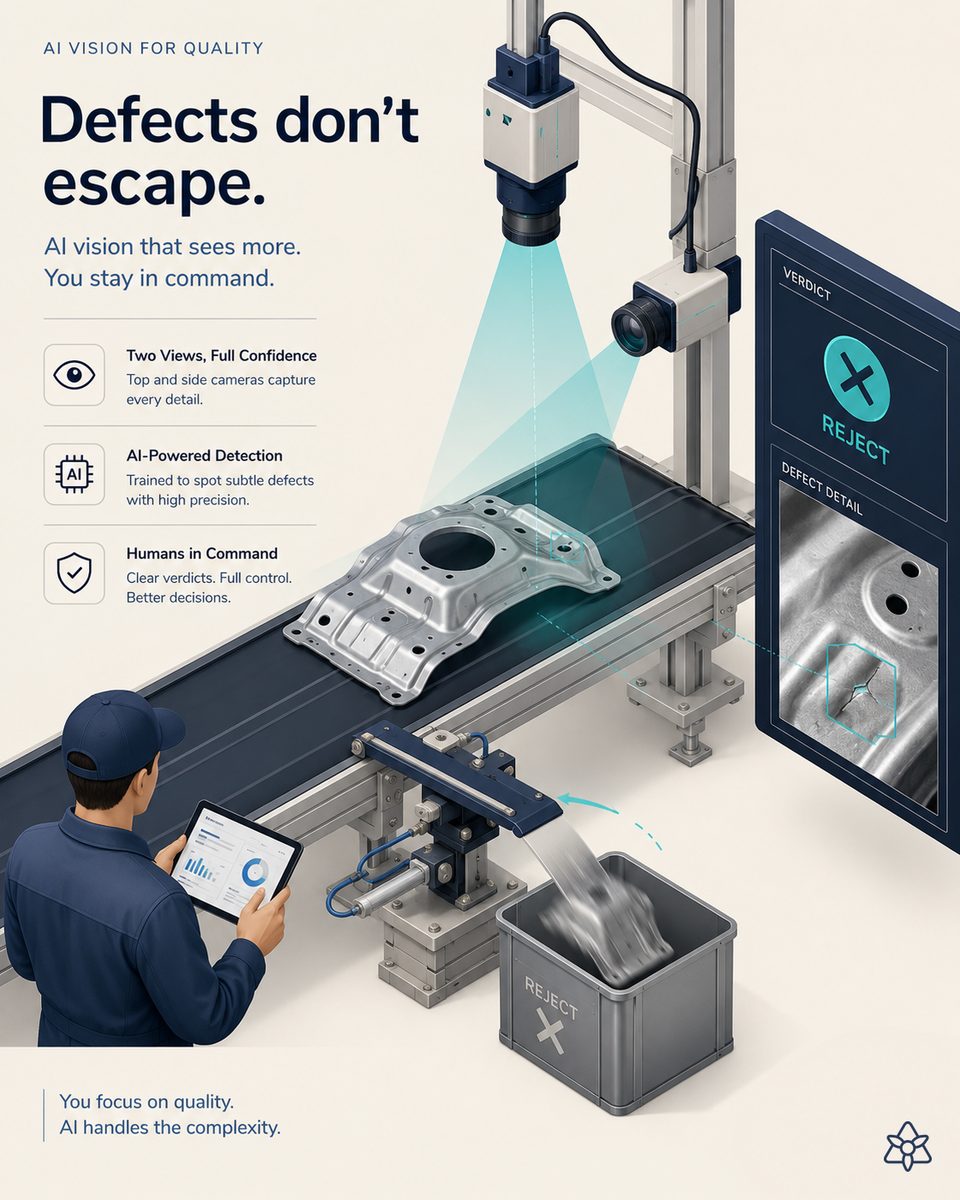
- Edge — a terminal with machine vision (CNN) over the inspection area. It detects pack deformation, terminal corrosion and signs of thermal runaway, module by module. It works without a network. If the plant loses WiFi, Edge keeps inspecting and holding doubtful packs.
- Connect — captures the BMS history through a documented DBC when the manufacturer provides one, or by reading the diagnostic software screen when it does not — the information enters the system in a uniform format, whatever brand it comes from. And it captures what arrives from outside: the buyer's email with a new SoH threshold, the WhatsApp message from the dealership flagging a previous thermal event that was never recorded.
- Agent — cross-references the calculated SoH, the Edge visual inspection, the BMS history and the buyer's criteria. It proposes the destination (ESS / scooter / recycling), builds the dossier per pack and alerts the manager. The person validates; a critical pack is never labeled on its own.
Manual sorting vs. cross-referenced sorting with iLEAN
| Aspect | Manual inspection + spreadsheet | With iLEAN Edge + Connect + Agent |
|---|---|---|
| Reading the BMS | One screen per brand, data copied by hand | Direct integration or visual reading of the software itself, uniform data |
| Visual inspection | The technician's eye, loose photos, a paper report | Edge sees every module and logs every defect with photo and timestamp |
| Buyer's criteria | A PDF from the sales rep, a different version per customer | Live rules inside the agent, updated at second zero |
| Destination decision | The technician decides alone, under time pressure | The agent proposes with cross-referenced data; the person signs |
| Dossier per pack | Assembled after the fact, with data missing | Assembled on the fly, complete, ready for the customer |
| Traceability if it comes back | Searching through archives, days of work | History by serial number, instantly |
Impact estimate for your plant — to be validated with your numbers.
The block below is an estimate to be validated with the specific data of your operation. We put it forward so the committee has an order of magnitude; we refine it during the diagnostic.
- Remanufacturing shop with a mid-sized mixed flow of EV packs (several brands, output to ESS and secondary applications).
- Edge pilot in the intake area (camera over the inspection station + integration with the dominant BMS diagnostic tool). First value expected within a few weeks.
- Indicative payback between 4 and 9 months, driven by the reduction in misclassified packs that come back (buyer returns) and by sorting speed, not by operator hours.
- The hard lever is a single module with undetected thermal risk reaching an installed ESS. One unit avoided pays for the pilot several times over.
And IT's reasonable doubt
"What if the AI misreads the BMS history and classifies the pack wrong?" — hallucination is a problem of free generation, not of anchored tasks. In tasks where the AI merely recontextualizes a piece of data from one system into another (reading the BMS screen and posting it into your database), the best models brought error below 1.5% [1]. And even so, what is critical is never decided alone: iLEAN proposes the destination and the person signs. The three safety rings exist precisely for this.
[1] OpenAI paper "Why Language Models Hallucinate", 2025 — on the reliability of AI in anchored tasks.
What people ask about EV battery second life
What decides whether an EV battery pack is fit for second life or goes to recycling?
Three cross-referenced data sets: the State of Health (SoH) calculated from the BMS history (cycles, depth of discharge, temperatures, fast-charging events), the visual inspection of the pack and the modules (deformation, terminal corrosion, impact damage, signs of thermal runaway) and the buyer's criteria for second life (stationary ESS, scooter, industrial tool), which vary by application. iLEAN cross-references all three the moment the pack arrives at the remanufacturing shop.
Why doesn't manual inspection of EV packs scale?
Because the flow is about to multiply: the packs from the first mass wave of electric vehicles are reaching the end of their first life, and an operator who opens a pack, checks a module and reads a BMS history on an isolated screen spends hours per pack. The "fit / not fit" decision is made with incomplete information — and a single module with thermal risk inside an ESS installed in a building is a major loss event. Speed is not gained by skipping verification: it is gained by automating data capture and leaving the critical decision to the person.
How does iLEAN read the BMS history when every manufacturer uses its own protocol?
iLEAN Connect acts as putty between the pack's BMS (each manufacturer's CAN/UDS) and the rest of your systems. If the brand documents its DBC, integration is direct. If not, the agent reads the manufacturer's own diagnostic screen with computer vision and extracts the relevant data (SoH, cycles, events). The result enters the system in a uniform format, whatever brand the pack comes from, without the plant having to wrestle with 12 protocols.
What dossier does a second-life buyer need in order to accept a pack?
A file per pack containing: a readable BMS history, visual inspection photographs of every module, the result of the capacity and internal resistance test, the SoH value on arrival and on exit from the process, past thermal events, and the batch and vehicle of origin. iLEAN agents assemble that dossier automatically as the data is captured — the person validates and signs, they do not fill forms. The same method we use for evidence packs in aerospace.
How much does it cost to automate EV pack sorting?
An intake line at the remanufacturing shop with an Edge camera over the inspection area + integration with the BMS diagnostic tool + a sorting agent + a dossier per pack is in the same order of magnitude as any industrial Edge pilot. A single misclassified unit that ends up in an installed ESS can be a major loss event; the payback calculation is built around that lever, not around saved operator hours. We ask for your plant's data and send you the estimated ROI in 48h.
More cases in automotive
- AI control of electrical connectors and pins — a bent pin passes the inspection desk and shows up at the test bench.How iLEAN verifies pin geometry, sequence and crimping of automotive electrical connectors in line with…
- Poka-yoke in engine assembly with AI vision — the right part at every station, without a sensor per variant.iLEAN Vision verifies the right part at every engine assembly station. Variant errors caught before the…
- TPM on a high-takt engine line with AI — the 8 pillars working at once, not in silos.iLEAN runs the 8 TPM pillars on an engine line: from autonomous maintenance to predictive, all connected.
- AI manufacturing control of the on-board charger (OBC) — out-of-torque tightening does not fail at EOL; it fails months later, in the field.The OBC passes EOL and fails in the field months later. iLEAN ties torque and angle to the serial,…
- EV traction inverter control with AI — the weld the final electrical test cannot see is the one that gets whole populations blocked in the field.iLEAN verifies 100% of the EV inverter busbar welds and stitches the SiC/IGBT module genealogy so a…
- Exhaust and catalyst control with AI — clean welds, exact weight and Euro 6/7 with no surprises.How iLEAN cross-checks Edge vision on exhaust welds, catalyst precious-metal weight and VIN traceability…
Tell us your case and in 48h we'll send you the estimated ROI of this AI project for your EV remanufacturing shop.
We work on your operation's real data, not ours. Diagnostic with no commitment.
Request estimated ROI in 48h See automotive