AI manufacturing control of the on-board charger (OBC) — out-of-torque tightening does not fail at EOL; it fails months later, in the field.
An OBC with a poorly tightened busbar or irregular thermal paste passes the end-of-line test and fails months later in the vehicle. iLEAN ties the torque and angle of every screw to the serial number, verifies thermal dispensing on 100% of units before closing and holds the module if something does not add up. The person decides.
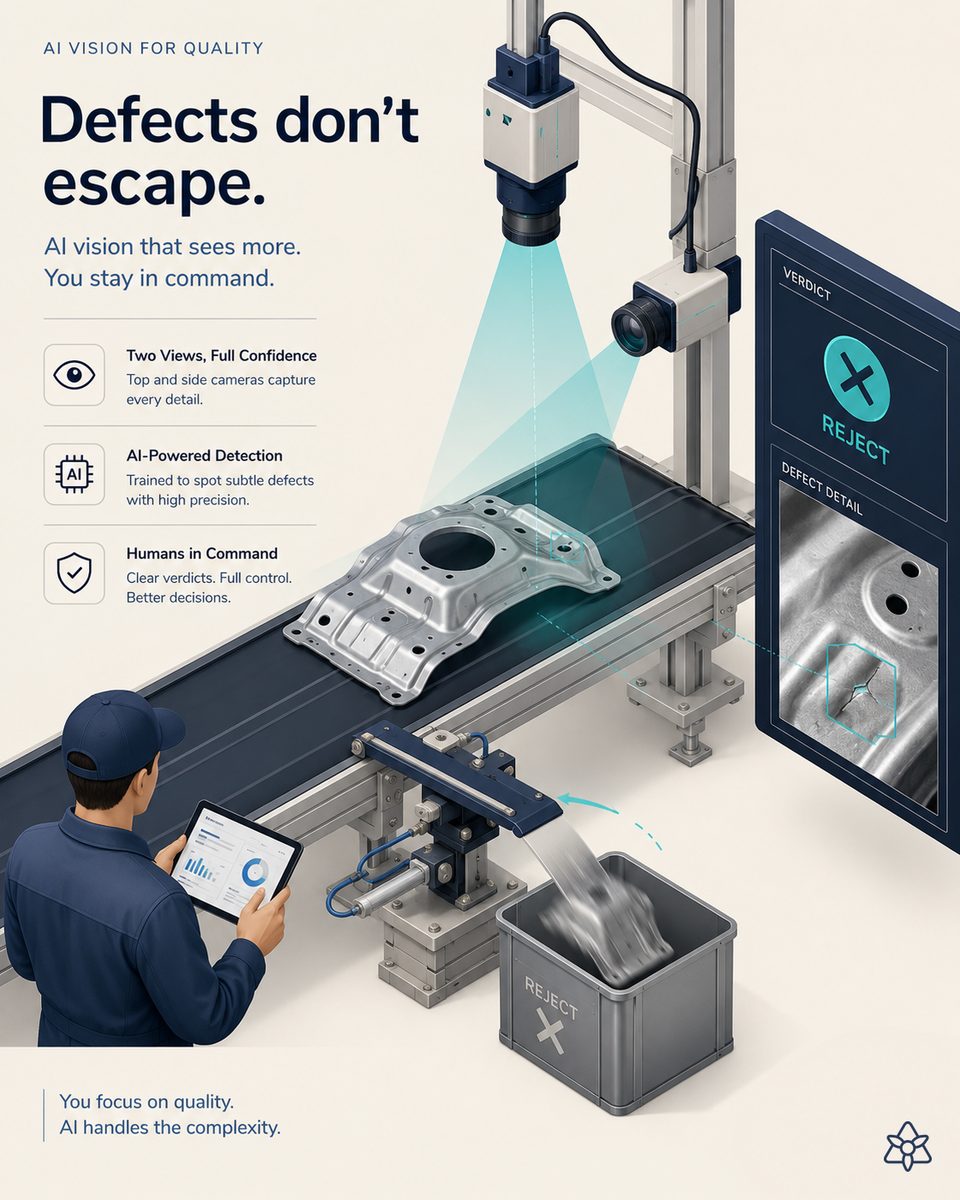
The assembly defect the EOL test cannot see — and that shows up months later, in the vehicle.
The OBC is one of the most thankless modules to build in electrification: it mixes power (busbars with critical tightening torques), high-voltage electronics and thermal dissipation (thermal paste or gap filler whose dispensing stops being visible the moment the cover closes). The end-of-line test checks that the unit charges and insulates — today. It does not check that in eight months, after thousands of thermal cycles, it still will.
Three things happen at once on a real OBC line, and almost no plant has all three solved together:
- Out-of-torque tightening does not fail at EOL — a busbar with low torque makes good contact during the test and works loose with thermal cycling in the field: contact resistance, heating, failure. The nutrunner records the curve, but nobody ties it to the unit's serial number.
- Thermal dispensing cannot be seen once the unit is closed — a discontinuous or displaced thermal paste bead leaves a power module poorly cooled. The unit passes EOL cold and degrades in the field. Destructive sampling arrives late and covers few units.
- Component traceability is done by hand — the serial numbers of the power modules and the transformer are contractually required, and on many lines someone transcribes or scans them into a spreadsheet. When the field incident arrives, reconstructing which units carry which batch takes weeks.
The result is always the same: the unit leaves the plant with a green EOL, the failure shows up months later in the vehicle, and only then does the plant discover it cannot prove what torque that screw got or scope how many more units share the problem. The cost is not the returned module — it is the campaign that cannot be scoped.
iLEAN does not replace your nutrunners or your EOL test — it ties them to the serial number.
The OBC problem is not a lack of equipment: the electronic nutrunners already record torque and angle, the EOL test already gives results, the components already carry serial numbers. The problem is that every piece of data lives on its own island and nobody brings them together per unit. iLEAN acts as the putty that binds nutrunners, vision, EOL test and component serial numbers into a single file per OBC, without asking you to change a single piece of equipment on the line.
Connect integrates what already exists. Edge verifies at 100% what stops being visible once the unit closes. JIDOKA AI holds the unit if something does not add up. Agents keep the genealogy so you can answer in hours. The person decides.
The iLEAN pieces applied to OBC manufacturing control:
- Connect — integrates the electronic nutrunners (torque and angle of every critical screw, tied to the unit's serial number), the existing EOL test and the serial readers for power modules and transformer. The traceability that is transcribed by hand today starts building itself, unit by unit, without changing the equipment.
- Edge — a local terminal with vision that verifies, before closing, the dispensing of thermal paste or gap filler (continuity, width, position) and the presence and orientation of the components, on 100% of units. It runs locally: if the plant loses the network, Edge keeps inspecting, recording and holding. What is critical does not depend on WiFi.
- JIDOKA AI — if a torque value falls outside the band, vision flags irregular dispensing or a serial number does not match, the unit is held before moving on to closing. The alert reaches the supervisor with the evidence; the person decides whether to rework, deviate or release. The system never releases a held unit on its own.
- Agents — keep the complete genealogy of every serial number (components, tightening curves, image of the dispensing, EOL result, shift, line) and answer the critical question when a field incident hits: which other units share the same condition. The answer goes from weeks to hours.
Classic OBC line vs. control with iLEAN
| Aspect | Line with EOL + scattered records | With iLEAN Connect + Edge + Agents |
|---|---|---|
| Torque and angle per screw | In the nutrunner, never cross-referenced with the unit | Tied to every OBC's serial number |
| Thermal paste dispensing | Invisible once closed, destructive sampling | 100% vision before closing, image per serial number |
| Component position before closing | Operator's eye, no evidence | Verified and recorded on every unit |
| Traceability of power modules and transformer | Manual transcription, error-prone | Serial number read and integrated automatically |
| Unit with something outside the band | Moves down the line, caught (or not) by the EOL test | Held by JIDOKA AI before closing |
| Response to a field incident | Weeks rebuilding records | Complete genealogy in hours |
Impact estimate for your plant — to be validated with your numbers.
The block below is an estimate to be validated with the specific data of your plant. We put it forward so the committee has an order of magnitude; we refine it during the diagnostic.
- OBC assembly line with electronic nutrunners that record torque and angle, thermal paste or gap filler dispensing, an end-of-line test and component serial traceability that is contractually required but kept by hand.
- Connect pilot over your existing nutrunners and EOL test + Edge with vision at the dispensing station. First value expected within a few weeks: the file per serial number and the first JIDOKA AI holds appear before the history is complete.
- Expected reduction of ≥30% in field failures attributable to assembly causes (out-of-torque tightening, irregular dispensing, mispositioned component), an estimate to be validated against your current return rate.
- Response to a field incident with the complete genealogy of the serial number in hours, not weeks — and a campaign scoped to the units that really share the condition.
- Indicative payback between 5 and 12 months, an estimate to be validated. The hard lever: a field failure on a high-voltage component costs orders of magnitude more than the module — reverse logistics, analysis, campaign, customer penalties.
And the quality manager's reasonable doubt
“What if the AI holds good units and stalls my line?” — iLEAN's JIDOKA AI never decides the fate of a unit on its own. It holds with evidence (tightening curve, image of the dispensing, serial number); the supervisor decides whether to rework, deviate or release. Hallucination is a problem of free generation, not of anchored tasks: in tasks where the AI compares a measured torque against a band or an image against a dispensing reference, the best models brought error below 1.5%[1]. And even so, what is critical goes through the safety rings — the AI lives in the outer ring, proposes inward, and the release of a held unit is signed by a person. Never the other way round.
[1] OpenAI paper “Why Language Models Hallucinate”, 2025 — on the reliability of AI in anchored tasks.
What people ask about AI manufacturing control of the OBC
What does Connect integrate on the OBC line?
What the line already has and that today does not talk to each other: the electronic nutrunners (torque and angle of every critical screw — busbars, power modules, cover — tied to the OBC's serial number), the existing EOL test (dielectric strength, insulation, charging curve) and the serial readers of the components that require traceability, such as the power modules and the transformer. Connect does not replace any of that equipment: it integrates it so every OBC leaves the line with its complete file — which screw got which torque, which power module it carries, what result it gave on the test — without anyone transcribing it by hand.
How do you verify the thermal paste if it cannot be seen once the unit is closed?
That is exactly why verification happens before closing. iLEAN Edge with vision inspects the freshly dispensed thermal paste or gap filler bead — continuity, width, position over the heat sink — as well as the presence and orientation of the components, on 100% of units, at the only moment when the dispensing is still visible. The image stays linked to the serial number: if months later a unit returned from the field has to be reviewed, the photo of its dispensing exists. Sampling stops being the only defense against a defect the EOL test does not catch.
What does JIDOKA AI do when something does not add up?
It holds the module before it moves on: if a torque value falls outside the band, if vision flags irregular dispensing or if a component's serial number does not match what was expected, the unit does not go on to closing or packing. It is classic jidoka applied with AI — stop the defect where it happens, do not discover it downstream. The hold triggers an alert to the supervisor with the evidence (tightening curve, image of the dispensing, component serial number), and it is the person who decides whether to rework, deviate or release. The system proposes; it never releases a held unit on its own.
How does it help when there is a field incident?
With the complete genealogy of the serial number. When a unit comes back from the field, iLEAN's Agents rebuild its file in minutes: batch of power modules and transformer it carries, torque and angle curves for every screw, image of the thermal dispensing, EOL result, date, shift and line. And they answer the reverse question, the one that really burns: which other serial numbers share the same condition. Scoping the real reach of an incident — 40 units and not 40,000 — goes from weeks of manual reconstruction to hours.
How much do field failures go down?
It depends on the starting point: a line with already traced nutrunners and vision on the dispensing has less headroom than one where traceability is written down by hand. As an order of magnitude — estimate to be validated with your data — a ≥30% reduction in field failures attributable to assembly causes (out-of-torque tightening, irregular thermal dispensing, mispositioned component) is defensible when 100% of units leave verified and tied to the serial number. Indicative payback runs between 5 and 12 months, dominated by the cost of the field incidents avoided and of the campaigns scoped in time. We send you the estimated ROI in 48h with the real numbers from your line.
More cases in automotive
- Poka-yoke in engine assembly with AI vision — the right part at every station, without a sensor per variant.iLEAN Vision verifies the right part at every engine assembly station. Variant errors caught before the…
- TPM on a high-takt engine line with AI — the 8 pillars working at once, not in silos.iLEAN runs the 8 TPM pillars on an engine line: from autonomous maintenance to predictive, all connected.
- EV battery second life with AI — a misclassified module is not scrap, it is a loss event.How iLEAN cross-references BMS history, visual pack inspection and second-life criteria to sort reusable…
- EV traction inverter control with AI — the weld the final electrical test cannot see is the one that gets whole populations blocked in the field.iLEAN verifies 100% of the EV inverter busbar welds and stitches the SiC/IGBT module genealogy so a…
- Exhaust and catalyst control with AI — clean welds, exact weight and Euro 6/7 with no surprises.How iLEAN cross-checks Edge vision on exhaust welds, catalyst precious-metal weight and VIN traceability…
- AI fuel tank control — a leak is not an incident, it is a recall.How iLEAN combines Edge vision, leak testing and traceability to catch leaks, weld defects and valve…
Tell us your case and in 48h we'll send you the estimated ROI of this AI project for your OBC line.
We work on your plant's real data, not ours. Diagnostic with no commitment.
Request estimated ROI in 48h See automotive