Poka-yoke in engine assembly with AI vision — the right part at every station, without a sensor per variant.
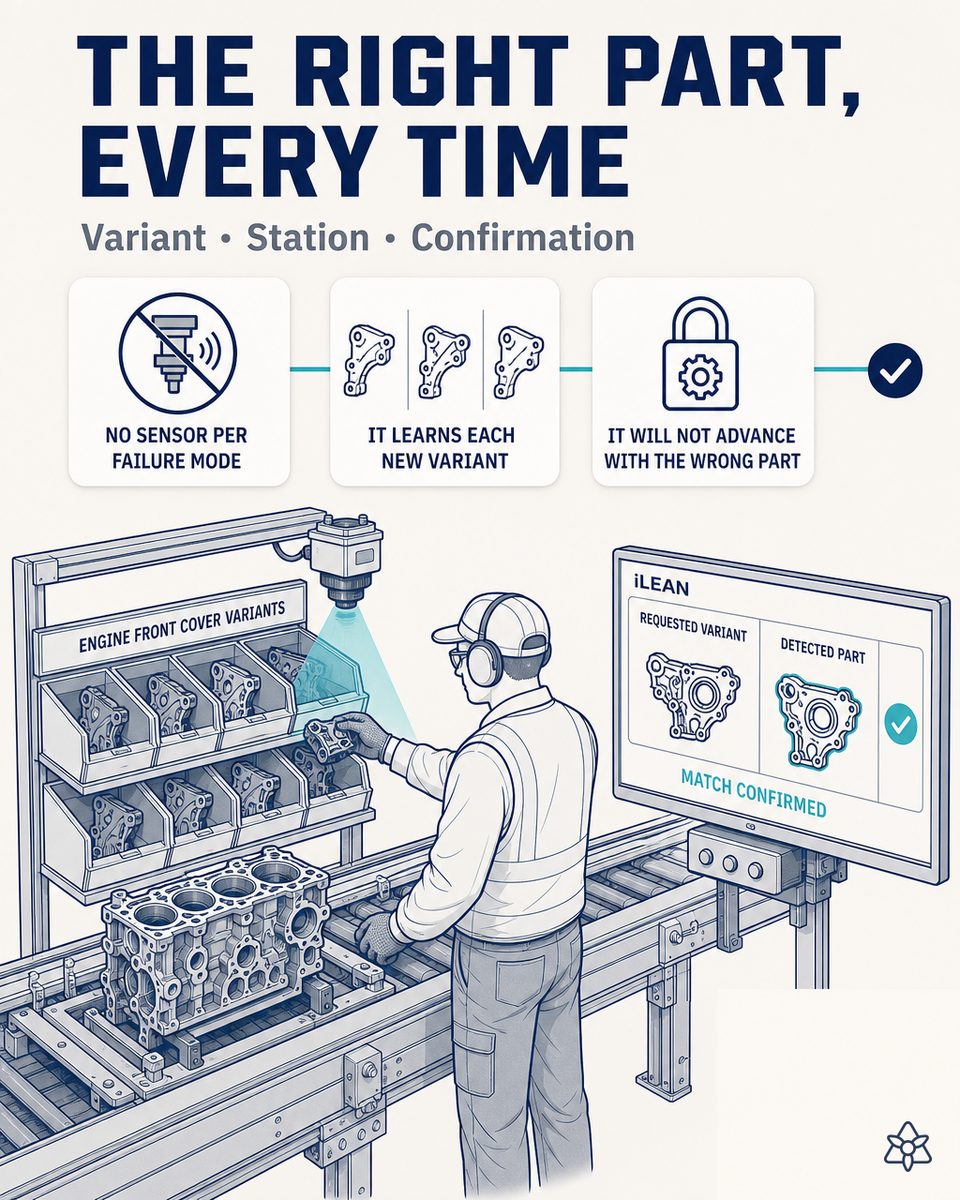
On an engine line with 30 variants, the classic poka-yoke (one mechanical sensor per failure mode) does not scale — every new variant demands a new sensor, and in the end the station is a porcupine. iLEAN Vision verifies the right part at every station by cross-referencing what the camera sees with the MES recipe, with no manual setup when the variant changes. The person signs.
The classic poka-yoke was brilliant — until the 30 variants arrived.
The classic poka-yoke is one of the most elegant ideas in lean: a mechanical detail that makes it impossible to fit the wrong part. It works perfectly when the line does one thing. A modern engine line does not do one thing — it does 30: different blocks, different brackets, different injectors, different gaskets, different sensors depending on the market. And then the classic poka-yoke breaks in three places:
- New variant, new sensor — every NPI adds another piece of hardware to the station. Two years later the station is full of sensors that break, get wet, shift with vibration, and in the end people bypass them.
- Right part, wrong revision — the mechanical sensor cannot tell rev. F4 from rev. F5 of the same bracket. The part fits; the engine should not be carrying it.
- Variant change on the line — the recipe change does not always reach the station. The person keeps building with the last set-up because the notice never got through, and it surfaces 12 stations downstream.
By the time the mixed-up part reaches the finished engine, it is no longer a few minutes of rework: it is a partial teardown, a batch containment, and sometimes a call from the OEM if the engine has already shipped. The classic system works almost every time. The few times it fails, it fails expensively.
iLEAN Vision does not replace the poka-yoke — it extends it to high-mix.
The idea behind the poka-yoke (make the error impossible) is still the right one. What changed is the line: variability went from 3 to 30, and the mechanical solution no longer scales. iLEAN does not ask you to rip out the sensors that work — it adds a vision + agent layer on top, as the putty that seals the gap the classic poka-yoke left exposed when high-mix arrived.
Edge sees what the operator is holding. The agent cross-references the MES recipe and says which engine is running now. If the part is not the one that belongs, the station locks before the bolt goes in. The person signs — never the other way round.
The iLEAN pieces applied to poka-yoke in engine assembly:
- Edge + Vision — a terminal with machine vision (CNN) and controlled lighting at the station. It sees the part in the person's hand (or in the feeder, or on the shelf) before the bolt goes in. It tells fine variants apart: same silhouette, different gasket color, different etching, different dimension. It returns OK/NOK to the station PLC over a dry contact or a bus. It works with no network: the model recipe travels with the part, Edge reads it, and if the plant loses WiFi it keeps verifying.
- Connect — captures the recipe of the model in progress from the MES or from the head-of-line PLC, and syncs to each station which variant is due. It also captures the active part revisions (which revision is valid right now?) from the engineering change list, which very often lives in a PDM folder the station never read.
- Agent — governs the rule for each station: for every engine in progress, which parts it should expect to see, in what order and with what tolerance. If a part does not match, it does not send an email at 10 p.m.: it locks the station, opens the incident with a photo and the reference of the expected part, and alerts the shift lead on whichever channel they use. No bolt ever goes in without verification.
Classic mechanical poka-yoke vs. poka-yoke with iLEAN AI vision
| Aspect | Classic poka-yoke (mechanical sensor) | With iLEAN Vision + Edge |
|---|---|---|
| Cost per new variant | New sensor, installation, wiring, calibration | A capture session in the plant; software, not hardware |
| Telling rev. F4 from rev. F5 of the same bracket | No (the part fits either way) | Yes (the CNN sees the etching, the agent cross-checks PDM) |
| Variant-change notice reaching the station | Paper / email — arrives late | MES recipe propagated to the station in seconds |
| Broken / bypassed sensors | Frequent with vibration and oil | Rugged camera + Edge self-diagnostics |
| Traceability of which part was fitted | “We assume the right one” | An automatic photo per engine at the moment of assembly |
| Setup at SKU changeover | Manual, blind window | Automatic reconfiguration from the recipe |
Impact estimate for your plant — to be validated with your numbers.
The block below is an estimate to be validated with the specific data of your plant. We put it forward so the committee has an order of magnitude; we refine it during the immersion.
- Engine assembly line with 20-40 active variants and 8-12 critical stations (the ones that concentrate the most mixed-up parts according to the MES Pareto).
- An Edge pilot on 1-2 stations from the Pareto. First value expected within a few weeks: detection above 90% on variants already in series production.
- Indicative payback between 4 and 9 months, depending on the historical frequency of mixed-up parts caught in final assembly and the average rework cost on a finished engine.
- A reasonable reduction of ≥ 30% in escaped mixed-up parts during the pilot; the rollout to the remaining critical stations done by your own trained people, in 2-3 months after validation.
And the quality manager's reasonable doubt
“What if the camera confuses two similar variants?” — visual inspection with the recipe as the anchor is an anchored task, not free generation. On that kind of task, the best models brought error below 1.5% [1]. And even so, what is critical is not decided alone: iLEAN locks the station and the person validates. The three safety rings exist precisely for this.
[1] OpenAI paper “Why Language Models Hallucinate”, 2025 — on the reliability of AI in anchored tasks.
What people ask about poka-yoke with AI vision in engine assembly
Can it recognize very similar variants (same block, different injector / bracket)?
Yes. The Edge CNNs are trained on real samples of every variant taken in the plant — not on renderings — and they learn the fine differences (the bracket dimension, the color of the O-ring, the marking etched on the injector). Where a classic poka-yoke needs an ad-hoc mechanical sensor per variant, AI vision tells them apart from the image + the agent cross-references the MES recipe that says which engine is running now. If the part is not the one that belongs, the station locks before the bolt goes in.
Does it work with the mixed lighting typical of a plant (LED + windows + reflections)?
Yes. Edge includes its own lighting to fix the conditions the CNN needs (the camera does not depend on how the sun hits the station at 4 in the afternoon). At stations where the reflection off the aluminum block or the chrome on the bracket adds noise, diffuse or polarized lighting is fitted — standard industrial vision equipment, integrated with the Edge terminal so the part always looks the same regardless of the shift and the outside light.
How is a new variant taught to the system (NPI / new engine)?
During the initial immersion we train the variants already in series production using real samples taken by the plant team — there is no need to ship parts to an external lab. For a new variant (NPI), a single capture session at the station during the first trial batches is enough; Edge adds the variant to the model and it is ready for production. Stations are not reprogrammed one by one — the recipe is managed from the agent and distributed to the relevant Edge.
Is it installed line-wide or station by station?
Both, depending on the Pareto. During the immersion we look at where the real variant errors are (MES data, internal complaints, rework in final assembly) and we start with the station where a mixed-up part costs the most or is most likely to escape into the finished engine. Once it is running there, replicating it to the other stations is marginal — the agent and the recipe already exist; you only add the Edge terminals that are missing.
How much does it cost per station?
The order of magnitude of an Edge vision station (terminal + camera + lighting + integration with the station PLC) is close to that of any industrial poka-yoke station — cheaper than an ad-hoc mechanical sensor replicated per variant. What changes the math is that the same Edge covers every present and future variant with no new hardware, just more training. We ask for your engine mix, your average rework cost and your historical rate of mixed-up parts, and we send you the estimated ROI in 48h, with your numbers.
More cases in automotive
- Elastomer seals with AI — a piece of flash that gets through today is a leak on the OEM assembly line tomorrow.How iLEAN cross-references the image of every seal, vulcanization parameters and mold traceability to…
- Permanent-magnet motor control with AI — a rotor defect does not stop the motor from being assembled; it shows up as vibration at the EOL test, when it is already too late.iLEAN inspects magnet insertion at 100%, ties magnetization and balancing to the rotor serial and…
- AI control of electrical connectors and pins — a bent pin passes the inspection desk and shows up at the test bench.How iLEAN verifies pin geometry, sequence and crimping of automotive electrical connectors in line with…
- TPM on a high-takt engine line with AI — the 8 pillars working at once, not in silos.iLEAN runs the 8 TPM pillars on an engine line: from autonomous maintenance to predictive, all connected.
- EV battery second life with AI — a misclassified module is not scrap, it is a loss event.How iLEAN cross-references BMS history, visual pack inspection and second-life criteria to sort reusable…
- AI manufacturing control of the on-board charger (OBC) — out-of-torque tightening does not fail at EOL; it fails months later, in the field.The OBC passes EOL and fails in the field months later. iLEAN ties torque and angle to the serial,…
Tell us your case and in 48h we'll send you the estimated ROI of this AI poka-yoke for your engine line.
We work on your plant's real data, not ours. Diagnostic with no commitment.
Request estimated ROI in 48h See automotive