Elastomer seals with AI — a piece of flash that gets through today is a leak on the OEM assembly line tomorrow.
A good seal is the intersection of three things — the image of the part at demolding, the real vulcanization curve and the traceability of mold and batch. iLEAN cross-references all three in line, pulls the doubtful part before it reaches the bin and leaves the PPAP / IATF dossier assembled on the fly. The person signs — marginal flash does not decide on its own.
The process curve is fine and the part is not.
Anyone molding elastomer seals for automotive lives with a daily contradiction:
- SPC says OK — pressure, temperature and vulcanization time within tolerance. The recipe was followed.
- The part says otherwise — flash along the parting line, injection marks, an internal void that only the leak test uncovers, a burr on the sealing lip.
- The OEM customer demands 25 PPM [1] — and a single batch with a defect rate above the threshold triggers an 8D, a containment action and an invoice.
What kills classic control is that the operator's eye works well on obvious defects and badly on marginal ones — and the marginal ones are precisely the ones that pass inspection, reach the customer and come back as a leak weeks later. The mold wears and nobody detects it until the burr is everywhere. SPC watches the process; nobody was looking at the part at the rhythm of the press.
iLEAN does not replace your SPC or your press — it puts an eye on the part, exactly where one was missing.
The problem in seal molding is not a lack of systems, it is a dead zone between process SPC and final quality control. iLEAN acts as the putty that fills that dead zone — Edge sees every part as it leaves the mold, Connect reads the real vulcanization curve whether it comes from the PLC or from the machine screen, and the agent cross-references both with the mold ID and the batch.
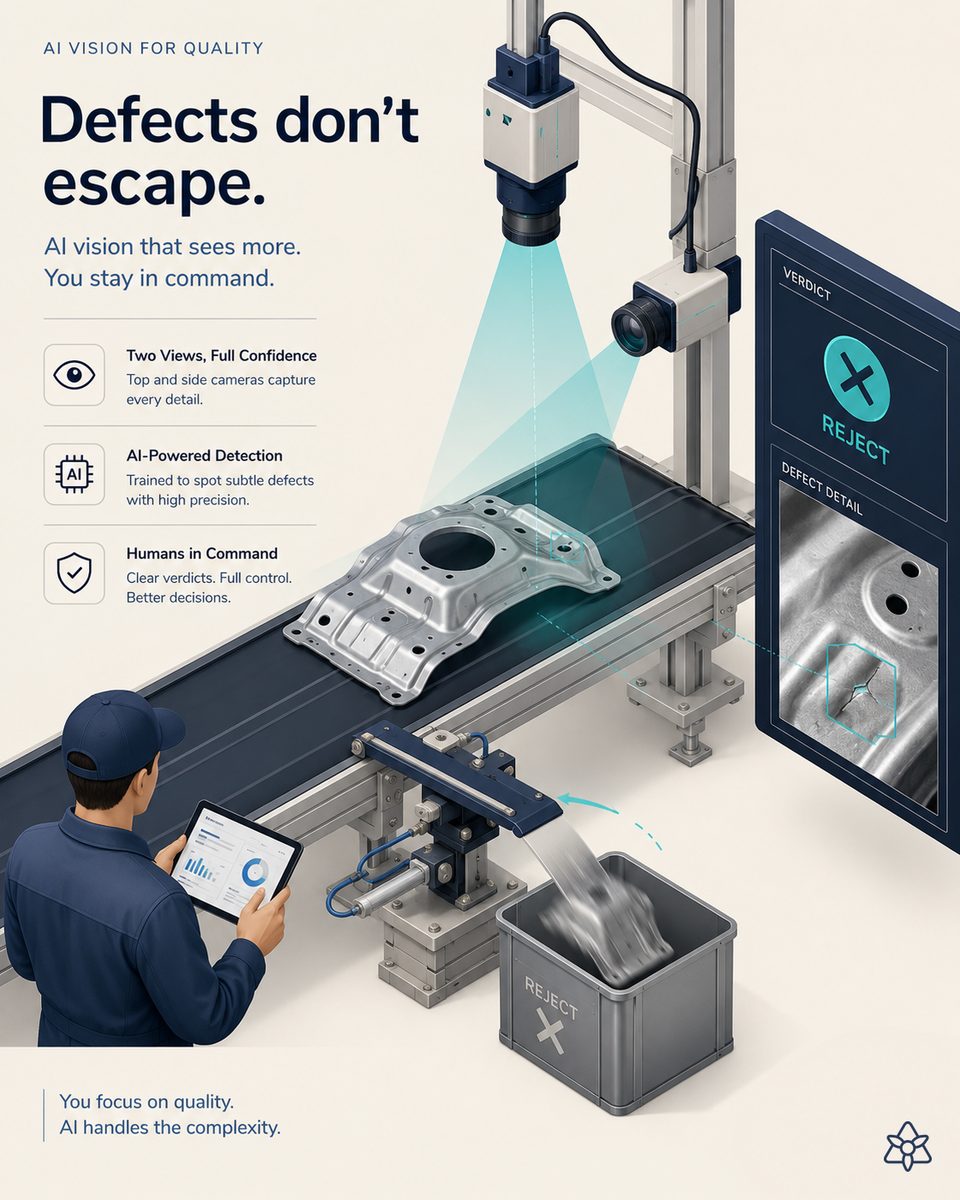
Edge sees every seal at demolding. Connect reads the real vulcanization curve, not the setpoint. The agent cross-references it with the mold ID and gives warning when the defect pattern starts to concentrate. The person signs — the line does not stop on its own.
The three iLEAN pieces applied to elastomer seal control:
- Edge — a terminal with machine vision (CNN) over the mold outfeed. It detects flash, surface voids, injection marks, underfill and cavity misalignment. It fires the actuator (ejector, stack light) in milliseconds, before the seal reaches the bin. It works with no network.
- Connect — captures the real vulcanization curve (not the PLC setpoint), the rubber batch, the cavity number and the mixing records. If the PLC has a modern interface, integration is direct; if it is old, the screen is read by vision, without touching the machine. It also captures what arrives from outside: an alert from the rubber supplier, a customer complaint.
- Agent — cross-references image, curve, mold, cavity and batch. It spots that cavity 4 has been producing increasing flash for three shifts — before the operator notices. It assembles the PPAP / IATF 16949 dossier on the fly, ready for the auditor.
Classic inspection vs. cross-referenced inspection with iLEAN
| Aspect | SPC + the operator's eye | With iLEAN Edge + Connect + Agent |
|---|---|---|
| Detecting marginal flash | The eye gets tired on the night shift | A consistent CNN shift after shift, no fatigue |
| Surface voids | They reach the customer and come back as a leak | Edge flags them at demolding and holds the part |
| Mold wear | Discovered when a whole batch fails | Pattern per cavity detected early |
| Mold-batch-curve traceability | Three systems, manual reconstruction | Dossier per part, automatic |
| Operation without network | n/a | Edge keeps inspecting on cabinet power |
| Ready for PPAP / IATF 16949 | Weeks of file digging | File on the fly, ready when the customer asks |
Impact estimate for your plant — to be validated with your numbers.
The block below is an estimate to be validated with the specific data of your plant. We put it forward so the committee has an order of magnitude; we refine it during the diagnostic.
- Automotive elastomer seal plant with several presses and in-house compounding.
- Edge pilot on one critical press (camera over the outfeed + actuator + integration with the vulcanization PLC and the MES). First value expected within a few weeks.
- Expected reduction in defect PPM at the customer of ≥ 30% within the scope of the pilot.
- Indicative payback between 4 and 9 months, dominated by rework avoided + PPM reduction at the OEM + a PPAP dossier that is ready.
And the quality manager's reasonable doubt
“What if the AI marks good parts as NOK and stops our press?” — the system is calibrated with good and bad samples from your own plant, and it learns the pattern of each cavity. Hallucination is a problem of free generation, not of anchored tasks: in tasks where the AI merely classifies an image against a known pattern, the best models brought error below 1.5% [2]. And even so, what is critical is never decided alone: iLEAN holds the doubtful part and the person signs.
[1] Automotive quality standard in the order of 25 PPM. Symestic.
[2] OpenAI paper “Why Language Models Hallucinate”, 2025 — on the reliability of AI in anchored tasks.
What people ask about elastomer seal control with AI
What are the typical defects of an automotive elastomer seal?
The critical defects are flash (burr along the mold parting line), voids (internal cavities from trapped air), injection marks, underfill, tearing at demolding and misalignment. Any of them, in an engine, transmission or fuel system seal, ends up as a leak at the customer. Manual inspection catches them when they are obvious; the marginal ones go through.
Why is process parameter control not enough on its own?
Because process SPC (pressure, temperature, vulcanization time) tells you whether the recipe was followed, not whether the part came out right. A worn mold can produce flash even with perfect parameters; incomplete air venting generates voids without triggering any alarm. What defines the quality of the seal is what you see on the part, not what the sensor says. That is why jidoka — see, stop, correct — demands an eye at the outfeed, not just measurement in the process.
How does iLEAN Edge detect internal voids without X-ray?
Most relevant voids show up at the surface as sunken marks, local deformation or a color change after demolding. Edge trains a CNN with good and bad samples from your own plant to recognize that pattern on the first view of the seal. For deep voids in critical seals, it is complemented with a leak test and the agent cross-references both results with the mold ID and the rubber batch. When there is doubt, the part is held and the person decides.
What about batch-vulcanization-mold traceability for PPAP or IATF 16949?
Every seal ends up linked to a dossier containing: incoming rubber batch, mixing record, mold ID, cavity number, vulcanization cycle (the real curve, not the setpoint), the Edge image, the OK/NOK decision and the signature of whoever validated it. The agents assemble it on the fly from Connect (process parameters) + Edge (image) + MES/ERP (batch). The file is ready when the customer asks for it; it is not rebuilt after the fact.
How much does it cost to deploy Edge on a seal molding line?
A pilot line with an Edge camera at the mold outfeed + an ejection actuator + integration with the MES and the vulcanization system has an order of magnitude close to other Edge pilots in automotive. The hard lever is the cost of a single return for a leak at the customer — a rejected vehicle, rework, an hour of plant time lost, an OEM penalty. We ask for your plant's data and send you the estimated ROI in 48h.
More cases in automotive
- Crankshaft machining with AI — the spindle says it long before the metrology room does.How iLEAN anticipates tool wear, spindle vibration and dimensional drift in crankshaft machining —…
- Critical engine and transmission torque with AI — a cylinder head tightened out of sequence is a warranty failure.iLEAN guarantees correct torque, angle and sequence on critical engine and transmission fastenings. No…
- Digital andon with automatic escalation — the light tower comes on, but if the line lead is at the far end of the shop floor, the stop gets longer.The andon lights up; iLEAN escalates the alert only if nobody responds and logs the response time at…
- Permanent-magnet motor control with AI — a rotor defect does not stop the motor from being assembled; it shows up as vibration at the EOL test, when it is already too late.iLEAN inspects magnet insertion at 100%, ties magnetization and balancing to the rotor serial and…
- AI control of electrical connectors and pins — a bent pin passes the inspection desk and shows up at the test bench.How iLEAN verifies pin geometry, sequence and crimping of automotive electrical connectors in line with…
- Poka-yoke in engine assembly with AI vision — the right part at every station, without a sensor per variant.iLEAN Vision verifies the right part at every engine assembly station. Variant errors caught before the…
Tell us your case and in 48h we'll send you the estimated ROI of this AI project for your seal plant.
We work on your plant's real data, not ours. Diagnostic with no commitment.
Request estimated ROI in 48h See automotive