Digital andon with automatic escalation — the light tower comes on, but if the line lead is at the far end of the shop floor, the stop gets longer.
An andon nobody sees is a stop that grows. iLEAN escalates the alert on its own: Connect captures the event wherever it is born and, if level 1 does not respond within X minutes, it alerts level 2 by earpiece or phone — logging how long each level took. The person decides how to fix it; the system guarantees they find out.
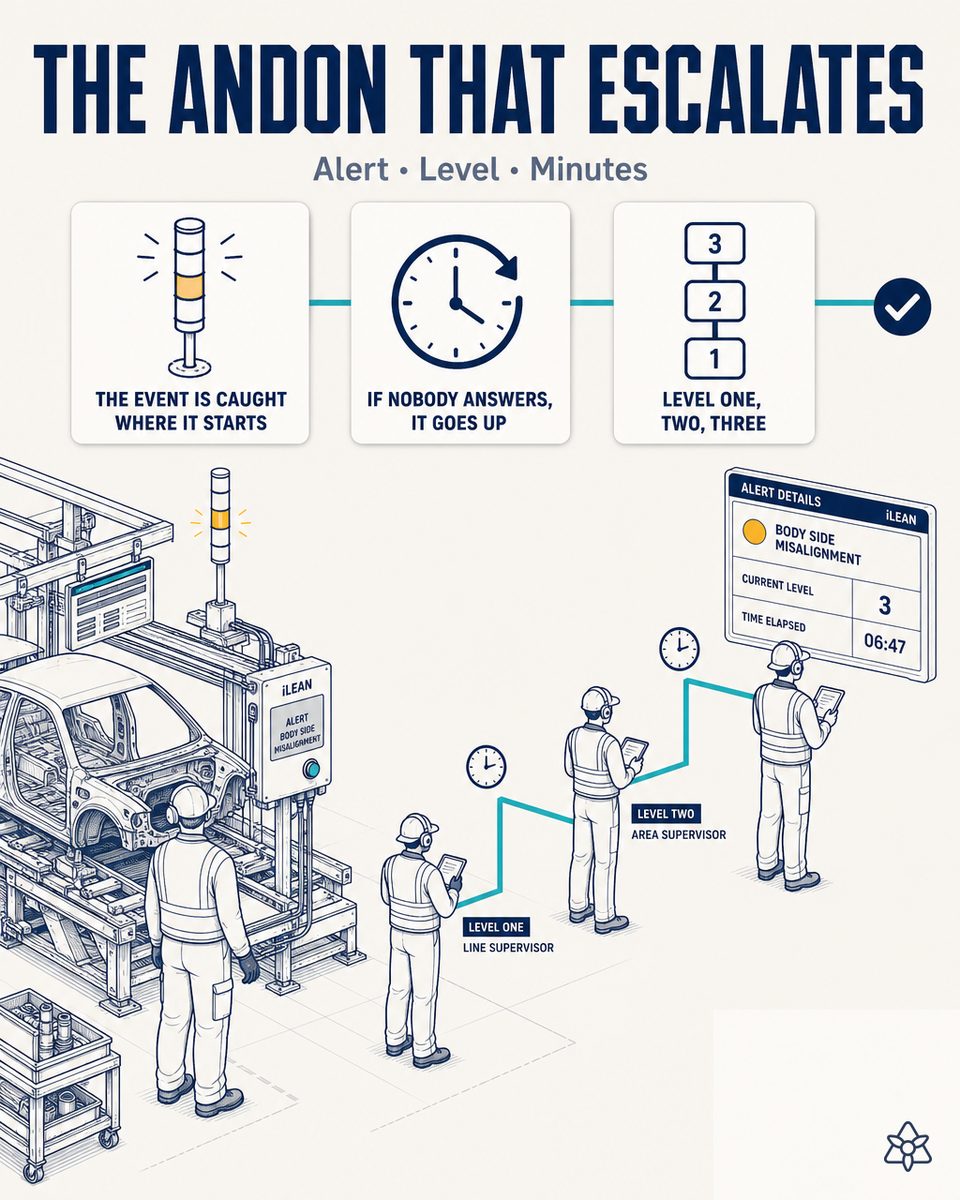
The classic andon turns the light on — but escalation still depends on somebody seeing it.
Production managers describe it the same way in every plant: the andon works. The operator pulls the cord or presses the button, the light tower comes on, the line stops if it has to. So far, textbook lean. The problem starts one second later: who found out? If the line lead is at the far end of the shop floor, dealing with another issue or in a meeting, the light stays on and the stop keeps running. The andon raised the flag; the alert did not travel.
Three things happen at once on a real line and almost no plant has them solved:
- The alert does not travel — the light tower is local. Seeing it means being nearby. Escalation to the supervisor or to maintenance depends on a phone call, a shout or a walk, and on the night shift sometimes not even that.
- Nobody measures how long each level took to respond — you know how long the stop lasted, but not how much of that was the actual fault and how much was waiting: minutes in which the line was down purely because the right person had not found out yet.
- Repeat issues leave no analyzable trail — the same micro-stoppage at the same workstation three times a shift gets fixed three times with the same workaround, and none of them is logged in a way that lets anyone cross-reference them and attack the root cause.
The result is always the same: short stops that turn long because of waiting nobody sees, a line lead condemned to keep an eye on the light tower on top of everything else, and continuous improvement working from memories (“I think that conveyor fails a lot”) instead of from data.
iLEAN does not replace your andon — it makes the alert travel, move up on its own and leave a trail.
The problem is not the andon: the "something is happening here" signal already exists, whether it is a modern connected light tower or a lamp board from twenty years ago. The problem is that the signal dies where it is born. iLEAN acts as the putty that picks up that event, turns it into an alert that chases the right person level by level, and leaves every hop on record — without asking you to change the andon, the PLC or the way the operator works.
Connect captures the andon event wherever it is born. The escalation rules move the alert up on their own if a level does not respond. Agents cross-reference the history and flag the repeat issues. The person decides how to fix it.
The two iLEAN pieces applied to andon escalation:
- Connect — captures the event wherever it is born. On lines with a modern andon, direct integration with the signal (dry contact, digital signal, API). On old lines, a camera pointed at the board or the light tower detects the state change and digitizes it — with nothing to wire. From there the escalation rules defined by the plant take over: alert to level 1 by earpiece or phone; if they do not acknowledge within X minutes, alert to level 2; and so on up the chain. It works locally: if the plant loses its network, Connect keeps capturing events and alerting on the floor. What is critical does not depend on WiFi.
- Agents — they aggregate the complete history of issues: which workstation, which type of stop, which shift, how long each level took to respond and how long to resolve. On top of that history they flag the repeat issues (the same micro-stoppage that gets worked around three times a shift) and the escalation bottlenecks (the level or the shift where alerts systematically get stuck). The agents do not decide who to alert — that is a deterministic plant rule —: they propose improvements, and the manager decides.
Classic andon vs. andon with iLEAN automatic escalation
| Aspect | Classic andon (light tower / board) | With iLEAN Connect + Agents |
|---|---|---|
| Reach of the alert | Local — you have to be nearby to see it | Travels to the earpiece or phone of whoever is on duty |
| Escalation if nobody responds | Depends on calls, shouts or walking over | Automatic by levels, within X minutes |
| Response time per level | Nobody measures it | Logged with a timestamp at every hop |
| Repeat issues | Worked around and forgotten, no trail | Aggregated history, patterns flagged by Agents |
| Load on the line lead | Keeping an eye on the light tower all day | The system guarantees the alert reaches them |
| Dossier for an IATF audit | Rebuilt by hand, stop by stop | Cross-referenced history, automatic |
Impact estimate for your plant — to be validated with your numbers.
The block below is an estimate to be validated with the specific data of your plant. We put it forward so the committee has an order of magnitude; we refine it during the diagnostic.
- Automotive assembly or machining line, andon by light towers or board, several lines per shop floor, line leads carrying more than one responsibility, and documented stops that dragged on because the alert did not reach the right person in time.
- Connect pilot on the existing andon (direct integration or a camera on the board) + escalation rules configured with the plant within a few weeks. First value almost immediate: the first response-time-per-level records appear from week one, before anything else is touched.
- Expected MTTR reduction ≥30% by eliminating escalation waiting — the alert moves up on its own, without depending on somebody seeing the light. Estimate to be validated with your real downtime history.
- Long stops caused by "nobody saw it" — the ones that hurt most on the night shift — are eliminated as a category: if level 1 does not respond, level 2 finds out within minutes, every time.
- Indicative payback between 4 and 9 months — estimate to be validated. The hard lever: every minute of line downtime in automotive carries a high direct cost, and the waiting portion of every stop is cost you can remove without touching the fault itself.
- A recurring benefit that does not go into the ROI but carries weight: the response history by level stays as the foundation of continuous improvement — the weekly kaizen works on real escalation data, not on memories.
And the production manager's reasonable doubt
“What if the system escalates a minor issue and wakes up level 3 in the middle of the night over a micro-stoppage?” — iLEAN escalation is not decided by the AI: they are deterministic rules signed off by the plant, by type of stop, line, shift and time of day. The AI part — the Agents that analyze the history — only proposes: which repeat issues to attack, which rules to adjust. Hallucination is a problem of free generation, not of anchored tasks: in tasks where the AI cross-references logged events against history, the best models brought error below 1.5%[1]. And even so, what is critical goes through the safety rings — the Agents live in the outer ring, propose inwards, and a change to an escalation rule is signed by a person. Never the other way round.
[1] OpenAI paper “Why Language Models Hallucinate”, 2025 — on the reliability of AI in anchored tasks.
What people ask about digital andon with automatic escalation
How does it capture the andon event?
Wherever it is born. If the line has a modern andon system (connected light towers, a digital board, a signal in the PLC), iLEAN Connect integrates directly — dry contact, digital signal or API, depending on what is there. If the line is old and the andon is an unconnected light tower or lamp board, Connect uses a camera pointed at the board that detects the state change and turns it into a digital event. Either way, the andon the operator already knows keeps working exactly the same: nothing changes at the workstation, the event is simply captured so the alert can travel.
How do the escalation rules work?
They are deterministic rules defined by the plant, not by the AI. A typical example: the issue is raised at the workstation → alert to level 1 (line lead) by earpiece or phone → if they do not acknowledge within X minutes, automatic alert to level 2 (area supervisor) → if there is still no response, level 3 (production or maintenance manager, depending on the type of issue). The times, the levels and the channels are configured by the plant per line, shift and downtime type. Every hop is logged with its timestamp, so escalation stops depending on somebody looking at the light tower.
Is this a way of controlling people?
No. iLEAN measures the response times of the escalation process — how long the alert took to reach each level and how long the issue took to resolve — not what each person does at their workstation. In practice it is the opposite: it takes away from the line lead the burden of keeping an eye on the light tower all day long, because the system guarantees the alert reaches them even if they are at the far end of the shop floor or in a meeting. The data the plant cares about is where escalation gets stuck — which level, which shift, which type of downtime — not who was slow.
Does it work on lines with no digital andon?
Yes, and it is one of the cases where it adds the most. On old lines with a light tower or a classic board, Connect captures the event with a camera above the board — with no wiring on the line and no touching the PLC. If there is not even a light tower, a physical push button wired to Connect acts as the entry point: the operator presses it and the issue enters the escalation circuit with the same traceability as on a modern line. The general iLEAN rule applies here too: we work with what the plant already has, we do not require you to replace the andon before you start.
How much does it reduce MTTR?
It depends on the starting point — a line with leads always at the line and stable shifts has less headroom than a large shop floor with several shifts and managers spread around. As a defensible floor, an MTTR reduction of ≥30% is realistic once escalation stops waiting for somebody to see the light — it is an estimate to be validated with your numbers. The most visible effect arrives sooner: the long stops caused by nobody seeing it disappear from week one, because the alert moves up on its own. We send you the estimated ROI in 48h using the real downtime history of your line.
More cases in automotive
- KTL/cataphoresis control with AI — the bath drifts hours before the paint fails; finding out in the touch-up booth is too late.iLEAN keeps the KTL bath in spec — pH, temperature, conductivity — and warns you before paint quality…
- Crankshaft machining with AI — the spindle says it long before the metrology room does.How iLEAN anticipates tool wear, spindle vibration and dimensional drift in crankshaft machining —…
- Critical engine and transmission torque with AI — a cylinder head tightened out of sequence is a warranty failure.iLEAN guarantees correct torque, angle and sequence on critical engine and transmission fastenings. No…
- Elastomer seals with AI — a piece of flash that gets through today is a leak on the OEM assembly line tomorrow.How iLEAN cross-references the image of every seal, vulcanization parameters and mold traceability to…
- Permanent-magnet motor control with AI — a rotor defect does not stop the motor from being assembled; it shows up as vibration at the EOL test, when it is already too late.iLEAN inspects magnet insertion at 100%, ties magnetization and balancing to the rotor serial and…
- AI control of electrical connectors and pins — a bent pin passes the inspection desk and shows up at the test bench.How iLEAN verifies pin geometry, sequence and crimping of automotive electrical connectors in line with…
Tell us your case and in 48h we'll send you the estimated ROI of this AI project for your andon.
We work on your plant's real data, not ours. Diagnostic with no commitment.
Request estimated ROI in 48h See automotive