Critical engine and transmission torque with AI — a cylinder head tightened out of sequence is a warranty failure.
On critical engine fastenings (cylinder head, connecting-rod bolts, plastic-elastic) and gearbox joints, torque alone proves nothing — you also need the correct angle and sequence. iLEAN combines the three signals in real time with vision + a read of the nutrunner, and holds the engine if anything departs from the model's spec. The person signs.
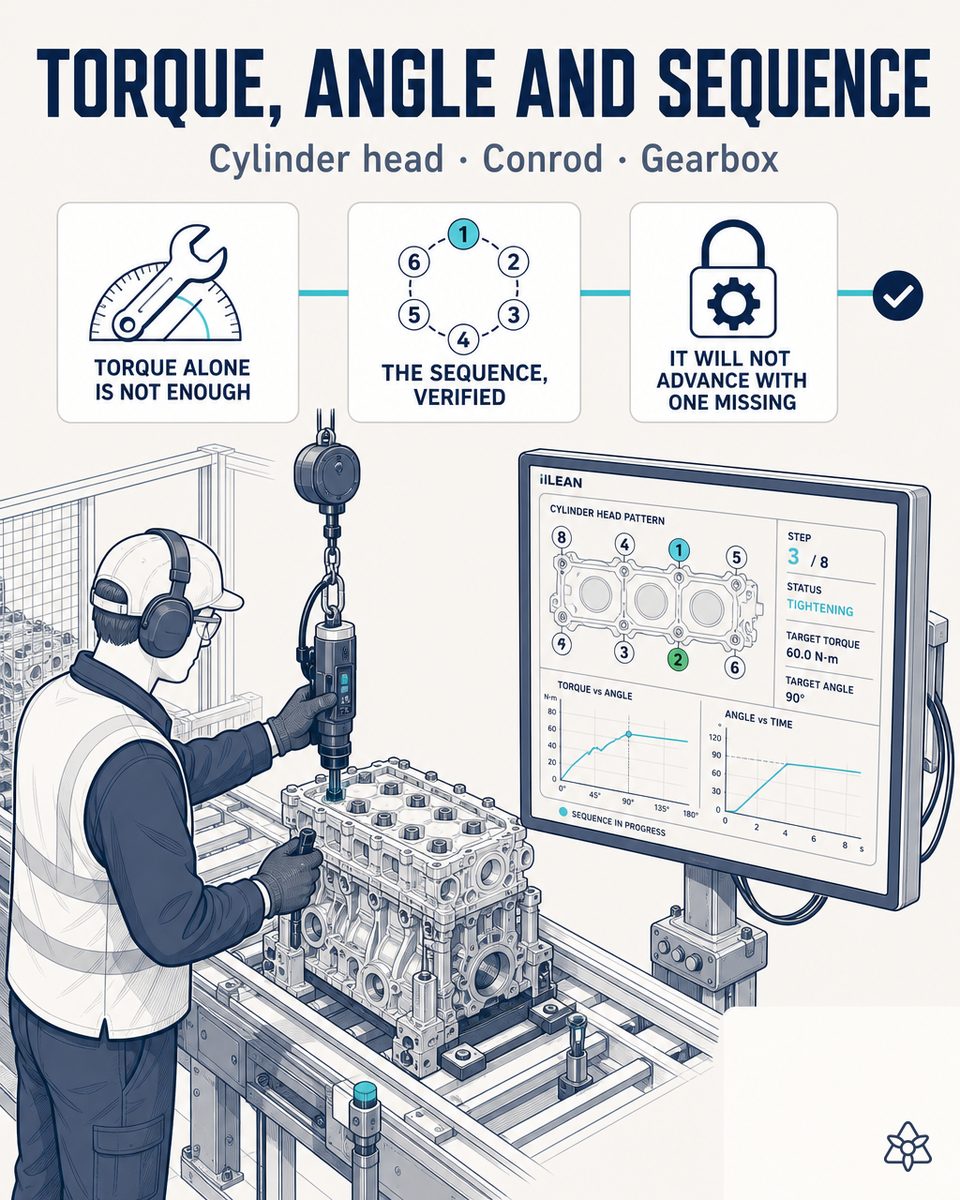
Correct torque is not the same as a correct tightening.
On critical engine fastenings (cylinder head, connecting-rod bolts, plastic-elastic fasteners) and transmission ones (gearbox, differential) three conditions have to hold at the same time for the joint to be valid under warranty:
- Torque inside the window. The nutrunner controller measures it well and, almost always, delivers it well.
- Correct residual angle. In plastic-elastic tightening, torque is only the start — the angle beyond the threshold torque is what proves the thread went exactly as far as it should.
- Correct sequence. A cylinder head is tightened in a cross pattern, in increasing passes. Doing it in another order leaves residual stresses that break the gasket at 30,000 km — at the customer, not in the plant.
The classic problem: systems that watch torque do not watch angle and sequence with the same rigor, or they do but the data is never cross-referenced with the specific part or with the VIN. A bolt skipped in the cross pattern, a damaged thread in the block that returns a beautiful torque with a strange angle, a single-use bolt re-tightened by mistake during a touch-up — these are the cases that slip through to the customer and come back as a warranty campaign. That is the most expensive invoice there is in engine manufacturing.
iLEAN does not change the tool — it puts torque, angle and sequence in the same file, engine by engine.
The problem is not a missing data point — it is that the three data points live on islands: torque in the nutrunner controller, angle in the same log but read by nobody, sequence in the operator's head and on the process sheet. iLEAN acts as the putty that fills those gaps, without asking you to change the nutrunner or the MES.
Edge sees which bolt is being tightened. Connect reads torque and angle from the nutrunner. The agent cross-references them with the model's sequence spec and, if something does not add up, holds the engine. The person signs — never the other way round.
The three iLEAN pieces applied to critical engine and transmission torque:
- Edge + Vision — a terminal with machine vision (CNN) over the station. It identifies which bolt is being run at each instant (1, 2, 3… in the cylinder head cross pattern) and leaves a timestamped record. It works with no network: if the plant loses WiFi, Edge keeps identifying and, if the sequence breaks, it triggers the actuator.
- Connect — captures torque + angle + time + program code from Atlas Copco, Bosch Rexroth, Cleco or Desoutter controllers over OPC UA, Profinet or EtherNet/IP, at second zero. And it also captures whatever arrives from outside (a recipe change for a fastener batch, an alert from the bolt supplier).
- Agents — cross-reference the triple signature (torque, angle, sequence) with the model's spec, compare it with the engine's VIN/serial and, if something falls out (wrong sequence, short angle, re-tightened bolt), hold the engine before it advances. The person validates and signs; the line never restarts on its own.
Classic critical tightening vs. tightening validated by triple signature with iLEAN
| Aspect | Nutrunner controller + checklist | With iLEAN Edge + Vision + Connect + Agents |
|---|---|---|
| Torque | Measured and stored in a log | Measured + cross-referenced with the recipe + tied to a specific bolt |
| Angle in plastic-elastic joints | Stored but rarely cross-referenced | Cross-referenced with the model's expected torque-angle curve |
| Sequence (cylinder head cross pattern) | Operator + paper checklist | Vision identifies bolt by bolt, agent validates the spec |
| Single-use fasteners | Risk of an undetected re-tightening | Agent blocks a second valid tightening on the same serial |
| Error detection | Later audit or warranty at the customer | Before it moves to the next station, in seconds |
| File for 8D / IATF | Rebuilt by hand, weeks | Automatic dossier per engine, with torque + angle + sequence |
Impact estimate for your plant — to be validated with your numbers.
The block below is an estimate to be validated with the specific data of your plant. We put it forward so the committee has an order of magnitude; we refine it during the immersion diagnostic.
- Engine or gearbox plant with plastic-elastic tightening on the cylinder head + single-use fasteners on rod bolts; between 15 and 40 critical joints per engine.
- Edge + Vision pilot on one key station (cylinder head or bedplate). First value expected within a few weeks: torque + angle + sequence cross-referenced and the engine held if the sequence breaks.
- Indicative payback between 4 and 9 months, depending on the average cost of a torque-related 8D, the volume of warranty campaigns with "tightening" as root cause and your exposure to a mass campaign.
- Hard lever: reduction of ≥ 30% in incidents with "critical tightening" as root cause (a conservative estimate to be validated). A single engine campaign avoided pays for the system many times over.
The standard that measures whoever audits you
Automotive quality operates in the order of 25 PPM (parts per million) of admissible defects [1]. With 15-40 critical joints per engine and volumes of hundreds of thousands a year, the only honest way to defend a low PPM on critical fastenings is to record the triple signature (torque + angle + sequence) per bolt and per engine. The CAIO's reasonable doubt ("what if vision misidentifies a bolt in the cross pattern?") is defused: the AI here is not inventing anything — it is recontextualizing a repeated visual pattern. In anchored tasks, the best models bring error below 1.5% [2]. And even so, what is critical is never decided alone: iLEAN holds, the person signs.
[1] 25 PPM automotive quality standard — Symestic.
[2] OpenAI paper "Why Language Models Hallucinate", 2025 — on the reliability of AI in anchored tasks.
What people ask about critical torque in engines and transmissions
How does iLEAN verify the tightening sequence (bolt order)?
iLEAN combines two signals to validate the sequence. The first is the data from the nutrunner controller: every tightening comes with a program code, a timestamp and a target bolt. The second is Edge with vision over the station: a CNN identifies which bolt is being tightened at that instant. The agent cross-references the two and, if the sequence departs from the model's spec (a cylinder head cross pattern done wrong, for example), it holds the engine before it moves to the next station. The person decides; iLEAN never restarts on its own.
Does it work with plastic-elastic fasteners (angle tightening)?
Yes — and this is where the difference shows most. In plastic-elastic tightening, torque is only the start: the data that really validates the joint is the angle (residual rotation beyond the threshold torque). iLEAN stores both for every bolt, cross-references them with the model's expected torque-angle curve and detects deviations (damaged thread, wrong lubrication, reused bolt) that a system watching torque alone would let through. The agent classifies every tightening as OK / suspect / outside the window and traces it against the VIN.
Does it work with single-use fasteners?
Yes. With single-use fasteners (torque-to-yield bolts, certain connecting-rod and cylinder-head bolts) the risk is not only a badly measured torque — it is that a bolt gets re-tightened when it should not be. Edge with vision identifies the bolt, Connect captures the tool log and the agent checks that there are not two valid tightenings on the same serial of the same VIN. If there are, it holds the unit and leaves a signed record. The file is ready for a warranty claim or an audit.
Does it integrate with poka-yoke already installed at the station?
Yes, and it usually reinforces it rather than replacing it. If the station already has poka-yoke (light curtains, photocells, a torque-arm with an encoder), iLEAN Connect reads those signals as one more source and cross-references them with the rest. Where the plant sees fit, iLEAN can add an Edge with vision for cases that mechanical poka-yoke does not cover: part orientation, the wrong bolt in the same spindle, a step skipped in the sequence. The philosophy is putty — sealing the gaps left by classic poka-yoke, not replacing it.
How much of a reduction in warranty failures can be expected?
On critical engine and transmission fastenings, the pattern is very stable: warranty failures caused by tightening come from a handful of causes (a wrong sequence, torque outside the window because of a damaged thread, a reused bolt, insufficient angle in plastic-elastic joints). A system that records all four and holds the unit before it advances eliminates most of them — the reasonable order of magnitude to put in front of the committee is a reduction of ≥ 30% in incidents with "critical tightening" as root cause (an estimate to be validated with your current warranty data). A single engine campaign avoided pays for the system many times over.
More cases in automotive
- Car upholstery with AI — the shade and the stitching are caught the first time, or they are caught at the dealership.How iLEAN inspects leather, fabric and stitching in car upholstery with AI vision, anticipates shade and…
- KTL/cataphoresis control with AI — the bath drifts hours before the paint fails; finding out in the touch-up booth is too late.iLEAN keeps the KTL bath in spec — pH, temperature, conductivity — and warns you before paint quality…
- Crankshaft machining with AI — the spindle says it long before the metrology room does.How iLEAN anticipates tool wear, spindle vibration and dimensional drift in crankshaft machining —…
- Digital andon with automatic escalation — the light tower comes on, but if the line lead is at the far end of the shop floor, the stop gets longer.The andon lights up; iLEAN escalates the alert only if nobody responds and logs the response time at…
- Elastomer seals with AI — a piece of flash that gets through today is a leak on the OEM assembly line tomorrow.How iLEAN cross-references the image of every seal, vulcanization parameters and mold traceability to…
- Permanent-magnet motor control with AI — a rotor defect does not stop the motor from being assembled; it shows up as vibration at the EOL test, when it is already too late.iLEAN inspects magnet insertion at 100%, ties magnetization and balancing to the rotor serial and…
Tell us your case and in 48h we'll send you the estimated ROI of this AI project for your engine or transmission line.
We work on your plant's real data, not ours. Diagnostic with no commitment.
Request estimated ROI in 48h See automotive