KTL/cataphoresis control with AI — the bath drifts hours before the paint fails; finding out in the touch-up booth is too late.
A KTL tank out of spec produces defective paint hours later. iLEAN keeps pH, temperature and conductivity in band with Edge on the bath instrumentation and Brain cross-referencing signals, consumption and output. It warns before the defect. The person decides what to correct.
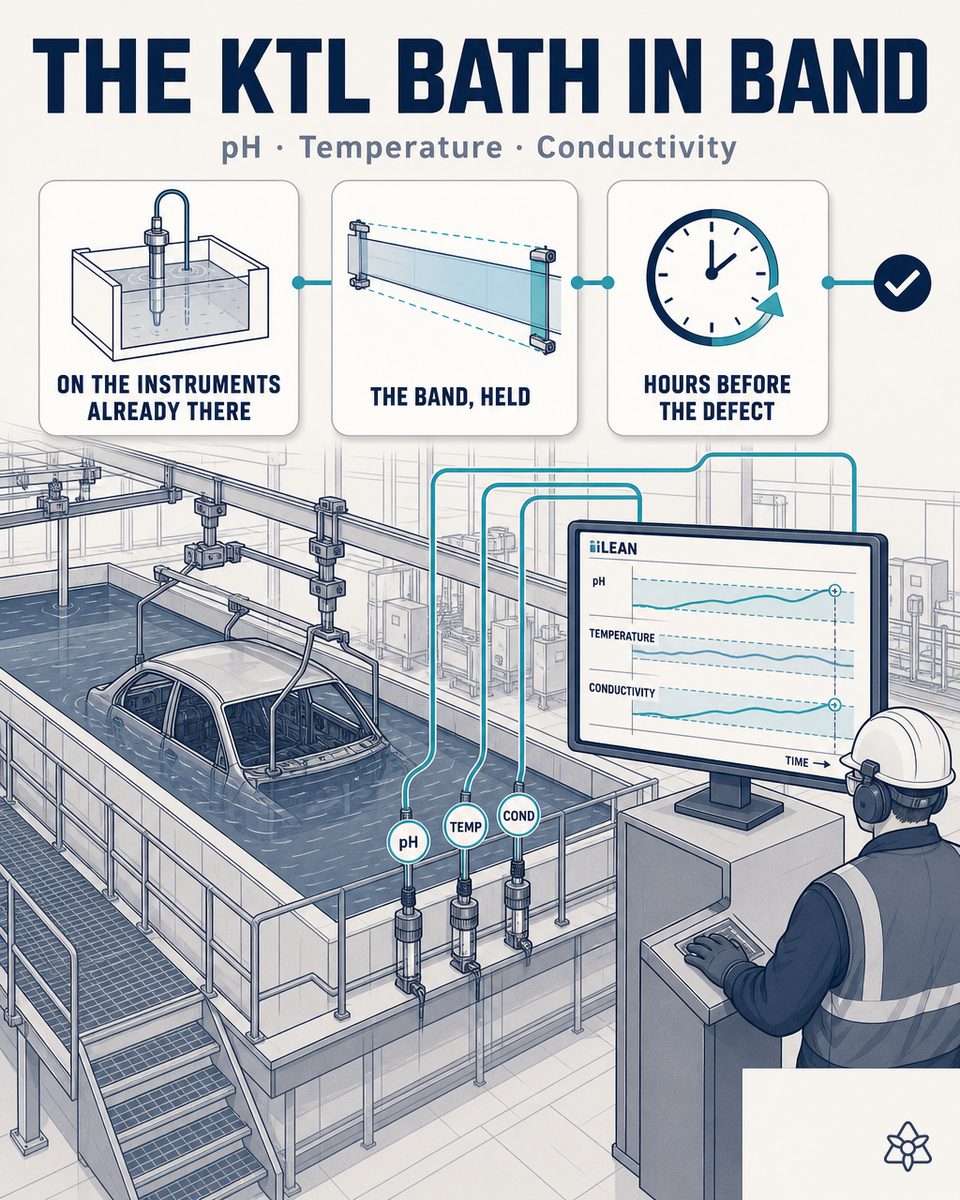
The bath drifts inside the band — and the defect shows up two hours later.
The paint line manager tells it with the same frustration in every plant: the SCADA panel shows pH 5.98, temperature 30.1, conductivity 1,450. All green. And in the touch-up booth, two hours later, bodies appear with craters, pinholing, uneven thickness. The bath was not out of spec when those bodies went through — it was drifting.
Three things happen at once in a real cataphoresis line, and almost nobody looks at them together:
- The bath signals each go their own way — pH, temperature, conductivity, solids. Each with its own threshold. Combined drift (pH creeping down, conductivity creeping up) does not trigger an alarm because no single one steps outside its limits.
- Paint consumption is not cross-referenced with quality — the top-up is done by recipe, without checking whether the ratio is pulling away from that tank's history for that part reference.
- A large tank is not homogeneous — the gradient between the ends, uneven recirculation, dead spots in parts of the cage do not show up in the central reading. The veteran operator knows it; the system does not.
The outcome is always the same: the defect is spotted in the touch-up booth, the plant pays the rework cost, and the veteran operator once again puts out the fire with his eye and his notebook. The knowledge that prevents the problem lives in his head; the day he retires, it walks out with him.
iLEAN does not replace the SCADA — it joins up what the SCADA keeps apart.
The KTL problem is not a lack of instrumentation: most lines already measure pH, temperature and conductivity. The problem is that each signal lives on its own island and combined drift triggers no individual alarm. iLEAN acts as the putty that binds those signals, paint consumption, line output and the history of your specific tank, without asking you to change the SCADA or the rectifiers.
Edge reads the bath signals in real time. Brain cross-references them with history and consumption, detects in-band drift and warns with hours of margin. The person decides what to correct.
The two iLEAN pieces applied to KTL control:
- Edge — a local terminal connected to the bath probes (pH, temperature, conductivity, ultrafiltration conductivity) and to the rectifiers. If the plant has modern probes, direct integration; if the probes are old and isolated, reading through the tank's local computer or complementary instrumentation. It runs locally: if the plant loses the network, Edge keeps reading, recording and firing alerts on the shop-floor panel. What is critical does not depend on WiFi.
- Brain — an agent that cross-references the bath signals with paint consumption (actual vs. expected top-up), the line's body output and the history of that specific tank for each part reference. It detects in-band drift (every signal inside its individual spec but combining toward a defect) and anticipates what to correct before rework appears. The brain does not act alone on anything critical — it proposes, the plant manager decides.
Classic KTL control vs. control with iLEAN
| Aspect | SCADA + threshold alarms | With iLEAN Edge + Brain |
|---|---|---|
| Cross-check of pH, temperature, conductivity | Each on its own individual threshold | Live cross-check, combined drift detected |
| Paint top-up | By recipe, never cross-checked with quality | Ratio cross-checked with line output |
| Homogeneity of a large tank | Central reading, gradients invisible | Real map from multiple cross-referenced points |
| Anticipating the defect | Alarm once it is already out of spec | Trend warning, hours of margin |
| Capturing the veteran's knowledge | Lives in his head | Pattern learned by the brain, repeatable |
| File for IATF / OEM audits | Rebuild signal by signal | Cross-referenced history, automatic |
Impact estimate for your plant — to be validated with your numbers.
The block below is an estimate to be validated with the specific data of your plant. We put it forward so the committee has an order of magnitude; we refine it during the diagnostic.
- Automotive KTL line, large tank (tens of thousands of liters), classic pH/temperature/conductivity instrumentation, rectifiers with SCADA, rework for cosmetic defects documented over recent months.
- Edge pilot on the existing instrumentation + Brain learning the tank's pattern over 4-6 weeks before it starts anticipating. First value expected within a few weeks: the cross-check dashboard and the detection of the first in-band drifts appear early, before the predictive model is fully tuned.
- Expected reduction of ≥30% in rejects for cosmetic defects attributable to KTL in the first months, a defensible floor.
- Indicative payback between 4 and 9 months. The hard lever: every body that does not enter rework is direct cost removed, and the touch-up booth is one of the most expensive positions on the line.
- A recurring benefit that does not enter the ROI but carries weight: the pattern learned for the tank stays as a permanent capability of the plant, not of the person who retires.
And the quality manager's reasonable doubt
“What if the AI infers a deviation wrongly and triggers an unnecessary change?” — the iLEAN brain does not act on the bath by itself. It proposes; the plant manager decides; the correction is applied or it is not. Hallucination is a problem of free generation, not of anchored tasks: in tasks where the AI cross-references bath signals with history and output, the best models brought error below 1.5%[1]. And even so, what is critical goes through the safety rings — the brain lives in the outer ring, proposes inward, and the correction to the bath is signed by a person. Never the other way round.
[1] OpenAI paper “Why Language Models Hallucinate”, 2025 — on the reliability of AI in anchored tasks.
What people ask about KTL/cataphoresis control with AI
Which signals does it monitor?
The four that really drive KTL quality: bath pH (typical range 5.8-6.2 for cathodic epoxy), temperature (28-32 °C depending on formulation), conductivity (1,000-1,800 µS/cm depending on the resin) and the solids/water ratio. iLEAN Edge connects to your existing probes (the bath instrumentation) and, where there are none, integrates new ones. The value is not in reading each signal — any SCADA does that — but in cross-referencing them with the rectifiers, the immersion time and the tank's history to detect in-band drift, before the paint falls out of spec.
What about paint consumption?
Consumption is the data point that closes the loop. KTL paint is depleted with every body painted — the bath solids drop and have to be replenished (top-up). If the top-up / parts painted ratio drifts, something is going on: deposition above spec (extra cost and a possible thickness defect), or below it (insufficient coverage, corrosion sooner than it should appear). iLEAN cross-references consumption with line output and warns when the curve pulls away from the history. The most useful piece for the plant manager is not the one-off alarm, it is the trend warning with hours of margin to act before the defect.
Does it work with large tanks?
Yes — that is the normal case for automotive cataphoresis (tanks of tens of thousands of liters for full car bodies). The complication with large tanks is not measurement but bath distribution: pH and temperature gradients between the entry end and the exit end, recirculation that does not homogenize equally in every zone. iLEAN combines signals from multiple sampling points, cross-references them with the flow of car bodies and with the filtration and ultrafiltration cycles, and builds the real map of the bath — not the average map the central reading shows.
Does it learn from history?
Yes, and that is what separates a classic KTL control from an AI-driven one. The spec band is the same for everyone; the specific behavior of your tank (its natural drift by part reference, its response to a top-up of fresh paint, its recovery after a long stoppage) is unique. The iLEAN brain learns your tank's pattern and proposes which signals to look at first when there is a deviation. That turns cataphoresis into predictive jidoka: detecting and anticipating the root cause, not just firefighting once the defect is already there.
How much does it cut rejects?
It depends a lot on the starting point — a line with a well-instrumented bath and a veteran operator who already anticipates most problems does not have the same room as a line with partial instrumentation and shift rotation. As a defensible floor, a reduction of ≥30% in rejects for cosmetic KTL defects (craters, pinholing, poor coverage, uneven thickness) in the first months is realistic when the system cross-references bath signals with history and output. The hard lever is the touch-up booth: every body that does not need rework for a KTL defect is direct cost removed. We send you the estimated ROI in 48h with your tank's real data.
More cases in automotive
- Car air conditioning control with AI — an R-1234yf leak is not an incident, it is a regulated cost.How iLEAN joins Edge vision, refrigerant tightness and compressor/condenser/evaporator traceability to…
- Car hydraulic lines with AI — a line that passes the leak test can be a leak six months from now.How iLEAN cross-checks bending vision, leak testing and batch traceability to certify automotive…
- Car upholstery with AI — the shade and the stitching are caught the first time, or they are caught at the dealership.How iLEAN inspects leather, fabric and stitching in car upholstery with AI vision, anticipates shade and…
- Crankshaft machining with AI — the spindle says it long before the metrology room does.How iLEAN anticipates tool wear, spindle vibration and dimensional drift in crankshaft machining —…
- Critical engine and transmission torque with AI — a cylinder head tightened out of sequence is a warranty failure.iLEAN guarantees correct torque, angle and sequence on critical engine and transmission fastenings. No…
- Digital andon with automatic escalation — the light tower comes on, but if the line lead is at the far end of the shop floor, the stop gets longer.The andon lights up; iLEAN escalates the alert only if nobody responds and logs the response time at…
Tell us your case and in 48h we'll send you the estimated ROI of this AI project for your KTL tank.
We work on your plant's real data, not ours. Diagnostic with no commitment.
Request estimated ROI in 48h See automotive