Car upholstery with AI — the shade and the stitching are caught the first time, or they are caught at the dealership.
Upholstery is the component the end customer touches every day and judges without mercy. iLEAN inspects leather, fabric and stitching with AI vision, cross-references the material batch with the plant's acceptance history and pulls the part before the next cell. The person validates — the dealership is not the last filter.
The line forgives an upholstery defect — the end customer does not.
Upholstery is the cosmetic part of the interior par excellence: what the customer touches every day and what they look at under the overhead light of the dealership. And yet it is one of the few operations in an automotive Tier 1 where the main filter is still the veteran operator's eye.
- The material is not homogeneous — every batch of leather or fabric has its own shade, its own grain, its own behavior under light. Two panels of the same color loaded from different batches can clash in the finished car.
- Sewing is manual or semi-automatic — and the skipped stitch, the puckering or the pattern deviation show up in small but recurring numbers, above all at the end of the shift.
- Gaps when assembling onto the frame appear downstream — when the panel is already sewn, bonded and almost on the truck.
- The field claim is the worst — a seat returned from a dealership for a cosmetic defect costs ten times what it costs to recover it in cell 2.
The traditional filter — veteran operator + final review + field claim — works, but it lets through whatever a tired eye at the end of the shift lets through. And the end customer forgives none of them.
iLEAN does not replace the veteran operator — it captures their eye and sustains it shift after shift.
The upholstery problem is not a lack of information: it is information that lives in the veteran's eye and walks out the door the day they retire. iLEAN is the putty that captures that pattern and leaves it as a permanent capability of the line.
Edge sees the panel and the stitching. Connect reads the material batch. The agent cross-references shade, stitching and batch with the acceptance history and raises the alarm before the next cell. The person decides.
The three iLEAN pieces applied to car upholstery:
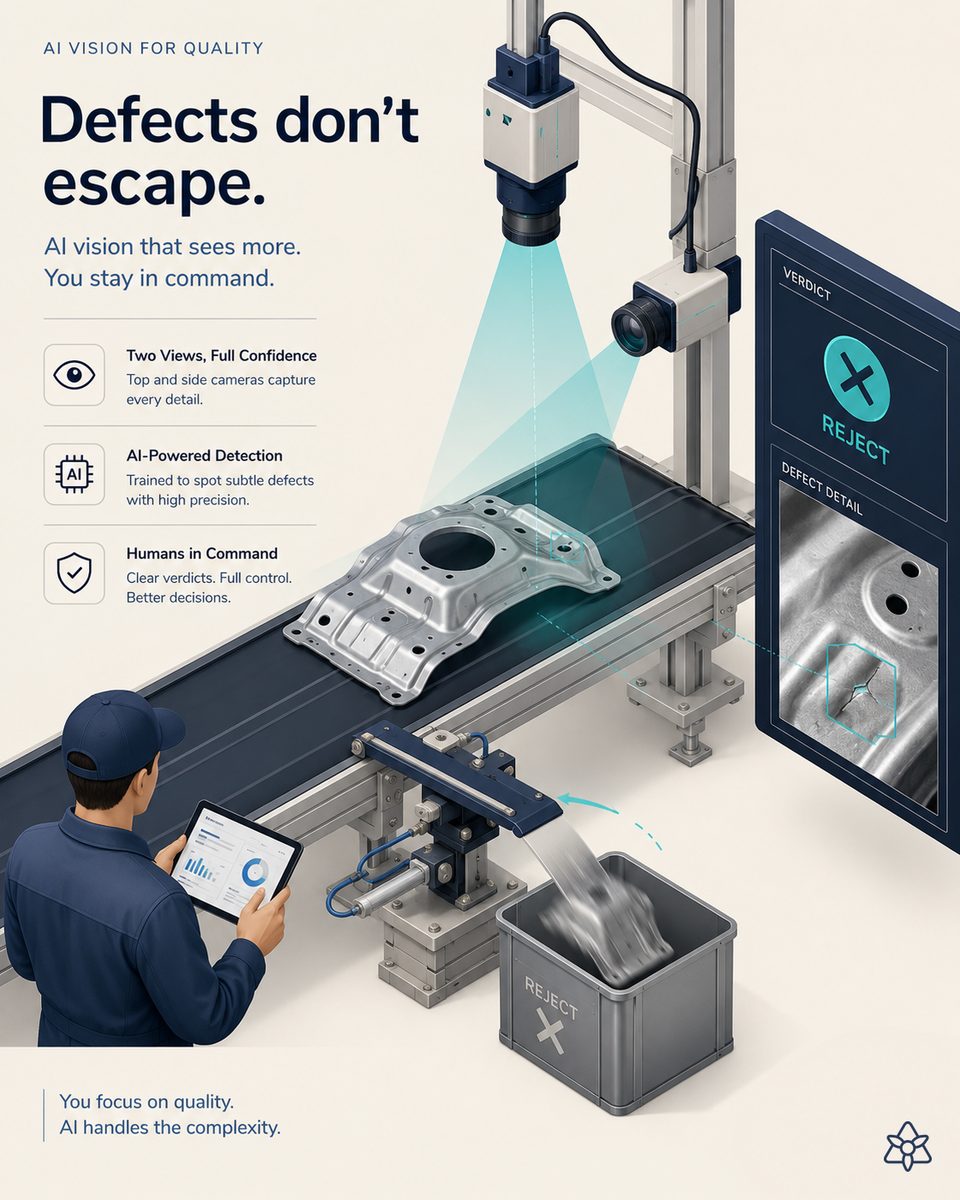
- Edge — cameras with controlled lighting over the sewing area and over the finished panel. CNNs trained on samples from your own plant recognize material defects (stain, scratch, shade irregularity), stitching defects (skipped stitch, loose thread, puckering, pattern deviation) and die-cutting defects. Verdict in milliseconds, without stopping the line. It works with no network.
- Connect — captures the batch of every roll of leather, fabric or Alcantara that enters the line (whether by digitizing the delivery note, reading a label, or integrating with the warehouse system). It also captures what arrives from outside: the supplier's email flagging a batch change, the SQA notice about a field claim from last week.
- Agent — cross-references shade and stitching with the batch, with that supplier's acceptance history and with the SQA claims. It does not just detect a one-off defect: it detects a batch trend before the panel reaches the dealership. It alerts the quality manager. The person decides whether to accept, to scrap, or to change the cutting direction to minimize the defect.
Visual inspection + field claim vs. AI vision + batch trend
| Aspect | Operator's eye + final review | With iLEAN Edge + Connect + Agent |
|---|---|---|
| Moment of detection | End of shift or field claim | Cell exit, in milliseconds |
| Shade between batches | Verbal, intuition, no traceability | Learned envelope + cross-check with supplier history |
| Defective stitching | Caught in the final review or never | Caught step by step, with a rework flag |
| Field claim | High cost, brand damage | Early warning: suspect batch held before it ships |
| Capturing the veteran's eye | Walks out with the veteran the day they retire | Stays as a trained model, permanently |
| Operation with no network | n/a | Edge keeps running on the light from the panel |
Impact estimate for your plant — to be validated with your numbers.
The block below is an estimate to be validated with the specific data of your plant. We put it forward so the committee has an order of magnitude; we refine it during the diagnostic.
- Plant with automatic cutting + semi-automatic sewing + assembly onto foam/frame, a mix of leather / fabric / Alcantara, at least 20 part numbers in flow.
- Edge pilot in 2 critical cells (post-sewing review + final review before bonding), cameras with controlled lighting and training on your own samples. First value expected within a few weeks.
- Indicative payback between 4 and 9 months, depending on the current frequency of field claims for cosmetic defects and the average cost of rework.
- Hard levers: rework avoided on an already sewn part + field claim avoided (the most expensive one) + a file per seat number for the OEM.
- The automotive quality standard is on the order of 25 PPM [1]: with upholstery in plain sight of the end customer, the real margin is even tighter.
And the interior quality manager's reasonable doubt
“What if the AI mistakes a shadow from the lighting for a defect and scraps a good part?” — hallucination is a problem of free generation, not of anchored tasks. In tasks where the AI classifies an image against patterns trained on your own samples, the best models brought error below 1.5% [2]. And even so, what is critical is never decided alone: the system flags the part for review, the person validates. iLEAN's three safety rings exist precisely for this.
[1] Symestic — automotive quality standard ~25 PPM.
[2] OpenAI paper “Why Language Models Hallucinate”, 2025 — on the reliability of AI in anchored tasks.
Related processes: automotive seat manufacturing · body panel sheet metal defects · digitized OEM CSR.
What people ask about car upholstery control with AI
Which upholstery defects does iLEAN detect?
The ones the veteran operator's eye catches well — but only when it is fresh and the light is good: material defects (stain, scratch, animal mark in leather, shade irregularity in fabric), stitch tension (skipped stitch, loose thread, puckering), panel alignment (crossed panels, seam off the pattern), die-cutting and cutting defects and gaps when assembling onto foam/frame. iLEAN Edge brings cameras with controlled lighting and CNNs trained on your own samples to recognize every pattern on the freshly sewn or freshly assembled part, before it reaches the next cell.
How does it handle shade variation between leather or fabric batches?
Shade is the big problem in upholstery: two panels of the same color can come from different batches and, under the overhead light of the dealership, the end customer sees the difference. iLEAN Connect captures the material batch (whether that is a digitized supplier document, a roll label, or a delivery note) and the agent cross-references it with the plant's acceptance history: “this batch from supplier X, color Y, has been trending darker over the past week”. When a freshly cut part drifts outside the batch envelope, the system raises the alarm before it enters the sewing cell — not after assembly onto the frame.
How is stitching inspected without stopping the line?
With vision at line speed: the camera looks at the freshly sewn seam while the part moves, not stopped. Trained CNNs recognize skipped stitch, loose thread, puckering and pattern deviation. When something drifts, the system flags the part by its scan code and routes it to the rework cell, without slowing down the rest of the line. The operator's visual inspection at the end of the shift stops being the only filter — and the late one.
Does it work with every material (leather, vinyl, technical fabric, microfiber, Alcantara)?
Yes — the trick is that iLEAN learns from the customer's own samples, not from a generic model. Every material reacts differently to the camera: leather reflects differently from vinyl, technical fabric has textures a generic model mistakes for a defect, Alcantara changes shade depending on the nap. The pilot starts with the two or three part numbers at the top of the customer's Pareto (the ones that concentrate 80% of the volume and the scrap) and generalizes from there. It is not the camera vendor's model — it is your model, trained on your material.
How much can rejects come down on an upholstery line?
It depends on the starting point — a plant with homogeneous material from a single supplier and stable operators has less headroom than a plant with several suppliers, a material mix and shift rotation. As a defensible floor to present to the committee: a reduction of shade, stitching and alignment defects of ≥30% in the first months, with the hard lever of rework avoided on a part already sewn and assembled (the most expensive kind). Recovering a bad upholstery part in cell 2 costs a few minutes; recovering it in cell 6, after bonding to foam, means scrapping the whole part. We send you the estimated ROI in 48h with your line's data.
More cases in automotive
- Brake disc and caliper control with AI — the part that cannot afford a single escape.How iLEAN cross-references Edge vision on the disc machining line, critical caliper torque and VIN…
- Car air conditioning control with AI — an R-1234yf leak is not an incident, it is a regulated cost.How iLEAN joins Edge vision, refrigerant tightness and compressor/condenser/evaporator traceability to…
- Car hydraulic lines with AI — a line that passes the leak test can be a leak six months from now.How iLEAN cross-checks bending vision, leak testing and batch traceability to certify automotive…
- KTL/cataphoresis control with AI — the bath drifts hours before the paint fails; finding out in the touch-up booth is too late.iLEAN keeps the KTL bath in spec — pH, temperature, conductivity — and warns you before paint quality…
- Crankshaft machining with AI — the spindle says it long before the metrology room does.How iLEAN anticipates tool wear, spindle vibration and dimensional drift in crankshaft machining —…
- Critical engine and transmission torque with AI — a cylinder head tightened out of sequence is a warranty failure.iLEAN guarantees correct torque, angle and sequence on critical engine and transmission fastenings. No…
Tell us your case and in 48h we'll send you the estimated ROI of this AI project for your upholstery line.
We work on your plant's real data, not ours. Diagnostic with no commitment.
Request estimated ROI in 48h See automotive