Brake disc and caliper control with AI — the part that cannot afford a single escape.
A disc out of thickness or a caliper with torque outside the window is active safety: either you catch it in line, or the customer's workshop catches it. iLEAN cross-references Edge vision on disc machining, real torque from the caliper nutrunners and VIN traceability, and holds the part before it moves on. The person signs — the line does not restart on its own.
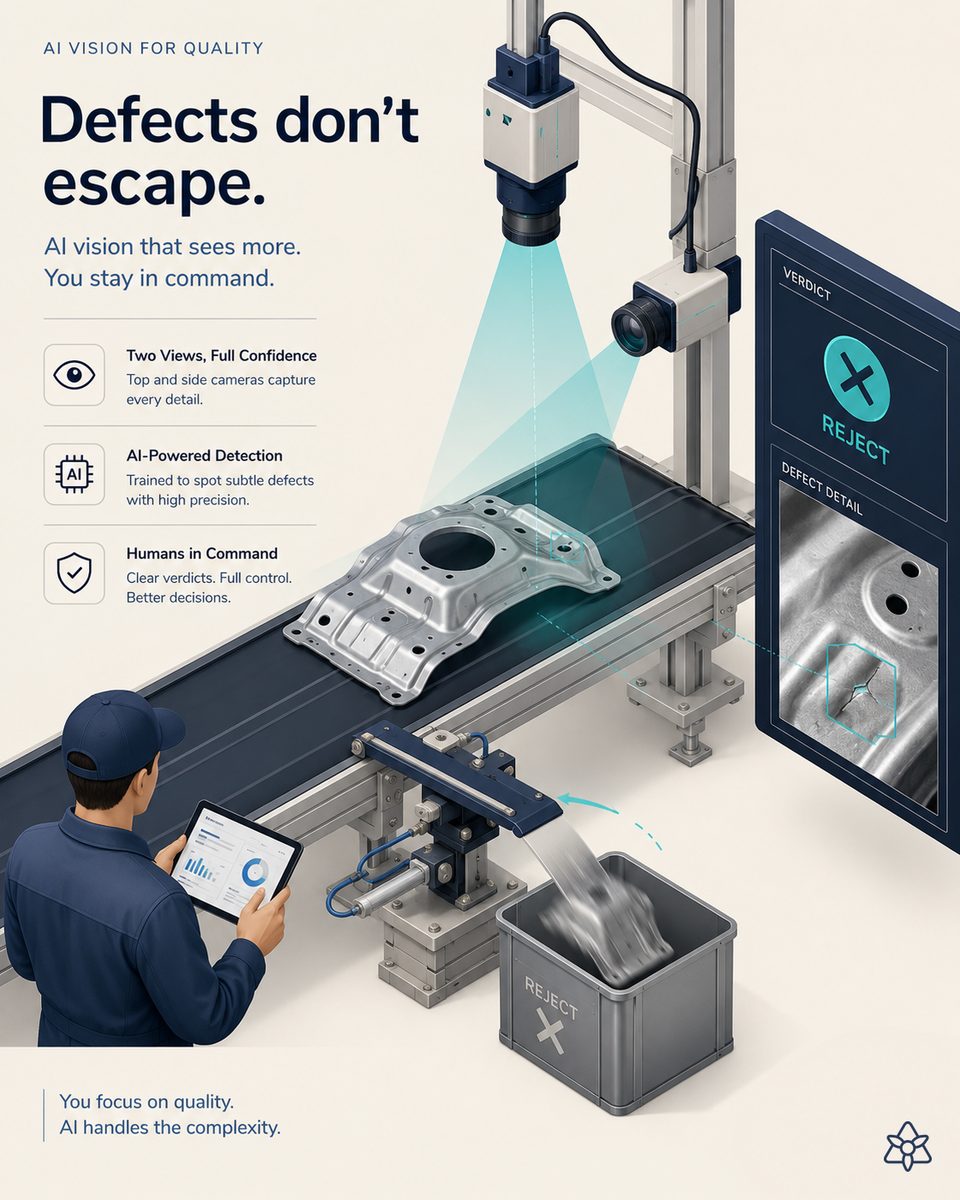
Every disc and every caliper is the Tier 1's signature in front of the OEM.
Controlling the disc and the caliper is not an average-quality problem: it is a long-tail problem. The line runs fine 99.99% of the time. The problem is part number 73,842 in the batch, the one that goes through with a micro machining defect in the run-out, or the one that comes off the nutrunner with torque two tenths below the window because the bolt batch changed and nobody adjusted the expected curve.
- The disc — the turning/grinding line holds tight tolerances (DTV, run-out, minimum thickness of the braking band). The operator inspects by sampling. What happens between one sample and the next is unknown — and the line takt leaves no room to stop and count.
- The caliper — assembly tightens guide bolts, knuckle fixing bolts and, on hydraulic calipers, the fitting. Each operation has a target torque and angle set by the carmaker's manual. The nutrunner knows the value; the ERP never receives it, or receives it in a spreadsheet that lands at the end of the shift.
- Traceability — the OEM asks for history by VIN for every active safety component. If there is a recall tomorrow, you have to reconstruct which disc, from which melt number, ended up in which vehicle. With no system, that means a spreadsheet and a week of the quality team's time.
The classic system (operator + sampling + checklist + a nutrunner with its own screen) works 99.99% of the time. The 0.01% is what reaches the end customer and, if it turns into a pattern, the recall. The difference between a Tier 1 that renews its contract and one that goes into OEM escalation is that 0.01%.
iLEAN does not add a fourth system — it seals the cracks between the lathe, the nutrunner and the ERP.
Disc and caliper control does not fail for lack of data: it fails because the lathe's data, the nutrunner's data and the OEM specification each live on their own island and nobody cross-references them in real time. iLEAN is the putty that fills that gap without asking you to change lathe, nutrunner, MES or ERP.
Edge sees every disc as it leaves the lathe. Connect captures the nutrunner torque at second zero. The agent cross-references it with the OEM specification and holds the part if something does not add up. The person signs — never the other way round.
The three iLEAN pieces applied to brake disc and caliper control:
- Edge — a terminal with machine vision (CNN) over the disc machining line. It inspects 100% of parts as they leave the lathe: run-out, DTV, porosity, surface damage. It acts on the ejector in milliseconds. It works with no network: if the plant loses WiFi, the detect-and-eject cycle keeps running, because what is critical cannot depend on connectivity.
- Connect — captures torque and angle for every nutrunner operation (Atlas Copco, Stanley, Bosch) through whatever channel already exists (OPC-UA, local file, direct integration). It also captures the supplier's bolt batch (the change-notification email, the delivery note) and the latest revision of the OEM specification that arrived by email from the customer. It unifies all of it at second zero.
- Agents — continuously cross-reference the lathe data, the nutrunner torque, the bolt batch, the disc melt number, the VIN of the destination vehicle and the OEM specification in force. If there is a deviation, they hold the part before it moves to the next station and alert the quality engineer. And they build, without anyone asking, the file by VIN that the OEM requests in any IATF 16949 audit.
Sampling-based control vs. 100% in-line control with iLEAN
| Aspect | Classic control (sampling + checklist) | With iLEAN Edge + Connect + Agents |
|---|---|---|
| Disc coverage | Sampling every N parts, gauge/projector | 100% inspected in line, in milliseconds |
| Critical caliper torque | Nutrunner screen, spreadsheet at end of shift | Captured at second zero, checked against the expected curve |
| Bolt batch change | Email notice, risk of not updating the curve | Connect captures the notice, the agent recalibrates the window |
| Traceability by VIN | Manual reconstruction in a recall, days | Automatic file per part, audit-ready |
| Operation without network | n/a | Edge keeps inspecting on cabinet power |
| IATF 16949 documentation | A folder and many hours of the quality engineer | Dossier by batch and by VIN, continuously |
Impact estimate for your plant — to be validated with your numbers.
The block below is an estimate to be validated with the specific data of your plant. We put it forward so the committee has an order of magnitude; we refine it during the diagnostic.
- Tier 1 with one disc machining line + one caliper assembly line, exporting to a European carmaker with active PPM escalation and IATF 16949 requirements.
- Edge pilot at the disc lathe output + Connect integration with the caliper's smart nutrunner + an agent building the file by VIN. First value expected within a few weeks.
- Indicative payback between 4 and 9 months, depending on the historical frequency of OEM returns and the average cost of rework/return.
- The hard lever is not theoretical PPM — it is a single recall campaign avoided or an OEM escalation reversed. Either one pays for the pilot and the next two years of operation.
And the OEM standard
The automotive quality standard for critical components sits in the order of 25 PPM[1] — 25 defective parts per million produced. Holding that with a human audit at the end of the line is not feasible: the brain gets tired, the takt never stops. AI in anchored tasks (reading a part, comparing it against the specification) has error rates below 1.5% in the best models[2], and even so it does not decide alone — it holds and asks for a human signature. The three safety rings are there precisely for this.
[1] Symestic — automotive quality standard in the order of 25 PPM for critical components.
[2] OpenAI paper “Why Language Models Hallucinate”, 2025 — on the reliability of AI in anchored tasks.
What people ask about brake disc and caliper control with AI
What critical defects can an AI detect in a brake disc?
In line, the main ones are: disc thickness variation (DTV), run-out deviation, porosity in the braking band, burrs at the hub center and surface damage after grinding. iLEAN Edge with vision (CNN) inspects the disc as it leaves the lathe, measures in real time and ejects any part out of tolerance before it reaches balancing. A part that is out is not argued over and not recycled by downgrading its criticality — it is separated and documented for the quality engineer.
How is critical torque controlled when assembling the brake caliper?
The caliper has two critical torques: the guide bolts and the bolts fixing it to the knuckle/steering carrier. IATF 16949 and the carmakers' assembly manuals require torque and angle to be recorded for every operation, by VIN. iLEAN Connect captures the data straight from the smart nutrunner (Atlas Copco, Stanley, Bosch) without the operator having to write anything down, and an Agent compares the real torque against the expected curve for that batch of bolt plus thread. If the torque falls outside the window, it holds the part before it moves to the next station.
What quality level do carmakers demand on brake parts?
For active safety components, OEMs work to targets in the order of 25 PPM (defective parts per million) or below. That means that out of a million discs or calipers shipped to the customer, no more than 25 may carry a defect. Achieving it with a human audit at the end of the line is no longer viable: the human brain gets tired, the takt never stops. iLEAN turns every part into a 100% in-line inspection, and leaves the quality engineer the work that matters: fixing the root cause when it appears, not counting bad parts.
Can iLEAN integrate with presses, lathes and nutrunners that are already installed?
Yes — that is exactly the putty metaphor. iLEAN does not force you to replace the disc lathe or the caliper nutrunner. Connect reads whatever is already there (PLC signals, OPC-UA, Modbus, the nutrunner's local file, an HMI panel photographed by the operator if that is what it takes) and puts it into the system. Edge is installed as one more terminal on the line, connected to the existing IoT. If the plant loses its network, the detect-and-eject cycle keeps running — what is critical cannot depend on WiFi.
How long before an Edge pilot on a brake line shows its first savings?
On comparable in-line quality projects in automotive, first value shows up within a few weeks — a real capability running, not a demo. The full pilot line is typically operational in around 60 days. The estimated payback, to be validated with your data, sits between 4 and 9 months, and the hard lever is not theoretical PPM but the cost of a single OEM return or, in the worst case, a recall campaign avoided. We ask for your plant's data and send you the estimated ROI in 48h, with your numbers.
Related topics in automotive: Shock absorber and suspension control · Alloy wheel control · Wheel ABS sensor control.
More cases in automotive
- Bi-color wheel painting with AI — a mist on the transition is the most expensive part of the day.How iLEAN cross-references masking vision, booth parameters and the color transition line to avoid…
- Visual defects on body panels — deflectometric light, an eye that never tires, on every part.iLEAN Vision detects dents and scratches on body panels with deflectometric lighting. 100% inspection,…
- Torque traceability by bolted joint — a badly tightened fastener is not a penalty, it is a mass recall.iLEAN stores the torque and angle value of every critical bolted joint together with its part and its…
- Car air conditioning control with AI — an R-1234yf leak is not an incident, it is a regulated cost.How iLEAN joins Edge vision, refrigerant tightness and compressor/condenser/evaporator traceability to…
- Car hydraulic lines with AI — a line that passes the leak test can be a leak six months from now.How iLEAN cross-checks bending vision, leak testing and batch traceability to certify automotive…
- Car upholstery with AI — the shade and the stitching are caught the first time, or they are caught at the dealership.How iLEAN inspects leather, fabric and stitching in car upholstery with AI vision, anticipates shade and…
Tell us your case and in 48h we'll send you the estimated ROI of this AI project for your brake line.
We work on your plant's real data, not ours. Diagnostic with no commitment.
Request estimated ROI in 48h See automotive