ABS wheel sensor control with AI — the active safety part where PPM tends to zero.
The ABS sensor is an active safety part: a PPM here is a field risk, not a cosmetic issue. iLEAN Edge sees the overmolded geometry, the encapsulation and the connector polarity before electrical end-of-line, and an agent builds the PPAP/IATF dossier per batch. The person signs — the carrier does not move on its own.
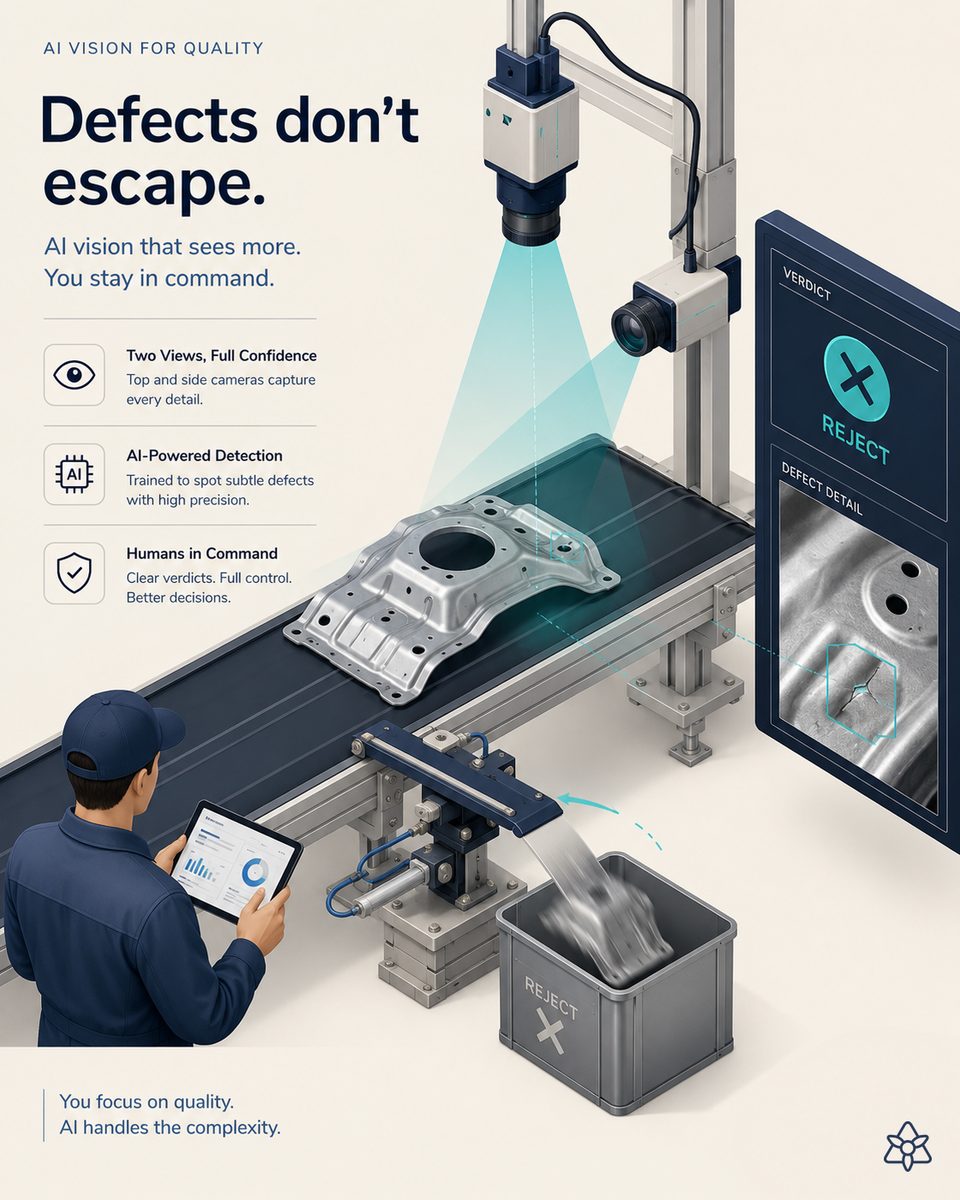
The part where a defect is not scrap — it is product liability.
The ABS sensor is not just another brake component: if it fails in the field, ABS is disabled and ESP/ESC goes into degraded mode. For the OEM, that means this part lives with a different level of scrutiny:
- Overmolded geometry — the air-gap area has tight tolerances. Minimal flash on the overmold changes the sensor's response to the tone wheel.
- Encapsulation and sealing — a pore invisible to the eye lets water and salt in out in the field. The sensor dies six months later, in the middle of winter, far from your plant.
- Connector polarity — a reversed assembly passes the static electrical bench, but throws an error code the first time the car is started.
- Magnet and Hall traceability — a magnet batch change or a Hall chip wrongly assigned turns an 8D into a recall call.
The operator knows it. So does the quality manager. And even so, the classic system (visual + electrical end-of-line) works 99% of the time. That 1% is what the OEM does not forgive in active safety.
iLEAN does not replace electrical end-of-line — it takes load off it and gives it context.
The typical ABS sensor defect is not electrical, it is geometric or in the encapsulation. And the information the control needs (BOM, magnet batch, overmolding window, variant changeover) lives on islands and does not reach the decision-maker in time. iLEAN acts as the putty between the line, the ERP, the MES and end-of-line.
Edge sees the part before the electrical bench. Connect reads the BOM and the magnet batch wherever they live. The agent cross-references with the variant and builds the dossier. The person signs — never the other way round.
The three iLEAN pieces applied to ABS sensor control:
- Edge — a terminal with machine vision (CNN) over the carrier leaving the overmolding station. It verifies body geometry, cable length, and the presence and orientation of the connector. Where applicable, dedicated lighting to detect pores in the encapsulation. It triggers the actuator in milliseconds. It works without a network.
- Connect — captures the BOM, the magnet batch and the overmolding window whether they come from the ERP, the MES or the sheet for the new SKU. And it captures what arrives from outside (an OEM email with a tolerance change, a note from the magnet supplier about a dimensional change) at second zero.
- Agent — cross-references the BOM, the line's history, the image of the sensor and the traceability data. If there is a deviation, it holds the part and builds the file — photo, batch, shift, magnet and Hall batches, operator. The person validates and signs; the carrier does not move on its own.
Classic control vs. cross-referenced control with iLEAN
| Aspect | Visual + electrical EOL | With iLEAN Edge + Connect + Agent |
|---|---|---|
| Flash in the air-gap area | Passes if the electrical response is within band | Detected by geometry before EOL |
| Encapsulation pore | Invisible to the eye, shows up in the field | Dedicated lighting + CNN |
| Connector polarity | Found in the field (too late!) | Verified in line by image |
| Magnet / Hall batch | Manual traceability, an Excel sheet | Linked to the batch by the agent |
| PPAP/IATF dossier | Rebuilt by hand, weeks of work | Automatic per batch, with photos |
| Response to the OEM's RDR | Days | Seconds |
Impact estimate for your plant — to be validated with your numbers.
The block below is an estimate to be validated with the specific data of your plant. We put it forward so the committee has an order of magnitude; we refine it during the diagnostic.
- Tier-1 brake sensor plant, 2-4 active variants, overmolding + assembly + electrical EOL on the same line.
- Edge pilot over the carrier leaving the overmolding station (camera + lighting + actuator + integration with the ERP/MES BOM and the magnet batch). First value expected within a few weeks.
- Indicative payback between 4 and 9 months, driven by the avoided cost of a single 8D return and by the reduction in field risk (on an active safety part, that lever carries a lot of weight).
- Expected reduction in geometric and encapsulation defects of ≥30% in the first quarter and ≥80% by the sixth month, according to the catalog Pareto.
The industry standard and the reliability of anchored AI
In automotive the standard is on the order of 25 parts per million defective [1]. On an active safety part such as the ABS sensor, the OEM pushes even lower. A CNN-equipped camera reaches where the eye cannot.
On the reliability of AI: hallucination is a problem of free generation, not of anchored tasks. In tasks where the AI merely recontextualizes a piece of data (reading the part and comparing it with the BOM), the best models brought error below 1.5% [2]. And even so, on an active safety part, what is critical is never decided alone: iLEAN holds the part and the person signs. The three rings exist precisely for this.
[1] The 25 PPM standard in automotive quality — Symestic.
[2] OpenAI paper "Why Language Models Hallucinate", 2025 — on the reliability of AI in anchored tasks.
What people ask about ABS wheel sensor control with AI
Why is an ABS wheel sensor critical for the OEM?
Because it is an active safety part: if the sensor on one wheel fails, ABS is disabled and ESP/ESC goes into degraded mode. That turns any field PPM into a homologation and product liability variable. The OEM demands PPM tending to zero, with a complete batch dossier, and an 8D here costs several times more than on a cosmetic part.
What defects typically appear on a passive or active ABS sensor?
Three families: geometry (overmolding with flash in the air-gap area, cable exit length out of tolerance, reversed connector polarity), encapsulation (a pore or a sealing gap that lets moisture in and kills the sensor in the field) and traceability (the magnet batch or the Hall sensor batch wrongly assigned during a variant changeover).
How does iLEAN Edge verify geometry and encapsulation?
Edge is a terminal with vision (CNN) and, where applicable, dedicated lighting for encapsulation (UV/IR). It verifies the geometry of the overmolded body, the presence and orientation of the connector, the cable length and, if there is a polarity mark, its orientation. It cross-references the part with the batch BOM that Connect has read from the ERP. If something does not add up, it holds the part before electrical end-of-line.
How does it integrate with the PPAP/IATF dossier and the OEM's RDR?
An agent builds the dossier per batch: a photo of the overmolded body, a photo of the connector, the magnet batch, the Hall batch, time, line, the operator who signed and the result of every check. The file is available for audit and for the OEM's RDR without anyone rebuilding it by hand. If the OEM opens an 8D, the agent delivers the batch and the image in seconds.
How much does an Edge pilot for an ABS sensor cost?
The order of magnitude of an Edge pilot on an ABS sensor line is close to that of any industrial Edge pilot: terminals + cameras + actuator + integration with ERP/MES, plus an annual license. A reasonable payback to present to the committee is several months — and on an active safety part the hard lever is eliminating field risk, far more than saving scrap. We ask for your data and send you the estimated ROI in 48h.
More cases in automotive
- AI control of vehicle rear camera modules — the module passes the functional test, fails in the field, and the OEM returns the whole batch.iLEAN checks optical alignment and seal quality on 100% of rear camera modules at end of line and ties…
- Automotive water pump control with AI — the coolant leak starts in the second of assembly.How iLEAN cross-references Edge vision, flow testing and vibration signature to catch leaks, faulty…
- Digital 5S on the assembly line — the standard drifts between audits; finding out on the next monthly walk is too late.iLEAN sustains 5S between audits: gemba walk with photo and voice, verification of the workstation…
- ADAS radar manufacturing control with AI — final calibration passes the radar, but the result was decided upstream.iLEAN verifies ADAS radar assembly before closing, stitches every calibration to the serial number and…
- AI aftermarket part packaging — the right box costs little; the wrong one costs you a rating on Amazon.How iLEAN cross-references kit vision, label reading and the ERP part number to prevent returns for the…
- Airbag assembly control with AI — a defect is not scrap, it is a recall of the whole series.iLEAN combines Edge vision on airbag assembly, critical tightening torque and batch-to-VIN traceability…
Tell us your case and in 48h we'll send you the estimated ROI of this AI project for your ABS sensor line.
We work on your plant's real data, not ours. Diagnostic with no commitment.
Request estimated ROI in 48h See automotive