Digital 5S on the assembly line — the standard drifts between audits; finding out on the next monthly walk is too late.
The 5S of an assembly line degrades in days and gets audited in months. iLEAN sustains it between audits: Connect captures the gemba walk with photo and voice, Edge verifies the workstation standard in the critical areas — locations and objects, never people — and the Agents carry the action plan through to closure.
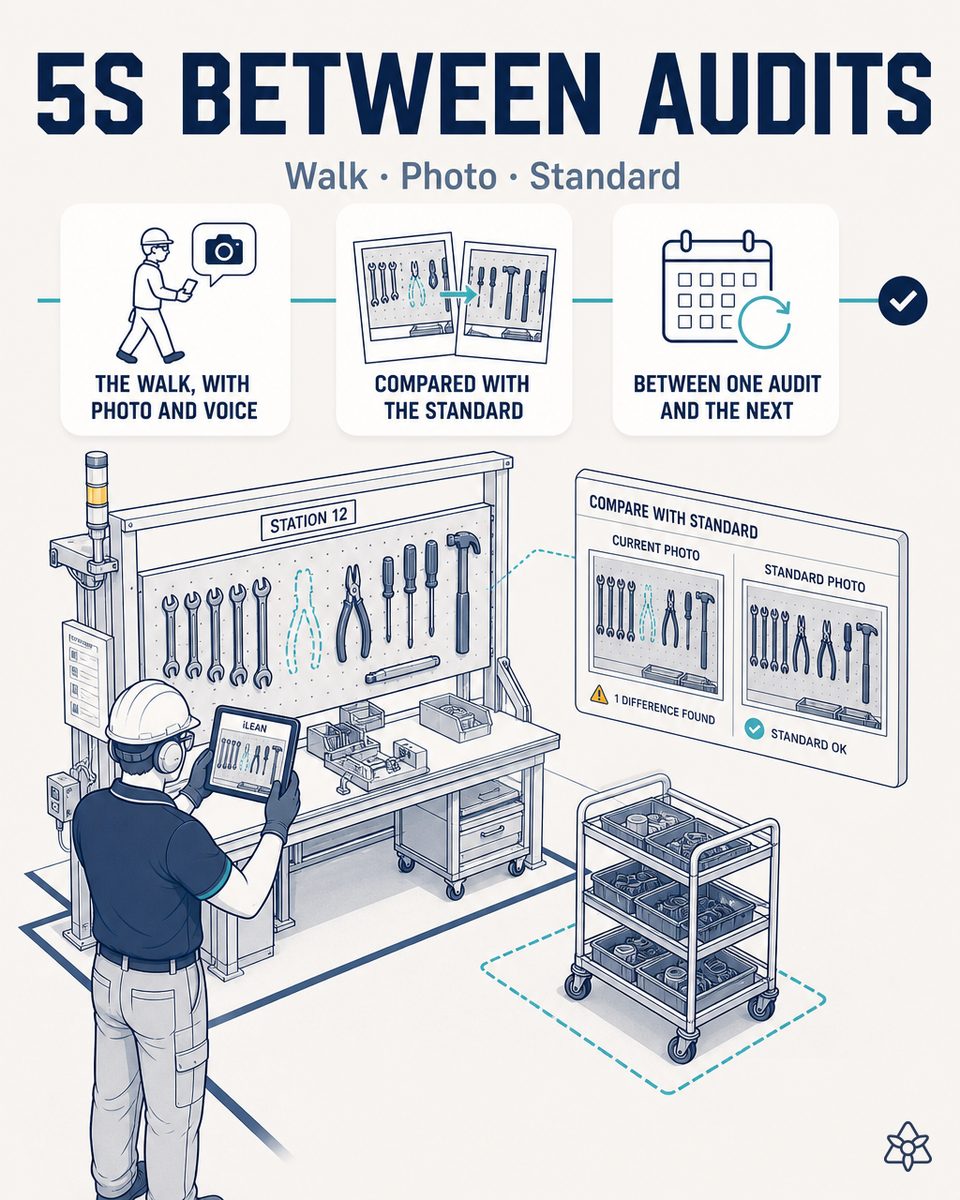
The audit is monthly — the standard drifts daily.
The production manager of an assembly line knows it by heart: the 5S audit is done with a paper checklist, once a month, area by area. On walk day everything gets tidied up; the score comes out respectable; the action plan gets written down. And a few days later reality returns: the torque tool is working outside its shadow, the internal logistics aisle wakes up blocked by containers, unidentified material shows up next to workstation 14. Nobody logs it — not because it cannot be seen, but because the next walk is three weeks away.
Three things happen at once on a real line and the paper checklist solves none of them:
- The standard drifts between audits and nobody sees it in time — the degradation is gradual (one location not respected today, two tomorrow) and only becomes visible, all at once, on the next monthly walk. By then it is the area's normal.
- The photo evidence lives on each auditor's phone — everyone with their own camera roll, their own criteria and their own way of naming findings. When someone needs to compare the state of an area between two walks, the evidence is missing or cannot be found.
- The action plan gets lost in a spreadsheet — it is filled in with good intentions on audit day, assigned “to the area” rather than to a person with a date, and the next walk arrives with half the actions still open and nobody having flagged it.
The result is a 5S that gets rebuilt before every audit instead of holding between audits. The plant pays twice: the hours spent getting everything ready for the walk — or for the customer visit — and the daily micro-stoppages spent hunting for a tool or a material that is not where the standard says it should be.
iLEAN does not digitize the checklist — it sustains the workstation standard.
Moving the checklist from paper to an app solves very little: the walk is still monthly and the drift is still daily. iLEAN attacks the three cracks at once — capture with friction, invisible drift and the orphaned action plan — with three pieces that already exist in the IRIS architecture, without changing your audit system or your 5S standard.
Connect captures the walk with photo and voice. Edge verifies the workstation standard in the critical areas — objects and locations, never people. The Agents turn every finding into an assigned action and follow it through to closure.
The three iLEAN pieces applied to 5S on an assembly line:
- Connect — the gemba walk with no friction. The auditor walks the line with their phone or tablet: a photo of the finding and a voice note (“iLEAN, log this: torque tool out of location at workstation 14”), and the finding is recorded with area, workstation, evidence and date on the spot, not back in the office two hours later. The evidence stops living in each auditor's personal camera roll and moves into the shared history of the area.
- Edge — fixed cameras in the critical areas of the line (shadow boards, logistics aisles, material areas) that verify the workstation standard between walks: tool locations respected, aisles clear, material identified. Verification of the workstation standard, never of people: the vision model works on objects and locations, with no biometric identification and no individual metrics — the iLEAN principle is to assist and simplify the work, not to control it. It works locally: if the plant loses its network, Edge keeps verifying and recording. What is critical does not depend on WiFi.
- Agents — every finding (from the Connect walk or from an Edge detection) becomes an action with an owner and a date, gets assigned, gets chased and is followed through to closure with evidence. The agents also maintain the drift history by area: which areas degrade fastest, which type of finding repeats, which actions close first time and which ones come back. The agent proposes and chases; the person decides and closes.
5S with a paper checklist vs. 5S with iLEAN
| Aspect | Paper checklist + spreadsheet | With iLEAN Connect + Edge + Agents |
|---|---|---|
| Capturing the walk | Paper on the floor, written up in the office | Photo + voice with Connect, recorded on the spot |
| Drift between audits | Invisible until the next monthly walk | Edge detects it the day it starts |
| Photo evidence | In each auditor's phone camera roll | History by area, searchable in seconds |
| Action plan | Spreadsheet, assigned “to the area”, no follow-up | Action with owner and date, tracked to closure |
| Audit time | Hours per area, evidence to be rebuilt | ≥50% less (estimate to be validated) |
| Dossier for an IATF / customer audit | A photo folder and a spreadsheet from the week before | Traceable finding-action-closure history, automatic |
Impact estimate for your plant — to be validated with your numbers.
The block below is an estimate to be validated with the specific data of your plant. We put it forward so the committee has an order of magnitude; we refine it during the diagnostic.
- Typical starting scenario: assembly line at an automotive supplier, monthly 5S audit with a paper checklist, photo evidence scattered across phones, action plan in a spreadsheet with irregular closure, and a “rebuild” of 5S before every audit or customer visit.
- Pilot in two phases: Connect first (the digital gemba walk works from week one, with nothing installed on the line) and Edge afterwards in 2-3 critical areas agreed with production and the works council — the framing documented before the first camera goes up.
- Audit time ≥50% lower (estimate to be validated): the evidence is already captured when the walk comes around, and the auditor confirms instead of rebuilding.
- The underlying change: 5S holds between audits instead of being rebuilt before each one — drift by area is seen the day it starts, and the action goes out assigned that same day.
- Indicative payback between 4 and 9 months (estimate to be validated). The levers: auditor hours freed up, fewer micro-stoppages spent hunting for tools and material, and evidence ready for IATF and customer audits with no weeks of preparation.
- A recurring benefit that does not go into the ROI but carries weight: the drift history by area stays as a permanent capability of the plant — you know which areas degrade, by what pattern and which actions come back, and that survives any turnover of auditors.
And the reasonable doubt from the works council and the production manager
“Isn't pointing cameras at the line a way of controlling people?” — it is the first correct question, and the answer lies in the design, not in a promise. Edge verifies the workstation standard: objects and locations — that the tool is in its shadow, that the aisle is clear, that the material carries identification. Never people: no biometric identification, no individual metrics, no comparisons between operators; the framing of every camera is agreed with production and with the works council before it is installed, and what it looks at and what it does not is documented. The iLEAN principle is the same across every piece: assist and simplify the work on the line, not control it. And when Edge detects drift, the alert goes to the area's action plan — to fix the cause (a badly sized location, a logistics flow that spills into the aisle) — not into someone's file.
What people ask about digital 5S on the assembly line
Do the cameras record the operators?
No — and that is the design red line. iLEAN Edge verifies the workstation standard: that the tool is in its marked location, that the aisle is clear, that material carries identification. The framing and the vision model work on objects and locations, not on people: no biometric identification, no individual metrics, no comparisons between operators. The iLEAN principle is to assist and simplify the work on the line, not to control it. The framing of every camera is agreed with production and with the works council before the first one is installed, and what it looks at and what it does not is documented.
How is the gemba walk captured?
With iLEAN Connect, from the auditor's phone or tablet and with no friction: a photo of the finding and a voice note — “iLEAN, log this: torque tool out of location at workstation 14” — and the finding is recorded with area, workstation, evidence and date. No going back to the office to write the checklist up cleanly: the walk is closed on the floor. The photo evidence stops living in each auditor's camera roll and moves into the area's history, where the next auditor — and the agent doing the follow-up — find it in seconds.
Does it replace the monthly 5S audit?
It does not replace it: it sustains it. The periodic audit remains the management ritual that sets the level; what changes is what happens between audits. Edge detects standard drift in the critical areas the same day it happens — a tool out of its location, an aisle blocked, unidentified material — and the agents turn it into an assigned action with an owner and a date. The practical result: the walk stops finding a plant “rebuilt the week before” and starts confirming a standard that has held, and audit time drops by ≥50% (estimate to be validated) because the evidence is already captured by the time the auditor arrives.
Does it work as evidence for IATF or customer audits?
Yes — it is one of the benefits that carries the most weight in automotive. Every finding is stored with photo, date, area, assigned action and verified closure, and the drift history by area can be pulled up in seconds. When the IATF 16949 auditor or your customer's auditor asks for evidence that 5S is a living system and not a monthly event, the dossier comes out of the history — not out of a photo folder and a spreadsheet rebuilt the week before. Finding-action-closure traceability, with who, when and with what evidence, is exactly the kind of documentary discipline those audits examine.
What payback does a digital 5S have?
As an order of magnitude — and always as an estimate to be validated with your plant's data — between 4 and 9 months. The levers: auditor hours freed up (≥50% less walk time, estimate to be validated), fewer hunts for tools and material that interrupt the line, and a lower cost of rebuilding 5S before every audit or customer visit. There is one benefit that does not go into the calculation but decides it: the standard holds between audits, and drift by area is seen the day it starts, not three weeks later. We send you the estimated ROI in 48h with the real numbers of your line.
More cases in automotive
- Part-to-VIN traceability in tier-1 — from the material batch to the car, without adding one more scan on the line.iLEAN joins batch, part and the final car's VIN. Full IATF 16949 traceability, from material receipt to…
- AI control of vehicle rear camera modules — the module passes the functional test, fails in the field, and the OEM returns the whole batch.iLEAN checks optical alignment and seal quality on 100% of rear camera modules at end of line and ties…
- Automotive water pump control with AI — the coolant leak starts in the second of assembly.How iLEAN cross-references Edge vision, flow testing and vibration signature to catch leaks, faulty…
- ABS wheel sensor control with AI — the active safety part where PPM tends to zero.How iLEAN verifies ABS wheel sensor geometry, encapsulation and connector polarity in line with Edge and…
- ADAS radar manufacturing control with AI — final calibration passes the radar, but the result was decided upstream.iLEAN verifies ADAS radar assembly before closing, stitches every calibration to the serial number and…
- AI aftermarket part packaging — the right box costs little; the wrong one costs you a rating on Amazon.How iLEAN cross-references kit vision, label reading and the ERP part number to prevent returns for the…
Tell us your case and in 48h we'll send you the estimated ROI of this digital 5S project for your assembly line.
We work on your plant's real data, not ours. Diagnostic with no commitment.
Request estimated ROI in 48h See automotive