ADAS radar manufacturing control with AI — final calibration passes the radar, but the result was decided upstream.
A radar that calibrates "just barely" today can drift out of calibration with the first thermal cycle. iLEAN verifies antenna and assembly on 100% of units before closing with Edge, stitches every calibration curve to the serial number with Connect and detects process drift with JIDOKA AI before the rejects start. The person decides what to correct.
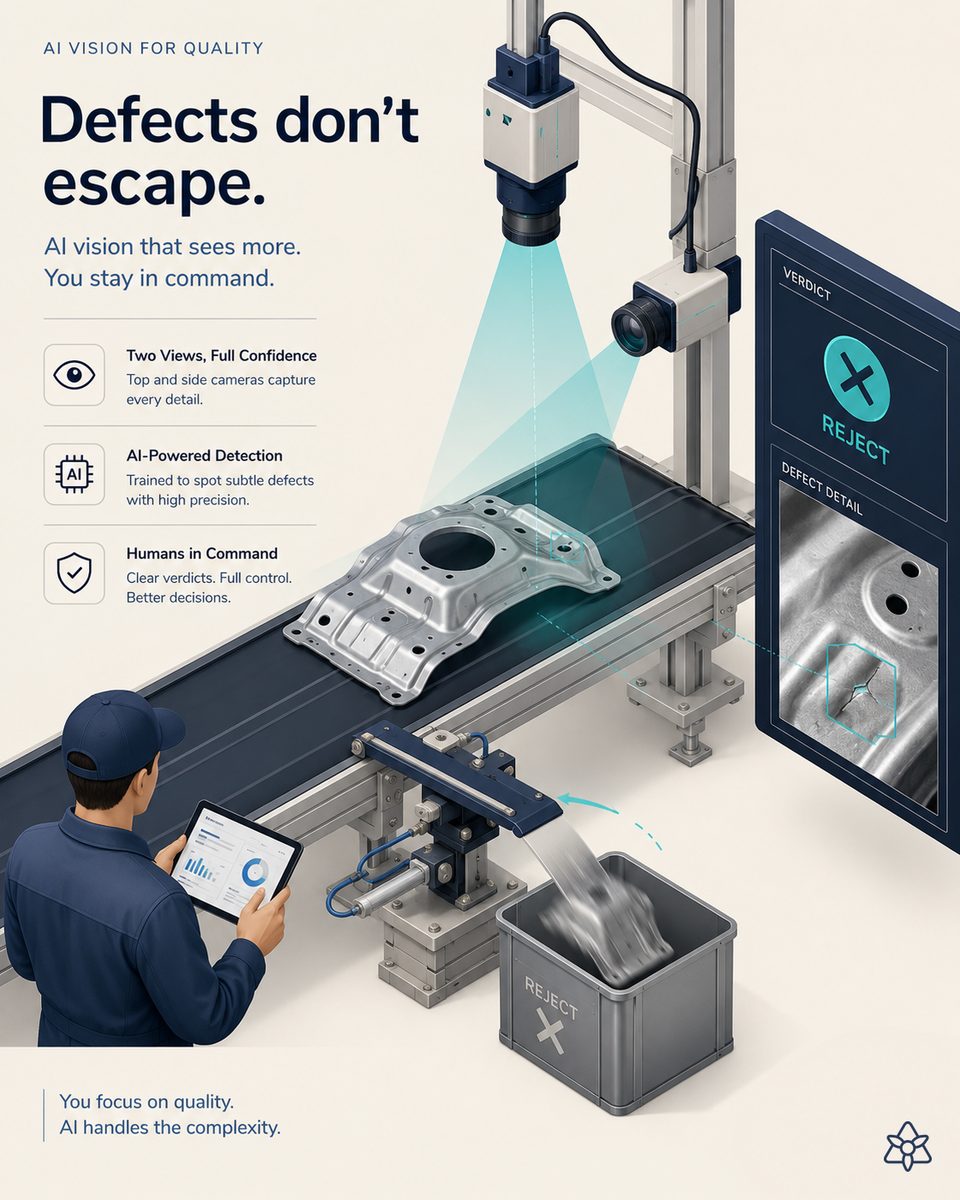
The RF chamber passes the radar — but it cannot see why it calibrated at the limit.
Radar is a safety component: emergency braking and adaptive cruise control depend on it. And in manufacturing, everything converges on a single point: final calibration in the RF chamber, the bottleneck of the line. Every unit goes in, is calibrated against a reference and comes out with a pass or a fail. The problem is that this result is not decided in the chamber — it is decided in everything that came before: the antenna position on the PCB, the housing torque, the radome tolerances.
Three things happen at once on a real radar line, and almost nobody puts them together:
- The assembly defect is discovered late and expensively — an antenna rotated half a degree or a housing closed with uneven torque is invisible once the unit is sealed. It shows up as a poor calibration in the chamber, when the radar is already finished and rework costs the most.
- Today's "just barely passed" is tomorrow's field failure — a radar that calibrates hard against the limit can drift out of calibration with vibration and thermal cycling. A binary pass/fail cannot tell a robust unit from a marginal one, and process drift (calibrations creeping ever closer to the limit) triggers no alarm at all until the rejects start.
- Safety traceability demands what the line does not keep together — reconstructing the complete process of every unit: assembly, torques, radome batch, calibration curve. When the audit or a field problem arrives, the file has to be stitched together by hand, system by system, and containment ends up covering the entire batch.
The outcome is always the same: the calibration chamber acts as the only barrier, rejects appear when the drift has already been running for hours, and the knowledge of why this part number calibrates worse after a batch change lives in the head of the line technician. The day they move to another shift or another company, it leaves with them.
iLEAN does not replace the calibration chamber — it joins what the line keeps apart.
The ADAS radar problem is not a lack of equipment: the line already has vision at some stations, nutrunners that log torque and an RF chamber that measures precisely. The problem is that each piece of data lives on its own island and the calibration result arrives without the context that explains it. iLEAN acts as the putty that joins assembly vision, torques, radome batch and the calibration curve of every unit, without asking you to change the chamber or the layout of the line.
Edge verifies assembly on 100% of units before closing. Connect stitches every calibration to the serial number. JIDOKA AI detects drift before the first reject. Agents keep the file for every unit. The person decides what to correct.
The four iLEAN pieces applied to ADAS radar manufacturing control:
- Edge — vision at the station before closing: antenna position and rotation on the PCB, housing seating and torque, radome condition. On 100% of units, not by sampling, because the assembly defect that slips through today is the poor calibration twenty minutes from now. It runs locally: if the plant loses the network, Edge keeps verifying and recording. What is critical does not depend on WiFi.
- Connect — integration with the RF calibration chamber and the rest of the stations: it stitches every calibration curve (power, phase, pattern by angle) to the unit's serial number, together with what vision saw and the torques applied. Pass/fail stops being an isolated data point and gains the full context of the process.
- JIDOKA AI — analyzes the distribution of calibrations continuously and compares it with the line's history for that part number. It detects process drift — calibrations creeping toward the limit, all of them passing — and flags it before the rejects start, pointing to what changed upstream. It does not act alone: it proposes, the line lead decides.
- Agents — maintain the file for every unit: verified assembly, torques, batches, calibration curve, reference used. Ready for the safety audit, and ready to narrow down the affected population by real process window when a problem appears in the field.
Classic ADAS radar line vs. control with iLEAN
| Aspect | Final calibration as the only barrier | With iLEAN Edge + Connect + JIDOKA AI + Agents |
|---|---|---|
| Assembly verification before closing | Sampling, or trust in the process | Edge vision on 100% of units |
| Calibration result | Isolated pass/fail in the chamber | Curve stitched to the serial with process context |
| Process drift | Invisible until the first reject | Detected as the population shifts toward the limit |
| Cause of a poor calibration | Unit sealed, cause invisible | Traced to antenna, torque or radome batch |
| Per-unit file for safety | Manual reconstruction, system by system | Automatic, by serial number |
| Containment after a field problem | Whole batches, as a precaution | Population bounded by real process window |
Impact estimate for your plant — to be validated with your numbers.
The block below is an estimate to be validated with the specific data of your plant. We put it forward so the committee has an order of magnitude; we refine it during the diagnostic.
- ADAS radar manufacturing line with final calibration in an RF chamber as the bottleneck, partial or sampling-based assembly verification before closing, and calibration rejects documented over recent months.
- Pilot: Edge with vision at the station before closing + Connect integrating the calibration chamber. JIDOKA AI learns the line's distribution over 4-6 weeks before it starts anticipating. First value expected within a few weeks: the curve-to-serial stitching and the detection of the first drifts show up early, before the model is fully tuned.
- Expected reduction in calibration rejects of ≥30% by attacking drift upstream — estimate to be validated with the real history of your chamber.
- Indicative payback between 5 and 12 months. The hard lever: every unit that does not reject in calibration frees up the bottleneck of the line, and reworking a sealed radar is among the most expensive operations in the process.
- A recurring benefit that does not enter the ROI but carries weight: the per-unit file is ready for the safety audit, and containment after a field problem goes from whole batches to populations bounded by process window.
And the quality manager's reasonable doubt
"What if the AI flags a drift that isn't there and we stop the line for nothing?" — JIDOKA AI does not act on the line by itself. It proposes; the line lead decides; the correction is applied or it is not. Hallucination is a problem of free generation, not of anchored tasks: in tasks where the AI cross-references calibration curves with history and assembly data, the best models brought error below 1.5%[1]. And even so, what is critical goes to the safety rings — JIDOKA AI lives in the outer ring, proposes inward, and any action on the process is signed by a person. Never the other way round.
[1] OpenAI paper "Why Language Models Hallucinate", 2025 — on the reliability of AI in anchored tasks.
What people ask about ADAS radar manufacturing control with AI
What does vision verify before the housing is closed?
The three points that decide whether final calibration will come out well: antenna position on the PCB (offset and rotation relative to the mechanical datum), housing torque and seating (an uneven closure distorts the radiation geometry) and radome condition (thickness and defects that attenuate or deflect the beam). iLEAN Edge does it with vision on 100% of units, before closing — because once the housing is closed, an assembly defect only shows up as a poor calibration whose cause can no longer be seen.
How does it integrate with the RF calibration chamber?
iLEAN Connect hooks into the calibration equipment you already have — RF chamber, test bench, end-of-line station — and stitches every calibration curve to the unit's serial number: power, phase, pattern by angle, cycle time. It does not replace the chamber or change the process; it adds the piece that is usually missing: the calibration result tied to everything that happened to that unit upstream (antenna vision, tightening torques, radome batch). With that stitching, a radar that calibrates right at the limit stops being an isolated data point and becomes a lead with context.
What is calibration drift and how is it detected?
It is the most dangerous pattern on this line: units keep passing, but closer and closer to the limit. None of them triggers an individual alarm — pass/fail stays green — and by the time the rejects start you have spent hours or days building marginal units that can drift out of calibration in the field with vibration or thermal cycling. JIDOKA AI analyzes the distribution of the calibration curves continuously, compares it with the line's history for that part number and flags it when the population shifts toward the limit, before the first reject. The line lead decides on the correction; detection stops depending on someone looking at the right chart at the right moment.
Does it cover the traceability that safety requires?
Yes — it is one of the two levers of the case. Radar is a safety component (emergency braking, adaptive cruise control) and safety traceability requires being able to reconstruct the complete process of every unit: what vision saw before closing, what tightening torques were applied, what calibration curve it produced and against what reference it was calibrated. iLEAN Agents keep that file by serial number, audit-ready, and when a field problem appears they let you narrow down the affected population by real process window — instead of recalling whole batches for lack of data.
How much does it reduce calibration rejects?
It depends on the starting point — a line with partial vision and calibration as the only barrier has more room than one that is already well instrumented. As an order of magnitude, a reduction in calibration rejects of ≥30% is achievable when you attack the upstream cause (assembly verified on 100% of units before closing) and detect drift before the population reaches the limit. It is an estimate to be validated with the real data from your line: indicative payback lands between 5 and 12 months, and we send you the estimated ROI in 48h with your numbers.
More cases in automotive
- Automotive water pump control with AI — the coolant leak starts in the second of assembly.How iLEAN cross-references Edge vision, flow testing and vibration signature to catch leaks, faulty…
- Digital 5S on the assembly line — the standard drifts between audits; finding out on the next monthly walk is too late.iLEAN sustains 5S between audits: gemba walk with photo and voice, verification of the workstation…
- ABS wheel sensor control with AI — the active safety part where PPM tends to zero.How iLEAN verifies ABS wheel sensor geometry, encapsulation and connector polarity in line with Edge and…
- AI aftermarket part packaging — the right box costs little; the wrong one costs you a rating on Amazon.How iLEAN cross-references kit vision, label reading and the ERP part number to prevent returns for the…
- Airbag assembly control with AI — a defect is not scrap, it is a recall of the whole series.iLEAN combines Edge vision on airbag assembly, critical tightening torque and batch-to-VIN traceability…
- Alloy wheel quality control with AI — pull the bad part before plating, not after.How iLEAN cross-references Edge vision over alloy wheel casting and machining, porosity X-ray and…
Tell us your case and in 48h we'll send you the estimated ROI of this AI project for your ADAS radar line.
We work on your plant's real data, not ours. Diagnostic with no commitment.
Request estimated ROI in 48h See automotive