Airbag assembly control with AI — a defect is not scrap, it is a recall of the whole series.
A badly assembled airbag is not scrap: it is a recall of the entire model. iLEAN combines Edge vision on the assembly line, capture of the module's critical tightening torque and batch-to-VIN traceability, and holds the part before it leaves the station when something does not add up. The person signs.
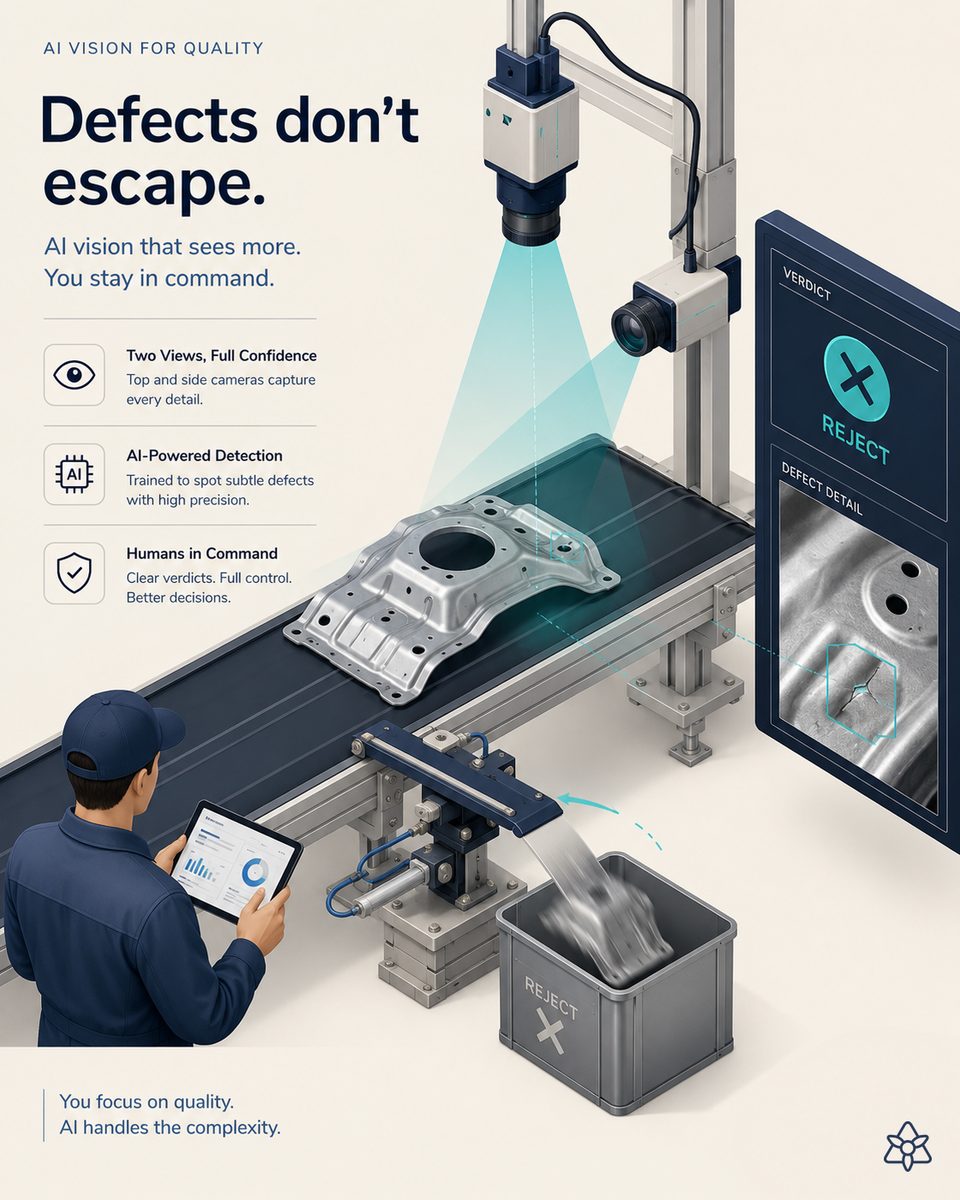
The airbag has zero tolerance, and the cost of failure is paid by the OEM with its own name on it.
An airbag module assembly station combines five realities that almost never live in the same system:
- The inflator batch — it comes from the pyrotechnic supplier. If that batch carries a defect, every unit built with it is suspect.
- The ultrasonic weld of the folded cushion — pressure, energy and time parameters on the welder. If it drifts outside the window, nobody sees it until deployment.
- The torque and angle of the module bolts — the smart nutrunner records them, but that data does not always reach the batch file.
- The module's laser marking — the unique serial number that will have to be matched to the VIN.
- The model recipe — which module version goes on each vehicle variant, a data point that changes whenever the OEM updates a specification.
The quality manager knows this. The operator has a smart torque wrench and a pick-to-light screen. And even so, a badly tightened module or a poorly welded cushion can go through 8 more stations and reach the OEM. The later audit spots the pattern when there are already thousands of units in the field. Every airbag recall that makes the press started exactly like this.
iLEAN does not add a sixth system — it seals the cracks between the five you already have.
The airbag control problem is not a lack of data: it is data in islands (ultrasonic welder, smart nutrunner, laser marker, supplier ERP, line MES) that at the critical moment — the exit from the station — have not been cross-referenced. iLEAN acts as the putty that fills those gaps, without asking you to change the vertical MES or the nutrunner.
Edge sees the assembly at every step. Connect reads the torque, the ultrasonic curve and the inflator batch wherever they live. The agent cross-references them with the model recipe and, if something does not add up, holds the part. The person signs — never the other way round.
The three iLEAN pieces applied to airbag assembly control:
- Edge — a terminal with machine vision (CNN) at every station: presence and orientation of the inflator, integrity of the cushion fold, alignment of the module in the housing, reading of the DataMatrix/laser marking. It fires the actuator (light, conveyor stop) in milliseconds if something does not add up. It works without a network: if the plant loses WiFi, Edge keeps reading and holding modules.
- Connect — captures the torque and angle from the smart nutrunner, the energy curve from the ultrasonic welder and the inflator batch from the supplier's delivery note — whether the data comes from a modern bus, from the nutrunner's old PC, or from the supplier's PDF. And it captures what arrives from outside (an email from the pyrotechnic supplier warning about a withdrawn batch) at second zero.
- Agent — cross-references the inflator batch, the recorded torque, the ultrasonic curve, the module's DataMatrix, the destination VIN and the model recipe. If something does not add up — torque outside the window on a single bolt, an inflator from a batch under suspicion — it holds the part and alerts the quality manager on their own channel. The person validates and signs; the line does not restart by itself.
Manual assembly + later audit vs. in-line control with iLEAN
| Aspect | Today (operator + nutrunner + later audit) | With iLEAN Edge + Connect + Agent |
|---|---|---|
| Inflator batch traceability | Supplier delivery note filed; cross-checked after the fact | Cross-checked with every module at second zero |
| Critical tightening torque | Recorded on the nutrunner PC, not linked to the VIN | Captured by Connect and linked to the module and the VIN |
| Ultrasonic weld of the cushion | History on the welder, local alarm if it drifts | Curve stored per part, anomaly caught before close-out |
| Defect detection | Dimensional audit at the end of the shift (1 in N) | At the station, before it leaves, module by module |
| Batch-to-VIN link | Rebuilt if there is an incident, taking weeks | Per-unit dossier, automatic, ready for PPAP/8D |
| Operation without a network | n/a | Edge keeps running on the panel's own power |
Impact estimate for your plant — to be validated with your numbers.
The block below is an estimate to be validated with the specific data of your plant. We put it forward so the committee has an order of magnitude; we refine it during the diagnostic.
- Airbag module assembly line with critical angle tightening, ultrasonic welding of the cushion and laser marking. IATF 16949 standard + the OEM's specification book.
- Edge pilot at one assembly station (camera over the module + integration with the nutrunner and the ultrasonic welder). First value expected within a few weeks.
- Indicative payback between 4 and 9 months, depending on the frequency of non-conformities raised by the OEM over recent years and the average cost of an 8D + passive safety sorting.
- The hard lever is a single recall avoided: the cost of one workshop call-back in passive safety pays for the pilot and the rollout.
And the quality manager's reasonable doubt
“What if the AI gets it wrong and lets a defective module through?” — hallucination is a problem of free generation, not of anchored tasks. In tasks where the AI does nothing more than read a DataMatrix and cross-reference it with a batch and a VIN, the best models brought error below 1.5% [1]. And even so, what is critical is never decided alone: iLEAN holds the part and the person signs. The three safety rings exist precisely for this. The automotive quality standard of the order of 25 PPM [2] no longer holds up with sampling: it holds up with vision on every part.
[1] OpenAI paper “Why Language Models Hallucinate”, 2025 — on the reliability of AI in anchored tasks.
[2] Symestic — automotive quality standard of the order of 25 PPM.
What people ask about airbag assembly control with AI
Why does a defect in airbag assembly escalate so fast into a recall of the model?
Because the airbag is an active safety component whose failure is only discovered at the exact moment it was supposed to work — the crash. IATF 16949 and the UNECE regulation oblige the OEM to notify and, in practice, to recall every unit built with the same suspect batch. A single badly tightened module, an ultrasonic cushion weld outside its window or an inflator from a contaminated batch translate into thousands or millions of vehicles called back to the workshop. The investment in catching it on the line is trivial compared with the cost of the recall.
Which airbag assembly parameters can be controlled in real time with vision + AI?
At every station: presence and correct position of the inflator (image + cross-check with the batch), integrity of the folded cushion seam, alignment of the module inside the housing, torque and angle of the critical bolts captured directly from the smart nutrunner, reading of the module's laser/DataMatrix marking and the link to the destination VIN. iLEAN Edge sees, Connect captures the data from the welder and the nutrunner, and the agent cross-references it with the batch recipe. If something does not add up, it holds the part before it leaves the station.
How is the airbag module linked to the vehicle VIN without touching the existing vertical MES?
iLEAN Connect acts as the putty between the islands: it reads the module serial number from the laser marking (Edge), captures the vehicle VIN from the assembly system (whether that is an ERP, a vertical MES or an operator handheld) and assembles a per-unit dossier that any downstream system can consume. We do not force you to replace the line's MES or to integrate invasively — we listen to every source exactly as it is today.
Can the AI reject the module on its own, or does a person have to validate?
The system allows it, but by default in passive safety it is configured so that the critical decision has human validation. iLEAN's three safety rings are designed precisely for this: the outer ring infers and proposes, the middle one validates, and the inner one (where the PLCs and the reject actuator live) only executes what a human has signed. The management team decides the degree of autonomy per station — and it is reconfigured without touching code.
How much does an airbag control pilot with iLEAN cost at an automotive Tier 1?
The order of magnitude of an Edge pilot at an airbag assembly station is close to that of any Edge pilot on an automotive line: vision terminals + integration with the smart nutrunner and the laser marker + the annual license. A reasonable payback to take to the committee is several months — the hard lever is a single defective unit caught on the line instead of at the OEM (or, worse, in the field). We ask for your plant's data and send you the estimated ROI in 48h, with your numbers, not ours.
More cases in automotive
- ABS wheel sensor control with AI — the active safety part where PPM tends to zero.How iLEAN verifies ABS wheel sensor geometry, encapsulation and connector polarity in line with Edge and…
- ADAS radar manufacturing control with AI — final calibration passes the radar, but the result was decided upstream.iLEAN verifies ADAS radar assembly before closing, stitches every calibration to the serial number and…
- AI aftermarket part packaging — the right box costs little; the wrong one costs you a rating on Amazon.How iLEAN cross-references kit vision, label reading and the ERP part number to prevent returns for the…
- Alloy wheel quality control with AI — pull the bad part before plating, not after.How iLEAN cross-references Edge vision over alloy wheel casting and machining, porosity X-ray and…
- Aluminum casting control with AI — porosity is invisible at demolding; finding it at the leak test means paying twice.iLEAN detects porosity and shrinkage at demolding and correlates the defect with injection parameters —…
- Aluminum FSW welding with AI — a kissing bond is invisible to the eye and shows up in the destructive test two days later.iLEAN combines FSW torque, force and temperature to detect defects in automotive aluminum instantly.
Tell us your case and in 48h we'll send you the estimated ROI of this AI project for your airbag plant.
We work on your plant's real data, not ours. Diagnostic with no commitment.
Request estimated ROI in 48h See automotive