AI control of vehicle rear camera modules — the module passes the functional test, fails in the field, and the OEM returns the whole batch.
A rear camera module combines optics, electronics and watertightness — and the electrical test only sees one of the three. iLEAN verifies optical alignment and the sealant bead with vision on 100% of modules at end of line, integrates your existing electrical test and ties every result to the module's serial number and to the destination VIN. The person decides what gets released.
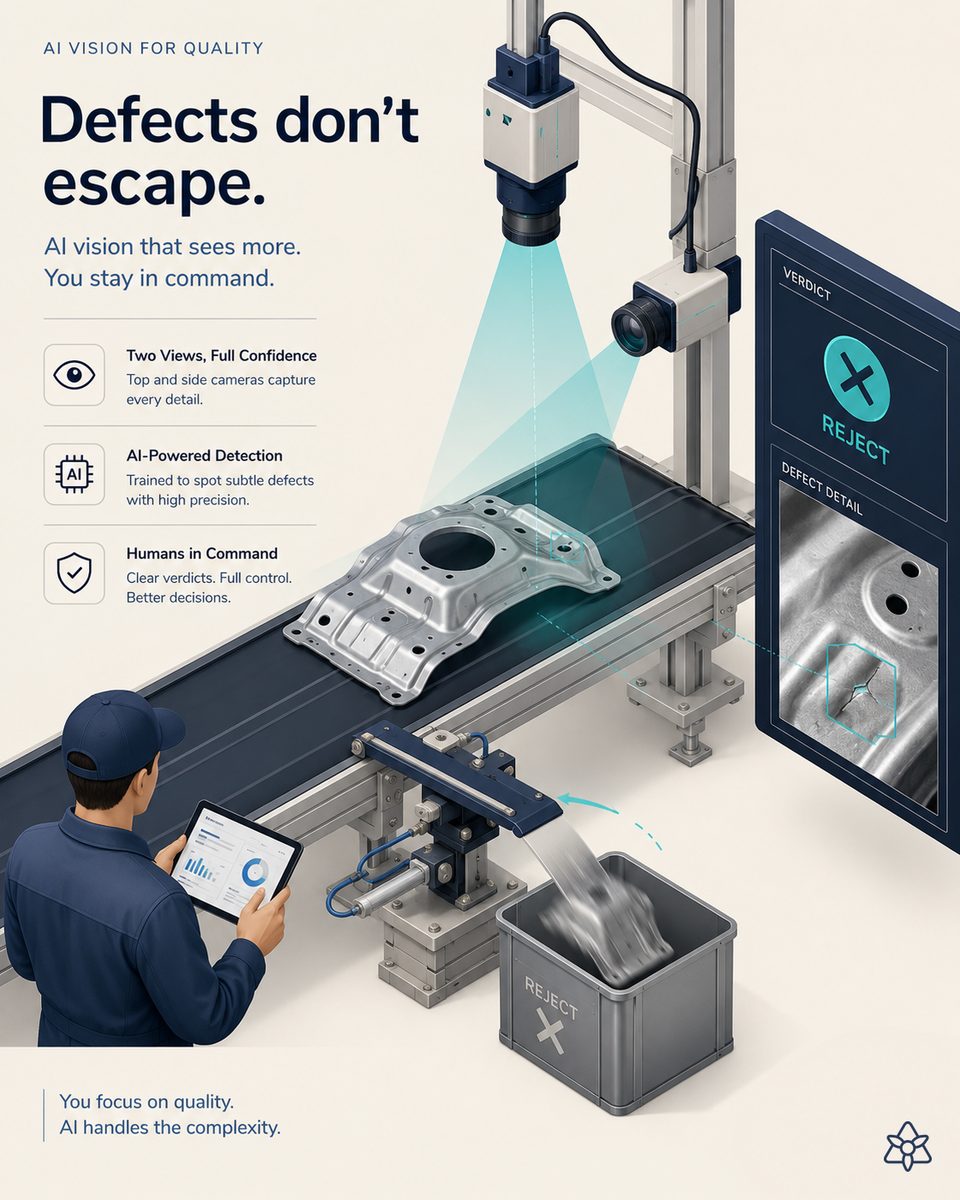
The functional test says OK — and the module fails in the field months later.
The quality manager of a camera module line knows the pattern well: the module passes the electrical test at end of line — power, communication, video signal — and leaves the plant packed with its OK. Months later the claim arrives: the image is off in the parking guide lines, there is condensation inside the optics. The module that passed was not right — it was inside what the functional test can see, which is not everything the module is.
Three things come together in a rear camera module, and almost no end of line covers all three at once:
- The optics are not verified piece by piece — focus and optical axis alignment are set at the station, but a fine misalignment the electrical bench cannot tell apart ends up on the customer's screen. The module works; it works crooked.
- Watertightness is decided before closing, and after that nobody sees it — the module is exposed to the weather; a sealant bead with a narrow or displaced stretch passes the day-one functional test and lets moisture in months later. Once the module is closed, no inspection is possible.
- Traceability by VIN is rebuilt by hand — when the OEM raises a claim, cross-referencing the module's serial number with its process parameters and the vehicle's VIN means days of spreadsheets. In the meantime, the OEM's prudent answer is to return the whole batch.
The result is always the same: the plant pays for batch returns where most modules were fine, the field claim is answered late and without data, and the knowledge that “this sealing station goes off-center when…” lives in the head of the veteran setter. The day they leave, it leaves with them.
iLEAN does not replace your end of line — it adds the eyes and the memory it lacks.
The problem with the camera module is not that a test is missing: it is that the test you have only covers the electronics, and what fails in the field is the optics and the watertightness. iLEAN completes the end of line with 100% vision verification, ties every result to each module's serial number and to the destination VIN, and holds the flow when the process drifts — without changing the test bench you already have.
Edge verifies optics and sealing with vision at end of line. Connect integrates the electrical test and ties the result to the serial number and the VIN. JIDOKA AI holds the flow on drift. The person decides what gets released.
The iLEAN pieces applied to rear camera module control:
- Edge — a local terminal with vision at end of line that checks, on 100% of modules, the alignment of the optical axis against a calibrated reference and the quality of the sealant bead (continuity, width, position) before closing, which is the last moment the seal can be seen. It runs locally: if the plant loses the network, Edge keeps verifying, recording and holding whatever does not pass. What is critical does not depend on WiFi.
- Connect — the integration layer that hooks into your existing electrical test bench and ties its result, together with Edge's checks and the sealing station parameters, to each module's serial number; and when the module is assigned to a vehicle, to the destination VIN. A single record per module, built on the line, with no manual transcription.
- JIDOKA AI — holds the flow on process drift, not only on the one-off failure: bead width falling while still inside tolerance, average misalignment growing shift after shift, electrical test spread opening up. It holds the affected modules and alerts with the specific signal; the supervisor decides whether to release, rework or adjust the station.
- Agents — when a field claim arrives, they correlate the reported symptom with the process signature of that specific module (its bead, its alignment, its test) and with the modules that share that signature. Exposure is scoped to the modules with a common cause, instead of assuming the whole batch.
Classic end of line vs. end of line with iLEAN
| Aspect | EOL with functional test | With iLEAN Edge + Connect + JIDOKA AI |
|---|---|---|
| Optical axis alignment | Set at the station, no 100% verification | 100% vision against a calibrated reference |
| Sealant bead | Operator's eye, invisible once closed | Vision before closing: continuity, width, position |
| Electrical test | Result isolated in the bench | Integrated and tied to the module's serial number |
| Process drift | Discovered once failures are already there | JIDOKA AI holds the flow on the trend |
| Field claim | Days rebuilding records by hand | Hours, with the exact module's signature by VIN |
| Batch return | Whole batch, because it cannot be scoped | Scoped to the modules with a common cause |
Impact estimate for your plant — to be validated with your numbers.
The block below is an estimate to be validated with the specific data of your plant. We put it forward so the committee has an order of magnitude; we refine it during the diagnostic.
- Rear camera module line with a functional test bench at end of line, a sealing station whose parameters are logged locally, VIN traceability rebuilt by hand and at least one documented batch return in the last year.
- Edge pilot with vision on alignment and the sealant bead + Connect tying your existing electrical test to the serial number. First value expected within a few weeks: the single record per module and the first drift holds show up early, before the learned pattern is fully tuned.
- Expected reduction in batch returns from avoidable causes — fine misalignment and marginal sealing, both detectable at end of line — of ≥30% in the first few months, a defensible floor and always an estimate to be validated.
- Field claims answered in hours with data on the exact module, instead of days of manual reconstruction — and exposure scoped to the modules that share the signature, not to the whole batch.
- Indicative payback between 5 and 12 months. The hard lever: every batch the OEM does not return is freight, re-inspection and penalties wiped out at once.
- A recurring benefit that does not enter the ROI but weighs: the veteran setter's judgement about the sealing station becomes a permanent capability of the plant, not of the person who is about to retire.
And the quality manager's reasonable doubt
“What if the AI correlates a claim wrongly and I hold good modules?” — the iLEAN system never decides material disposition on its own. JIDOKA AI holds and proposes; the quality manager decides whether to release or rework. Hallucination is a problem of free generation, not of anchored tasks: in tasks where the AI cross-references a module's process signature with its test result and its history, the best models brought error below 1.5%[1]. And even so, what is critical goes through the safety rings — the Agents live in the outer ring, propose inward, and batch disposition is signed by a person. Never the other way round.
[1] OpenAI paper “Why Language Models Hallucinate”, 2025 — on the reliability of AI in anchored tasks.
What people ask about AI control of rear camera modules
What does vision check at end of line?
Two things the functional test cannot see: the alignment of the optical axis against a calibrated reference (the module can produce a correct image on the bench and still carry a fine misalignment that the customer notices in the parking guide lines) and the quality of the sealant bead before closing — continuity, width and position of the bead, which decide whether the module survives years of weather or lets moisture in a few months later. iLEAN Edge does it with vision on 100% of the modules, not by sampling: the rear camera is exposed to the outside of the vehicle and a marginal seal can no longer be inspected once the module is closed.
Does it replace the electrical test I already have at end of line?
No — it builds on it. Your existing functional test (power, communication with the sensor, video signal, connector continuity) stays yours. iLEAN Connect integrates with that bench and ties its result, together with Edge's vision checks, to the serial number of every module. The result is a single record per module: process parameters, optical result, electrical result and seal status. Without changing the bench, without duplicating the test and without asking the operator to write anything down by hand.
How does traceability to the VIN work?
Every module leaves the end of line with its serial number tied to the full signature of its process: component batch, sealing station parameters, optical alignment result and electrical test result. When the module is assigned to a vehicle, Connect links the serial number to the destination VIN. When a field claim comes in, the question “what happened to this specific module?” is answered in hours, with data — not in days of rebuilding records by hand — and the question “how many other modules share that signature?” scopes the real exposure instead of assuming the whole batch.
What does JIDOKA AI do when the process drifts?
It holds the flow before the drift turns into a failure. Classic jidoka stops the line on a one-off defect; JIDOKA AI holds it on the trend: sealant bead width falling while still inside tolerance, average misalignment growing shift after shift, electrical test spread opening up. When the process signature separates from the learned pattern, the system holds the affected modules and alerts the supervisor with the specific signal that drifted. The person decides whether to release, rework or adjust the station — the system never acts on the process on its own.
How much do batch returns go down?
It depends on the starting point — a line with instrumented seal inspection does not have the same headroom as one that relies on the operator's eye. As a defensible floor, a reduction of ≥30% in batch returns from avoidable causes (fine misalignment and marginal sealing, both detectable at end of line) is realistic in the first few months, always as an estimate to be validated with your data. The hard lever is not just the rejected module: it is the whole batch the OEM stops returning and the field claim that closes in hours with data on the exact module. Indicative payback between 5 and 12 months. We send you the estimated ROI in 48h with the real data from your line.
More cases in automotive
- Tier 1 tire quality control with AI — uniformity, curing and OEM approval in a single file.How iLEAN cross-references Edge vision over curing and uniformity, rubber compound data and mold…
- Digital Hoshin Kanri in tier-1 automotive — the X-matrix that actually lives on the line.iLEAN turns the Hoshin X-matrix into live KPIs by plant, shift and workstation. No spreadsheet, no…
- Part-to-VIN traceability in tier-1 — from the material batch to the car, without adding one more scan on the line.iLEAN joins batch, part and the final car's VIN. Full IATF 16949 traceability, from material receipt to…
- Automotive water pump control with AI — the coolant leak starts in the second of assembly.How iLEAN cross-references Edge vision, flow testing and vibration signature to catch leaks, faulty…
- Digital 5S on the assembly line — the standard drifts between audits; finding out on the next monthly walk is too late.iLEAN sustains 5S between audits: gemba walk with photo and voice, verification of the workstation…
- ABS wheel sensor control with AI — the active safety part where PPM tends to zero.How iLEAN verifies ABS wheel sensor geometry, encapsulation and connector polarity in line with Edge and…
Tell us your case and in 48h we'll send you the estimated ROI of this AI project for your camera module line.
We work on your plant's real data, not ours. Diagnostic with no commitment.
Request estimated ROI in 48h See automotive