Part-to-VIN traceability in tier-1 — from the material batch to the car, without adding one more scan on the line.
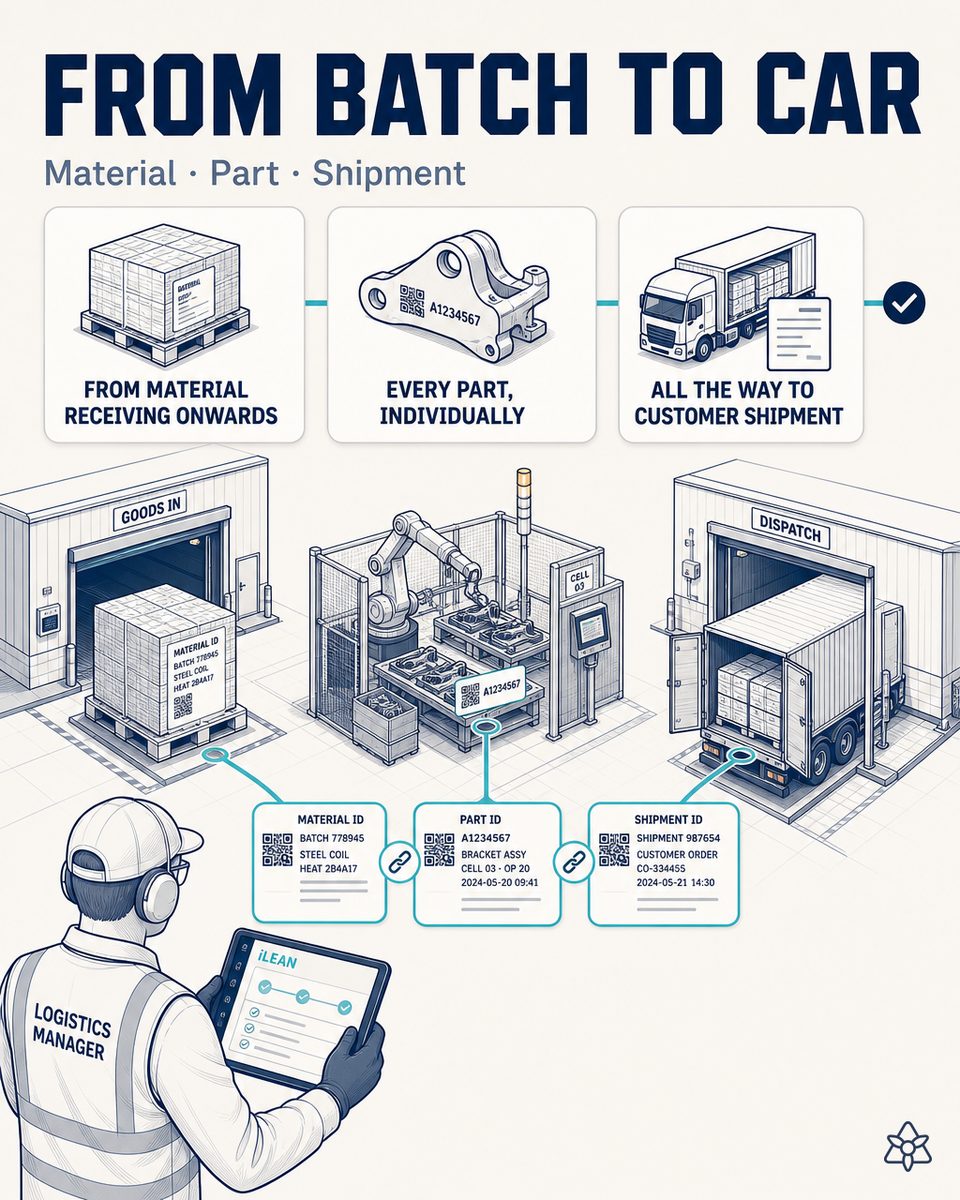
Part-to-VIN traceability is an OEM requirement in automotive. iLEAN covers it from material receipt to customer shipment, joining batch, individual part and VIN without asking the line to scan twice. IATF 16949 closed by design — the agent assembles the file, the person signs.
The file the auditor asks for in five minutes takes five days to assemble.
Any tier-1 quality manager knows what happens when an OEM safety recall goes off, or when the IATF auditor runs a finger down the shipment list for the last quarter and says “this batch, complete file”. The file exists — in five different places:
- The material — the steel mill's heat certificate is a PDF in a folder belonging to the purchasing manager; the plastic certificate is in an email from the supplier that somebody filed away.
- The manufacturing — in the MES (work order, shift, machine), but the fine parameter the part was made with that day (injection pressure, line torque, mold temperature) often lives in the SCADA or on a sheet at the machine itself.
- The release — on a sheet signed by the inspector, scanned and uploaded to SharePoint if there was time.
- The shipment to the OEM — in the ERP, with the delivery note; but the mapping to the car's VIN, when there is one, arrives by EDI in a different mailbox.
- The car's VIN — some OEMs provide it, others do not; those that do use their own format and their own system.
Assembling all of that by hand takes days — and when there is a recall, days mean penalties. The tier-1 that answers in hours keeps the customer; the one that takes weeks loses the next program.
iLEAN does not add a sixth system — it stitches together the five you already have.
The tier-1 does not lack information about its traceability; it has islands. Material in the PDM and in purchasing emails, manufacturing in the MES, parameters in the SCADA, release on the inspector's sheet, shipment in the ERP, VIN in the OEM's EDI. iLEAN acts as the putty that stitches the five islands together — without replacing any of them, without asking you to change your automotive vertical MES or your ERP.
Tracer links each individual part with its batch and its material. Connect captures material, parameters and VIN whatever channel they come through. The agent assembles the file and leaves it ready for the auditor or the OEM. The person signs.
The iLEAN pieces applied to part-to-VIN traceability in a tier-1:
- iLEAN Tracer + Vision — reading the individual part marking (DataMatrix, laser engraving, QR code) on the line, with AI vision where the classic code reader gives up (dirty part, partially erased code, awkward angle). Every part is linked to its manufacturing batch there and then, not in a separate scan.
- Connect — captures material certificates at goods receipt (steel mill PDF, plastic supplier email, coil sheet), parameter data from the SCADA by machine and shift, the release signed by the inspector, the delivery note for the OEM shipment in the ERP, and the VIN when it arrives by EDI or portal. Email, WhatsApp, SharePoint, EDI — everything comes in and becomes usable data.
- Agent — stitches material batch → individual part → manufacturing parameters → release → shipment → VIN. Faced with an auditor's query or an OEM recall, it assembles the file in seconds and delivers it exactly as the recipient asks for it. The person validates and signs — the file does not go out on its own.
Traceability rebuilt by hand vs. traceability stitched with iLEAN
| Aspect | Spreadsheet + PDFs + supplier email | With iLEAN Tracer + Vision + Connect + Agent |
|---|---|---|
| Material → part link | Manual, after the fact, fragile | Automatic from goods receipt, certificate attached to the batch |
| Individual part → batch link | Only if the operator scanned twice | Marking read on the line, no extra scan |
| Machine parameters for the day | In the SCADA, available to the technician | Attached to the batch there and then, inside the file |
| Shipment → OEM VIN link | Rebuilt by cross-checking EDI and delivery notes | The agent stitches delivery note, EDI and OEM sequence |
| Response to an OEM recall | “Give us 5 days” | List of affected batches and VINs, the same day |
| IATF audit preparation | Weeks, with a dedicated team | Hours, file assembled on demand |
Impact estimate for your plant — to be validated with your numbers.
The block below is an estimate to be validated with the specific data of your plant. We put it forward so the committee has an order of magnitude; we refine it during the immersion.
- Tier-1 with 2-4 part families for 1-3 OEMs, an automotive vertical MES already in place, material certificates received by email/portal, parameters in the SCADA by machine.
- Connect + agent pilot on one safety part family (the one the OEM is toughest on). First value expected within a few weeks: the first file assembled automatically.
- Indicative payback between 4 and 9 months, measured by person-hours saved in audit preparation plus the reduction in risk associated with a badly answered recall.
- Reasonable reduction of IATF audit preparation time of ≥ 50% in the first cycle; roll-out to the remaining families done by your own trained people, in 2-3 months.
And the quality director's reasonable doubt
“What if the AI rebuilds the link wrongly and puts the wrong material in the file?” — assembling a file from sources that already exist is a textbook anchored task (reformatting, reorganizing, cross-referencing fields from different systems). On that type of task, the best models brought error below 1.5% [1]. And even so, no file goes to the auditor or to the OEM without the person validating and signing it. The three safety rings exist precisely for this.
[1] OpenAI paper “Why Language Models Hallucinate”, 2025 — on the reliability of AI in anchored tasks (anti-hallucination when working on data from the system itself).
What people ask about part-to-VIN traceability in tier-1
What does IATF 16949 require on traceability?
IATF 16949 requires the tier-1 to be able to rebuild, in the event of a possible safety recall, the complete chain of the part: which material batch it came from, on which machine and shift it was manufactured, what parameters that machine was running that day, who released it, in which shipment it went to the OEM and — when the OEM provides it — in which VIN it is fitted. The level of detail varies by part family (higher for safety, lower for comfort) and by customer, but the principle is the same: any part, at any time, rebuilt forwards and backwards without rebuilding anything by hand.
What about material traceability (steel, plastic, electronics)?
iLEAN Connect captures material certificates at the moment of goods receipt: the supplier invoice, the steel mill's heat certificate, the datasheet for the plastic batch, the coil or pellet number. They arrive as PDFs, in emails, in an attached spreadsheet — any channel. The agent extracts the relevant fields and links them to the internal manufacturing batch. When the part leaves the plant, it already carries with it the data on which material formed it, without anyone having opened a PDF at 7 in the morning.
How is the part linked to the OEM's VIN if the OEM does not always share it?
There are three scenarios, and we cover all three: (1) the OEM provides the VIN-to-part mapping via EDI/portal — Connect collects it automatically and the agent links it to the part batch, file closed; (2) the OEM provides the assembly sequence but not the VIN directly — the agent rebuilds the link from the sequence logic plus the tier-1's shipping date; (3) the OEM provides nothing — the tier-1 keeps full traceability up to shipment and leaves the reverse query ready for whenever the OEM asks for it in a recall. In all three cases, the file comes out in seconds, not in weeks.
Does it work with the MES we already have, without throwing it away?
Yes — that is exactly the idea. iLEAN does not replace the MES, it sits on top of it as putty and fills in what the MES left exposed. Connect reads manufacturing data from the MES (work order, shift, machine, parameters), material receipt and OEM shipment data from the ERP, and the individual part marking from the label reader on the line. The agent stitches the three together. If your MES is an automotive vertical and already covers a good part of this, perfect — iLEAN takes the cracks it still has (typically the link with the material received and the closing link with the shipment to the OEM).
Does it reduce the effort of an IATF 16949 audit?
Yes, and it is the hard lever of the pilot. An iLEAN agent can reassemble the file of any part shipped to the OEM — material, manufacturing, release, shipment — in seconds, with the documentation organized the way the auditor asks for it. The quality team goes from spending weeks preparing the audit to spending hours reviewing it. And in the face of an OEM safety recall, the answer stops being “give us 5 days to rebuild it” and becomes “here is the list of affected batches and VINs” the same day.
More cases in automotive
- Suspension damper control with AI — the tolerance does not show on the bench, it shows in the curve.iLEAN applies Edge vision to damper assembly, captures the dynamic test and the force-velocity curve,…
- Tier 1 tire quality control with AI — uniformity, curing and OEM approval in a single file.How iLEAN cross-references Edge vision over curing and uniformity, rubber compound data and mold…
- Digital Hoshin Kanri in tier-1 automotive — the X-matrix that actually lives on the line.iLEAN turns the Hoshin X-matrix into live KPIs by plant, shift and workstation. No spreadsheet, no…
- AI control of vehicle rear camera modules — the module passes the functional test, fails in the field, and the OEM returns the whole batch.iLEAN checks optical alignment and seal quality on 100% of rear camera modules at end of line and ties…
- Automotive water pump control with AI — the coolant leak starts in the second of assembly.How iLEAN cross-references Edge vision, flow testing and vibration signature to catch leaks, faulty…
- Digital 5S on the assembly line — the standard drifts between audits; finding out on the next monthly walk is too late.iLEAN sustains 5S between audits: gemba walk with photo and voice, verification of the workstation…
Tell us your case and in 48h we'll send you the estimated ROI of this part-to-VIN traceability project for your tier-1.
We work on your plant's real data, not ours. Diagnostic with no commitment.
Request estimated ROI in 48h See automotive