Bi-color wheel painting with AI — a mist on the transition is the most expensive part of the day.
A good bi-color wheel is the intersection of three things — the real masking on the part, the booth recipe and the transition line seen in front of the oven. iLEAN cross-references all three before the oven and pulls the doubtful wheel while the paint can still be blown off and recovered. The person signs — the expensive wheel is never decided alone.
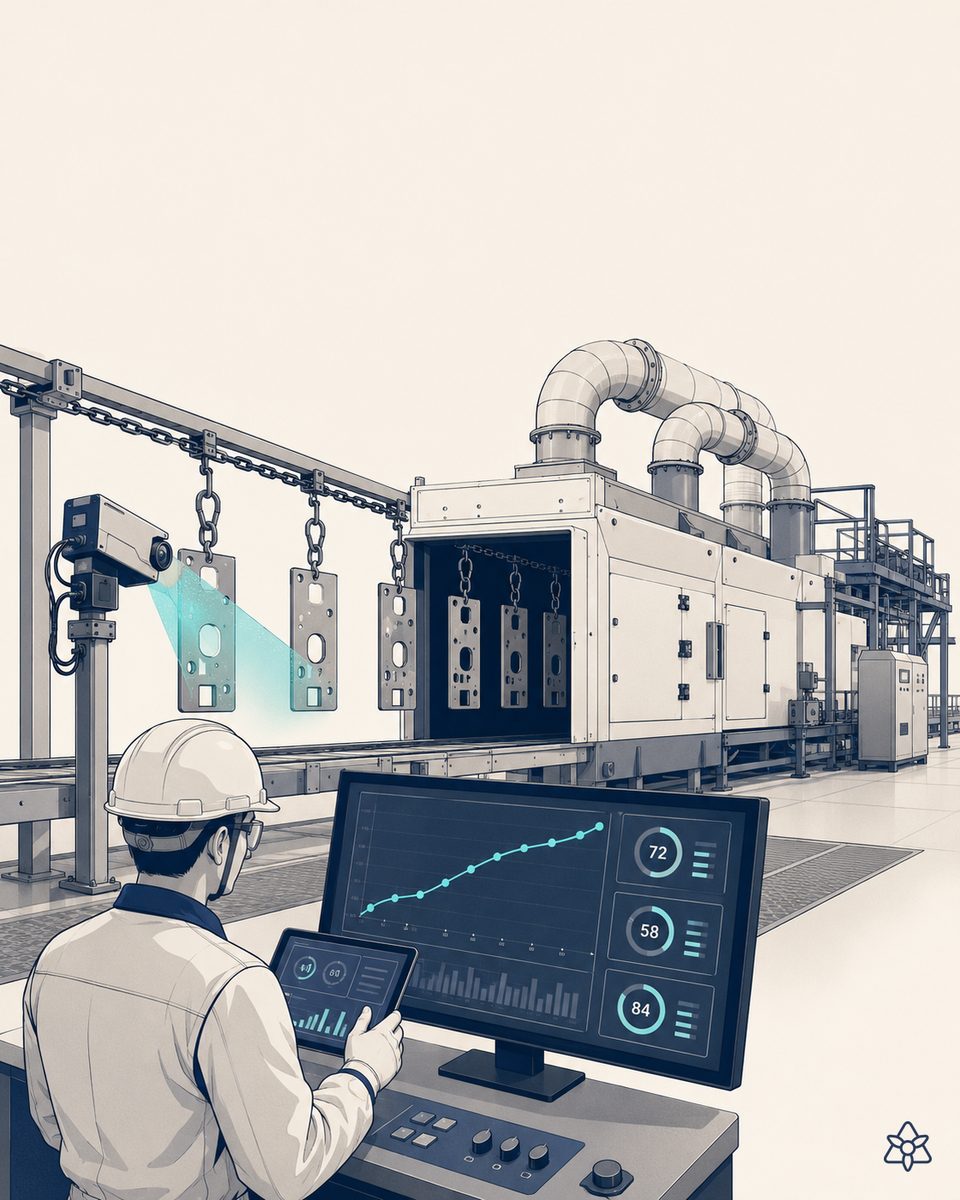
The most expensive part of the day, and the classic system looks at it once it can no longer be saved.
Anyone painting bi-color alloy wheels works against three pains that live side by side all shift long:
- The color transition — the zone where one color ends and the other begins. One mist, one run, one poorly defined edge, and the wheel is scrap or expensive rework.
- The masking — manual, robotic or with a reusable mask. It works most of the time. When it fails, the operator finds out after the oven, and by then there is no going back.
- Cost per unit — a high-end diamond-cut alloy wheel is one of the highest-cost parts in the plant. Bi-color scrap is the most painful scrap of the whole day.
Classic control looks at the end, not in the middle. The operator does what he can, the robot does what it was programmed to do, and during a model changeover or in the last hour of the shift the trouble shows up. What decides whether the wheel is good is what you see before the oven, not after.
iLEAN does not replace your booth or your robot — it puts an eye between the booth and the oven, exactly where there was none.
The problem in bi-color painting is not a shortage of robots, it is a blind zone between the booth and the oven where the defect already exists but is not scrap yet. iLEAN acts as the putty that fills that blind zone — Edge sees the transition, Connect reads the booth recipe, the agent cross-references with the wheel model and the batch.
Edge sees the transition before the oven. Connect reads the booth recipe and the part ID. The agent cross-references with the model's historical pattern and warns before the trouble piles up. The person signs — the expensive wheel is never decided alone.
The three iLEAN pieces applied to bi-color wheel painting:
- Edge — a terminal with machine vision (CNN) between the booth and the oven. It detects mist, runs, a dirty transition edge, missing coverage, cross-contact between colors. It fires the actuator to pull the part before the oven. It works with no network.
- Connect — captures the booth recipe (flow rates, pressures, robot path, mask applied) whether it comes from a modern PLC or from the screen of an old system. It captures the part ID, the wheel model, the SKU changeover. And it captures what arrives from outside: a notice from the paint supplier about a lot change, a note from the OEM customer about a new model.
- Agent — cross-references image, recipe, model, batch and operator. It detects that model X is drifting toward mist on the transition shift after shift — before the supervisor notices. It coordinates work instructions for the team to tune the booth and assembles the dossier by batch.
Classic bi-color control vs. cross-referenced control with iLEAN
| Aspect | Visual inspection at the end + SPC | With iLEAN Edge + Connect + Agent |
|---|---|---|
| Defect detection | After the oven, already cured | Before the oven, still recoverable |
| Mist on the transition | Subjective, depends on the shift's eye | Consistent CNN, no fatigue |
| Model / SKU changeover | The most vulnerable moment, no safety net | Edge already has the new model's pattern loaded |
| Process drift | Discovered through a batch of scrap | Historical pattern tracked by the agent |
| Recovering the part and the paint | Impossible after the oven | Blown off and reworked in line, before curing |
| Dossier by batch / part | Manual, weeks | Automatic, ready when the customer asks |
Impact estimate for your plant — to be validated with your numbers.
The block below is an estimate to be validated with the specific data of your line. We put it forward so the committee has an order of magnitude; we refine it during the diagnostic.
- Bi-color alloy wheel paint line with several models in rotation.
- Edge pilot between the booth and the oven (camera + actuator + integration with the booth recipe and the part ID). First value expected within a few weeks.
- Expected reduction of scrap from transition defects ≥ 30% within the pilot's scope.
- Indicative payback between 3 and 9 months, driven mainly by paint recovered + parts that never go to rework + oven hours freed up.
And the paint shop manager's reasonable doubt
"What if the AI gives false positives and pulls wheels that are fine?" — the system is calibrated with good and bad samples from the line itself, and the agent tunes the threshold per model. Hallucination is a problem of free generation, not of anchored tasks: in tasks where the AI classifies an image against a known pattern, the best models brought error below 1.5% [1]. And even so, a pulled part is never decided alone: the person inspects and signs.
[1] OpenAI paper “Why Language Models Hallucinate”, 2025 — on the reliability of AI in anchored tasks.
What people ask about bi-color wheel painting with AI
What makes bi-color paint control on wheels so critical?
A bi-color wheel (diamond-cut machining + dark clearcoat, or two masked tones) is one of the highest cost-per-unit parts in the whole plant and one of the hardest to recover when something goes wrong. The transition line between colors is the critical zone: a run, incomplete masking or a mist of one color over the other turns the wheel into scrap or expensive rework, and the operator finds out once it has already gone through the oven. Before the oven you save it; after, you do not.
Why is manual or robotic masking not enough?
Because correct masking in the CAD system does not guarantee correct masking on the wheel — the tape folds, the operator presses unevenly, a speck of dust lifts the edge. And the classic system only finds out when the part comes out of the oven with a dirty transition. Visual inspection at the end of the line works; the problem is that by then the paint has cured and the only way out is to strip it and repaint, with a hard cost in paint, energy and oven time.
How does iLEAN detect a color mist or a run before the oven?
iLEAN Edge installs a terminal with machine vision (CNN) between the paint booth and the oven entrance. The camera sees the wheel at line speed and recognizes: runs, mist, a poorly defined masking edge, abnormal film thickness, missing coverage, cross-contact between the two colors. The CNN is trained on good and bad samples from the plant itself, not on a generic dataset. If it detects a defect, the actuator pulls the wheel before the oven and the person decides whether it is blown off and recovered or sent down to rework.
Can it be cross-referenced with the booth recipe and the wheel type?
Yes — that is the agent's part. Every wheel model has its booth program (flow rates, pressures, robot path, mask applied). iLEAN Connect reads that recipe from the PLC or from the paint system, and the agent cross-references it with the part ID, with the Edge image and with the final result. When the agent sees that a model is drifting — for example, the transition line getting thicker shift after shift — it warns before scrap piles up. That is anticipatory jidoka, not reactive.
What does it cost and how fast does the investment pay back on a bi-color line?
An Edge pilot on a bi-color line is of a similar order of magnitude to other Edge pilots in automotive painting. The hard lever is very large: a diamond-cut alloy wheel is one of the most expensive parts in the plant, and bi-color scrap is the most painful scrap in the process. Recovering the part and the paint before the oven pays the pilot back quickly. We ask for your line's data and send you the estimated ROI in 48h.
More cases in automotive
- Battery pack laser welding with AI — a bad weld is not rework, it is a thermal risk.iLEAN combines vision, thermography and current to verify every battery pack laser weld. One defect =…
- SOC and degradation control for EV battery packs — catching the weak pack before the OEM finds it.iLEAN measures real SOC at end of line and detects packs with premature degradation before they ship to…
- EU Battery Passport — from lithium to the final pack, without rebuilding the data by hand the night before the audit.iLEAN covers the EU Battery Passport 2027 from cell to final pack, integrating lithium origin,…
- Visual defects on body panels — deflectometric light, an eye that never tires, on every part.iLEAN Vision detects dents and scratches on body panels with deflectometric lighting. 100% inspection,…
- Torque traceability by bolted joint — a badly tightened fastener is not a penalty, it is a mass recall.iLEAN stores the torque and angle value of every critical bolted joint together with its part and its…
- Brake disc and caliper control with AI — the part that cannot afford a single escape.How iLEAN cross-references Edge vision on the disc machining line, critical caliper torque and VIN…
Tell us your case and in 48h we'll send you the estimated ROI of this AI project for your bi-color wheel line.
We work on your line's real data, not ours. Diagnostic with no commitment.
Request estimated ROI in 48h See automotive