EU Battery Passport — from lithium to the final pack, without rebuilding the data by hand the night before the audit.
The EU Battery Passport 2027 requires multi-tier traceability per cell — lithium origin, chemistry, manufacturing, cycles, second life and recycling. iLEAN covers it from the cathode supplier's certificate all the way to dismantling, chaining every data point to the pack's unique identifier. The evidence already lives signed and packaged — you do not rebuild it, you export it.
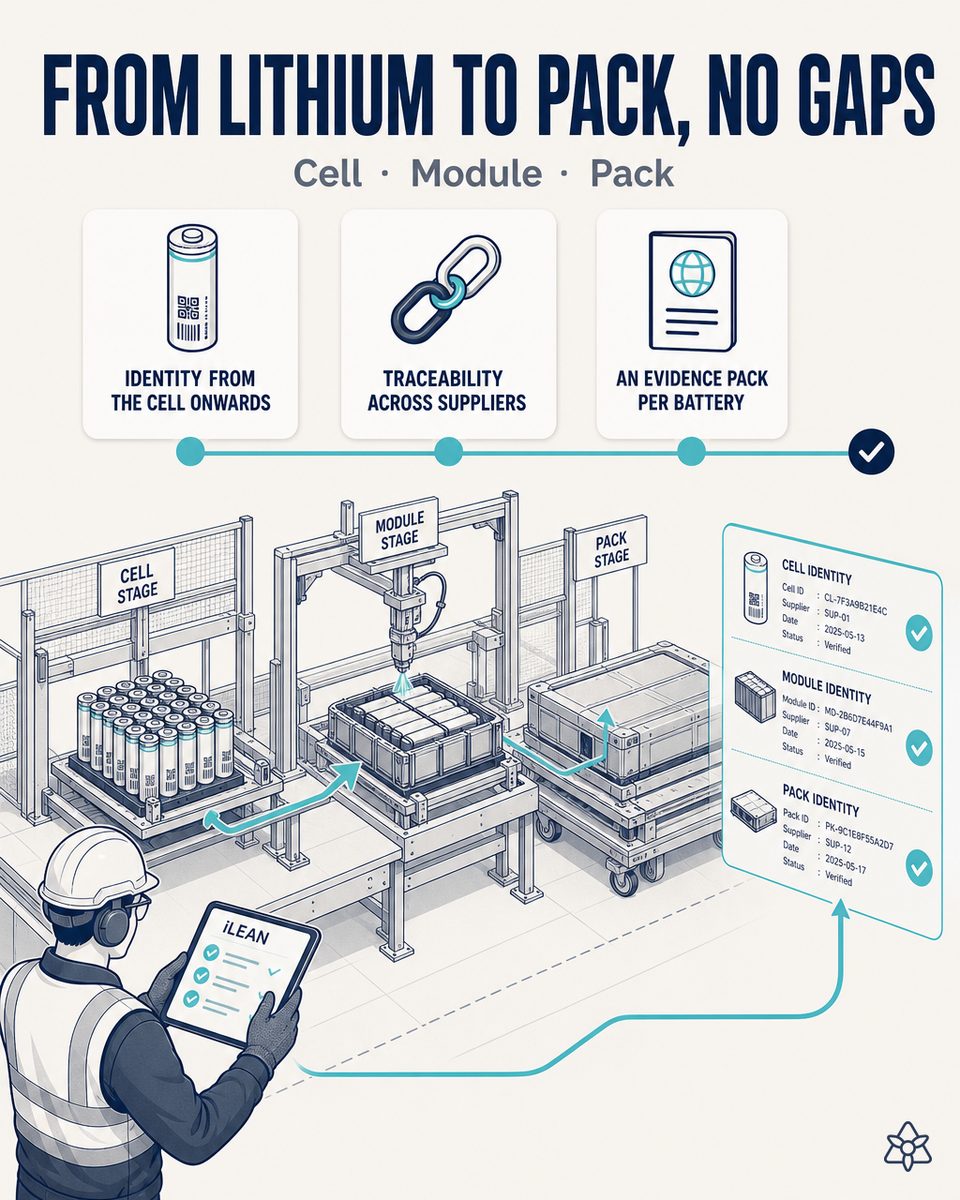
The lithium data sits in six systems that never talked to each other.
The Battery Passport is not a PDF at the end of the year — it is a living object, per pack, that starts with the cathode supplier's certificate and follows the pack throughout its service life. And the problem is that this data today lives in six different places that were never designed to talk to each other:
- The cathode supplier — sends certificates by email, EDI or its own portal. Each one in its own format.
- The cell supplier — delivers batches with its own internal traceability that it rarely exposes.
- Your ERP — records the purchase order and the batch receipt, but does not chain cell to pack.
- Your pack MES — knows which cell went into which pack, but has no idea where the lithium came from.
- The laser equipment, the thermography, the EOL tester — store process data per weld and per pack, in their own systems.
- The OEM customer — asks for the evidence per pack in its own format. And soon the European register will ask for it too.
Rebuilding that chain by hand, pack by pack, whenever the OEM or the auditor asks for it, is exactly the cross-functional work that used to be done with Excel, a phone and meetings because there was no other way to do it. There is now.
iLEAN does not replace your ERP or your MES — it seals the cracks between the six systems you already have.
The Battery Passport problem is not a lack of data: it is data living on islands that, the moment the regulator or the OEM asks for the evidence, never arrives in time and chained together. iLEAN acts as putty between the ERP, the MES, the line equipment and the supplier, without asking you to change any of them.
The supplier's certificate comes in through Connect. The line equipment signs every weld. The agent chains cell to pack and to lithium origin. The pack's unique identifier ends up with a living dossier — ready for an auditor, an OEM or the European register.
The three iLEAN pieces applied to cell traceability and the Battery Passport:
- Tracer (Edge + vision) — reads the unique identifier of every cell and every pack at the moment of assembly, without demanding changes to the MES. If a cell is missing or an identifier cannot be read, it holds the pack before closing. The chain is built in line, not after the fact.
- Connect — captures the cathode supplier's certificate whether it comes as a PDF, EDI, email or portal. It also captures the cell supplier's data, the OEM's customer-specific requirements and European regulatory changes through whichever channel they arrive on. The putty that covers the dead zones between ERP, MES, supplier and regulator.
- Writer (Agent) — chains every cell to its pack, every pack to its raw material origin, every weld to its quality evidence, and packages the whole thing as a signed dossier per pack. When the definitive format of the European register lands, the Writer exports to whichever schema is asked for — the data is already in your house.
Reactive traceability vs. a living Battery Passport with iLEAN
| Aspect | Classic traceability | With iLEAN Tracer + Writer + Connect |
|---|---|---|
| Cathode supplier certificate | A PDF in a purchasing folder | Digitized, extracted field by field, chained to the batch |
| Cell → pack | The MES knows it, but never cross-references raw material | Full cell-pack-lithium chain in a single query |
| Process data per pack | Scattered across laser, thermography, EOL | Chained to the unique identifier, signed |
| OEM evidence request | Rebuilt by hand, several days per pack | Dossier already generated, exported in whatever format is asked for |
| Second life / recycling | The data is lost at dismantling | Signed history handed to the next operator |
| Change of EU register format | Refactor the reporting | The data lives in your house; you export to the new schema |
Impact estimate for your plant — to be validated with your numbers.
The block below is an estimate to be validated with the specific data of your plant. We put it forward so the committee has an order of magnitude; we refine it during the diagnostic.
- EV pack manufacturer, 1-3 cell suppliers with NMC or LFP chemistry, tier-1 OEM with specific customer requirements demanding multi-tier traceability.
- Pilot: Tracer on the pack line (reading the unique identifier of cell and pack) + Connect with two priority suppliers + Writer packaging the dossier. First value expected within a few weeks, with the first packs traced end to end.
- Reduction in the time to generate a dossier per pack in the order of ≥ 30% by the end of the pilot; at some points of the cycle (reactive OEM requests) the reduction is far greater — the dossier goes from "rebuild" to "export".
- Indicative payback between 4 and 9 months, depending on the size of the team that today spends hours on reactive reporting and on the frequency of OEM and regulator audits.
- The hard lever here is not only cost: it is regulatory market access. Without a living Battery Passport you do not enter the EU market once the compliance date passes. Which is why, on this topic, "doing nothing" is the expensive option.
And the IT Director's reasonable doubt
"What if the regulator changes the format in two years and we have to redo everything?" — that is exactly why iLEAN stores the data in your house and as JSON signed per plant, not in this month's consortium format. The export layer gets rewritten; the data is never touched. And for anchored tasks like this one (chaining an identifier to a certificate, extracting a field from a PDF) the reliability of AI is a long way from the hallucination problem of free generation — the best models are below 1.5% error [1].
[1] OpenAI paper "Why Language Models Hallucinate", 2025 — on the reliability of AI in anchored tasks.
What people ask about cell traceability and the Battery Passport
What does EU Regulation 2023/1542 require regarding the Battery Passport?
Regulation (EU) 2023/1542 introduces a mandatory Battery Passport for traction batteries and industrial batteries above 2 kWh. It has to contain a unique identifier, manufacturer data, chemistry, rated capacity, critical materials and their origin, carbon footprint, durability and recyclability data, and information for repair and second life. It is multi-tier traceability: your factory alone is not enough — you have to prove where the lithium, the cobalt and the nickel came from. iLEAN does not invent the data; it collects it where it is born and leaves it signed, ready to upload to the European register once the definitive format is closed.
How is lithium traced back to its origin?
Through a documentary chain of custody + a cross-reference with the supplier's batch. iLEAN Connect captures the cathode supplier's certificate, cross-references it with the cell batch entering your plant and, going forward, with every pack you assemble. The lithium data arrives as a PDF, an EDI message or an email — Connect digitizes them, extracts the field and chains it to the batch. The important part: the chain of custody is not perfect anywhere in the industry today; what iLEAN offers is the best chain your supplier allows you to build, leaving what is known traceable and what is missing flagged — with nothing invented.
What about the battery's second life?
The Battery Passport follows the pack beyond the first customer: when the pack is dismantled for second life (stationary storage, BESS) or recycling, the next operator has to be handed its history — cycles, SOH (state of health), thermal incidents, deviating welds. iLEAN stores that history per pack, not as an aggregate, and hands it over as a signed dossier at the moment it changes hands. The next operator does not have to take your word for it; they read the evidence.
Does it integrate with European consortia and registers?
Yes, in whatever format the regulator ends up closing. The European consortia (Catena-X, GBA, the national registers) are converging on common semantic standards — iLEAN stores the data in a JSON structure signed per plant, with the unique battery identifier as the key, and exports to whichever schema the destination asks for. The important part for the CIO: you are not marrying a protocol today that may change tomorrow; the data lives in your house and gets exported when the time comes.
What is the real compliance deadline?
The Battery Passport becomes mandatory from the year the EU Regulation activates it for new traction batteries placed on the market. The timeline is not comfortable if you start today from scratch: you have to cover your own plant, integrate with tier-2 and tier-3, and leave the evidence auditable. That is why iLEAN is built in layers: first your plant (Tracer + Writer in line), then Connect out toward your suppliers, and finally the integration with the destination register. Compliance arrives in phases — it is not all done at once.
More cases in automotive
- Automotive wiring with AI vision — the intermittent field fault is born in a connector position the tester cannot see.How iLEAN inspects automotive wire harnesses with multi-camera vision, checks wire color, cavity…
- Battery pack laser welding with AI — a bad weld is not rework, it is a thermal risk.iLEAN combines vision, thermography and current to verify every battery pack laser weld. One defect =…
- SOC and degradation control for EV battery packs — catching the weak pack before the OEM finds it.iLEAN measures real SOC at end of line and detects packs with premature degradation before they ship to…
- Bi-color wheel painting with AI — a mist on the transition is the most expensive part of the day.How iLEAN cross-references masking vision, booth parameters and the color transition line to avoid…
- Visual defects on body panels — deflectometric light, an eye that never tires, on every part.iLEAN Vision detects dents and scratches on body panels with deflectometric lighting. 100% inspection,…
- Torque traceability by bolted joint — a badly tightened fastener is not a penalty, it is a mass recall.iLEAN stores the torque and angle value of every critical bolted joint together with its part and its…
Tell us your case and in 48h we'll send you the estimated ROI of the Battery Passport for your plant.
We work on the real data of your chain, not ours. Diagnostic with no commitment.
Request estimated ROI in 48h See automotive