OEM CSR digitized with AI — your customer publishes a new revision, nobody reads it end to end, and finding the gap at the audit is too late.
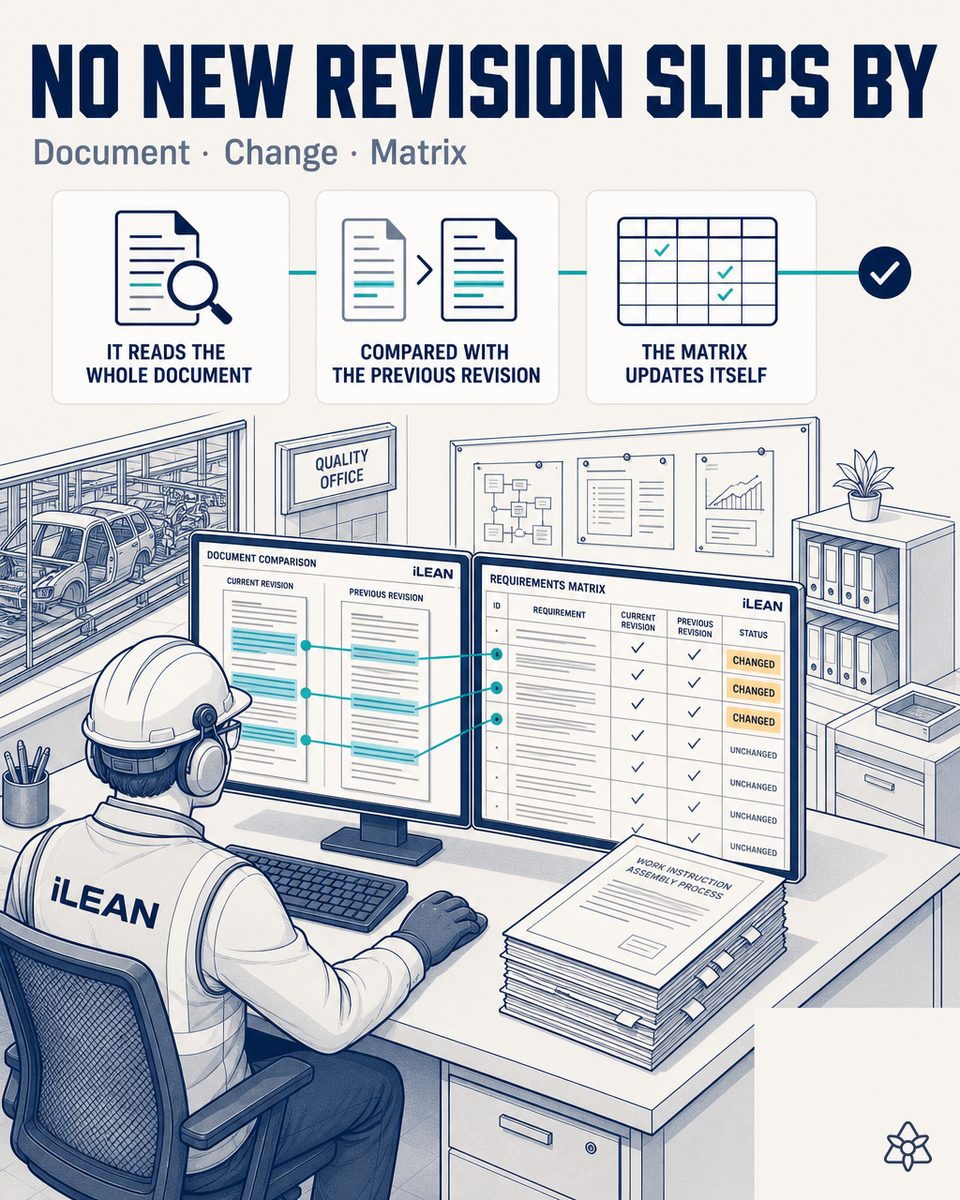
Every OEM publishes its CSR as PDFs running to dozens or hundreds of pages that change revision with little warning. iLEAN keeps the CSR matrix current on its own: Connect ingests the PDFs, a document-anchored model extracts and classifies every requirement, and Agents cross-check them against your procedures and flag the gaps. The person validates every match.
The CSR matrix goes stale by itself — and the gap surfaces at the audit or in a complaint.
The quality manager of a Tier-1 or Tier-2 tells the same story in every plant: each OEM publishes its Customer Specific Requirements as PDFs running to dozens or hundreds of pages, each with its own structure, its own vocabulary and its own portal. IATF 16949 requires you to demonstrate that the applicable CSR are identified and implemented in every process. And the tool used to demonstrate it, in practice, is an Excel matching matrix that somebody maintains by hand.
Three things happen at once, and almost nobody has time to look at them together:
- Revisions come out with barely any warning — the OEM posts the new version on its portal and does not highlight what changed. Finding out depends on somebody going in to look; understanding what changed depends on rereading the whole document.
- The matrix goes stale with every revision — each CSR change forces you to go through the matches one by one, for several customers at the same time. It is the task that always loses against whatever is urgent.
- Every requirement hits a different process — APQP, PPAP, traceability, packaging, logistics. The full PDF gets forwarded by email with a “take a look at this” and each owner eyeballs their own part. Whatever nobody claims ends up with no owner.
The outcome is always the same: the gap surfaces at the IATF audit or, worse, in a customer complaint about a requirement from a revision nobody processed. The knowledge of what each customer demands lives in the quality manager's head; the day they move on, the matrix is orphaned.
iLEAN does not replace your document system — it reads what nobody has time to read.
The CSR problem is not a lack of documentation: the PDFs are there, the internal procedures are there, the matrix exists. The problem is that nobody can reread hundreds of pages per customer on every revision and keep the matches alive. iLEAN acts as the putty that binds each customer's CSR, your internal procedures and your process map, without asking you to change the document manager or the matrix format the auditor already knows.
Connect ingests each customer's CSR PDFs. A document-anchored model extracts and classifies the requirements. Agents cross-check them against your procedures and flag the gaps. The person validates every match before it is closed.
The two iLEAN pieces applied to OEM CSR:
- Connect — ingests each customer's CSR PDFs, revision by revision. A language model anchored to the document (extraction, not free generation) identifies every requirement and classifies it by the process it affects: APQP, PPAP, traceability, identification and packaging, logistics, complaints. Every extracted requirement carries its exact citation — document, revision, page, paragraph — so that validating means reading the original, not trusting the summary.
- Agents — cross-check every extracted requirement against the plant's internal procedures and flag the gaps: requirements with no procedure covering them, procedures that fell short after a change. When the OEM publishes a new revision, they run the automatic diff against the previous one and report only what changed and who it affects. The Agents close nothing on their own — they propose the match, the quality manager validates it. Never the other way round.
Manual CSR matrix vs. CSR matrix with iLEAN
| Aspect | Excel matrix maintained by hand | With iLEAN Connect + Agents |
|---|---|---|
| Detecting a new CSR revision | Depends on somebody checking the customer portal | Automatic ingestion and diff, alert with what changed |
| Extracting requirements from the PDF | Manual reading of dozens or hundreds of pages | Document-anchored model, with page and paragraph citation |
| Matching to internal procedures | Goes stale with every revision | Gaps flagged by Agents, closed with human validation |
| Distribution by process (APQP, PPAP, packaging…) | Full PDF forwarded by email | Each owner sees only the requirements that affect them |
| Preparing the IATF audit | A one- or two-week sprint | Continuous evidence, traceable and exportable |
| When the gap is discovered | At the audit or in the customer complaint | Flagged as soon as it appears, with an owner assigned |
Impact estimate for your plant — to be validated with your numbers.
The block below is an estimate to be validated with the specific data of your plant. We put it forward so the committee has an order of magnitude; we refine it during the diagnostic.
- IATF 16949 certified Tier-1 or Tier-2 supplier, with several active CSR portfolios (each customer with its own document, its own portal and its own revision calendar), matching matrix in Excel maintained by the quality team.
- Connect pilot ingesting the full CSR portfolio + Agents cross-checking against the internal procedures. First value expected within a few weeks: the initial matrix extracted, classified by process and with the first gaps flagged shows up early, before the first new revision arrives.
- CSR matrix always current without maintaining it by hand: every new revision comes in with an automatic diff and the affected matches flagged for revalidation — zero surprises from an undetected revision, as an estimate to be validated on your specific portfolio.
- IATF pre-audit with no two-week sprint: the evidence that CSR are identified and implemented exists continuously, and what is left is reviewing the open items, not rebuilding everything.
- Indicative payback between 4 and 9 months (estimate to be validated). The hard lever is not only the reading hours saved: it is the cost of a major non-conformity or a customer complaint about a requirement nobody processed.
- A recurring benefit that does not go into the ROI but weighs: the map of what each customer demands stays as a permanent capability of the plant, not of the person who one day moves on.
And the quality manager's reasonable doubt
“What if the AI marks a requirement as covered when it is not?” — iLEAN's Agents never close a match on their own. They propose; the quality manager validates with the original CSR paragraph right there; the matrix only records what has been confirmed. Hallucination is a problem of free generation, not of anchored tasks: in tasks where the AI extracts and cross-checks text anchored to the source document, the best models brought error below 1.5%[1]. And even so, what is critical goes to the safety rings — the Agents live in the outer ring, propose inward, and conformity towards your customer is signed by a person. Never the other way round.
[1] OpenAI paper “Why Language Models Hallucinate”, 2025 — on the reliability of AI in anchored tasks.
What people ask about digitizing OEM CSR with AI
How do I stop the AI from inventing a requirement?
Because there is no free generation: the model works anchored to the document. Every extracted requirement carries its exact reference — document, revision, page and paragraph of the original CSR — and if the text is not in the PDF, it does not exist for the system. Anchored extraction is a reading task, not a writing task: the model locates, classifies and cites; it never drafts new requirements. And even so, no requirement-to-procedure match is closed without human validation: the Agents propose, the quality manager confirms. Whatever ends up in the matrix is something you have seen, with the original paragraph right next to it.
What happens when the OEM publishes a new revision?
That is the moment the system pays for itself. Connect detects the new revision, ingests it and runs the automatic diff against the previous one: which requirements changed, which appeared, which disappeared. Instead of rereading a PDF of hundreds of pages hunting for the differences, you get an alert with only what changed and who it affects — if the change touches packaging, it notifies logistics; if it touches PPAP, project quality. The matrix updates with the affected matches flagged as pending revalidation; it does not quietly go stale.
Is it useful for the IATF 16949 audit?
That is one of the two moments where the difference shows most (the other is a customer complaint). IATF 16949 requires you to demonstrate that the applicable CSR are identified, integrated into the management system and implemented in every process. With a manual matrix, that evidence is rebuilt in a one- or two-week sprint before the audit. With iLEAN, the evidence exists continuously: every requirement with its exact source, its associated internal procedure, who validated the match and when, plus the revision history. The auditor asks for the traceability of one specific requirement and it comes out in seconds, not after an afternoon of documentary archaeology.
How does it classify requirements by process?
The model classifies every extracted requirement by the process it affects — APQP, PPAP, traceability, identification and packaging, logistics and deliveries, complaint handling, requirements passed down to sub-suppliers… — using a taxonomy tuned to your real process map, not a generic one. A single CSR paragraph can affect two processes and be classified under both. The practical result: when a revision lands, each process owner sees only the requirements that concern them, instead of getting the full PDF with a “take a look at this”.
How much work does it save and how fast does it pay back?
It depends on the number of customers and revisions per year — a Tier-2 with three active CSR portfolios is not the same as a Tier-1 with twelve. As an order of magnitude, and always as an estimate to be validated with your numbers: maintaining the matrix by hand (rereading revisions, updating matches, chasing every process owner) disappears as a recurring task, the one- or two-week pre-audit sprint shrinks to reviewing what is still open, and the expensive risk — the undetected CSR revision that ends in a customer complaint or a major non-conformity — no longer depends on somebody checking the portal in time. On that basis, indicative payback lands between 4 and 9 months. We send you the estimated ROI in 48h with your real customer portfolio.
More cases in automotive
- OEE on a multi-model car line — one aggregate number does not tell you where productivity is leaking.iLEAN measures OEE in plants running N models on the same line and breaks losses down by model, shift…
- Multifunction steering wheel control with AI — five worlds in a single part, and no cross-check in time.iLEAN combines Edge vision on the multifunction steering wheel, an electrical test of every button and…
- Multipack fastener control with AI — one screw missing from the kit is a phone call from the customer.How iLEAN counts and verifies every screw in the multipack kit in line with Edge vision and agents —…
- OEM injection molded part control with AI — the sink mark the eye does not catch until the OEM assembles it.How iLEAN verifies geometry, sink marks and flash on the OEM injection molded part in line with Edge and…
- Predictive maintenance for the paint booth and the curing oven — the one bottleneck that, when it stops, stops the whole plant.iLEAN detects paint booth and oven drift — filters, fans, zone temperatures — and proposes when to…
- Automotive plastic injection with AI — the defect is not discovered, it is anticipated before the scrap piles up.How iLEAN detects flash, sink marks and streaks in automotive plastic injection before the defect piles…
Tell us your case and in 48h we'll send you the estimated ROI of digitizing your customers' CSR matrix.
We work on your plant's real data, not ours. Diagnostic with no commitment.
Request estimated ROI in 48h See automotive