Exhaust and catalyst control with AI — clean welds, exact weight and Euro 6/7 with no surprises.
The catalyst concentrates two Tier 1 risks: expensive precious metals and Euro 6/7 type approval. iLEAN cross-references Edge vision on exhaust welds, weight per part of the washcoat with Pt/Pd/Rh and VIN traceability, and holds the part before final assembly. The person signs — the line does not restart on its own.
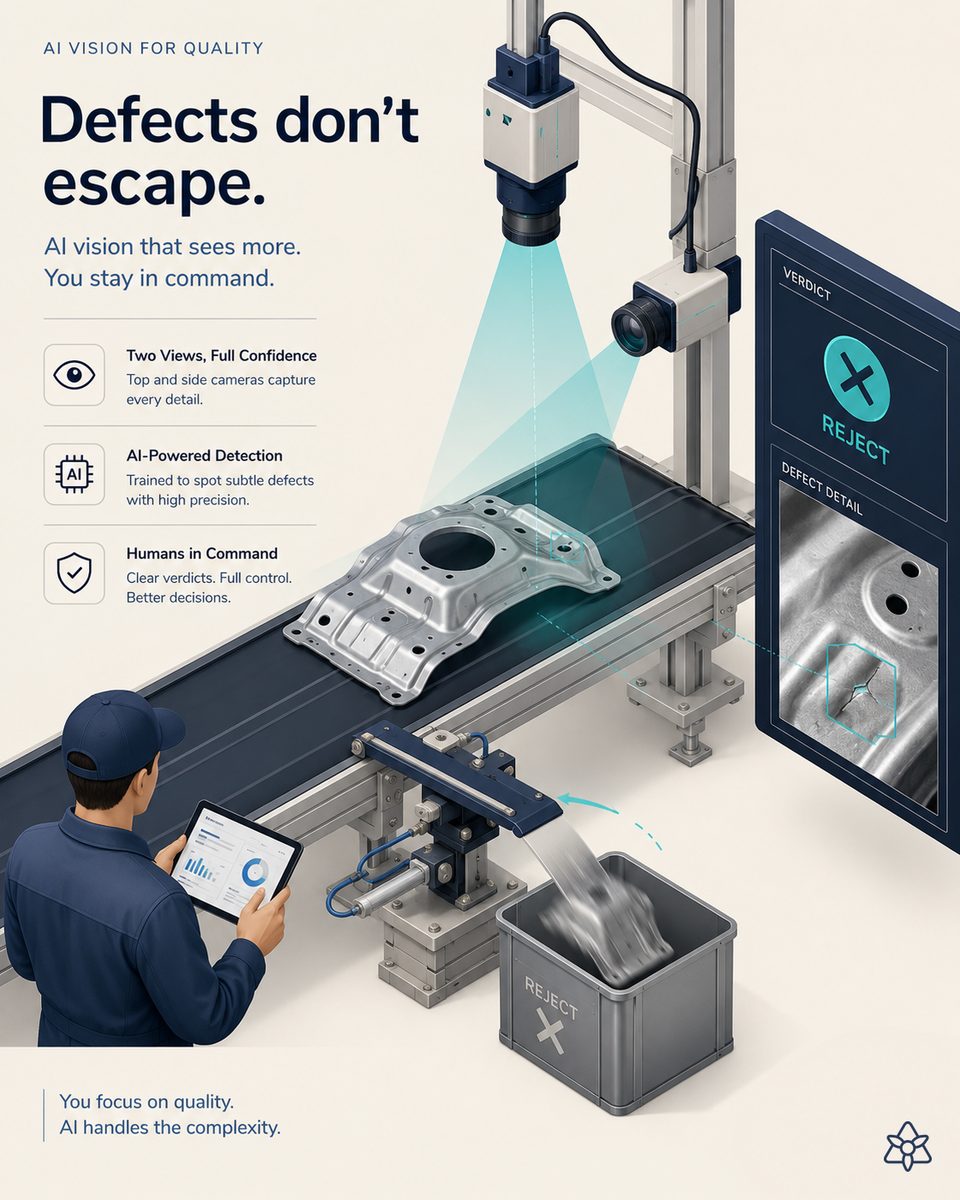
Two invisible defects: the bead with a pore and the washcoat that comes up a little short.
The exhaust+catalyst assembly concentrates two defects that sampling does not see and that hit the end customer hard:
- The exhaust pipe weld — MIG/MAG or laser robots on stainless steel, complex geometry, quality determined by speed, current and torch positioning. A bead with a pore or lack of penetration lets gas escape before the catalyst — the part passes the manufacturer's test and fails the end customer's after a few thousand kilometers.
- The washcoat with precious metals — the dispersion of platinum, palladium and rhodium onto the ceramic monolith is the functional and economic heart of the catalyst. Dosing is controlled by weight per part. A small variation: either the catalyst does not meet Euro 6/7 and comes back, or you are giving away precious metal part after part for a whole batch.
- The canning — the monolith is enclosed in its metal shell with a fiber mat that has to end up compressed within its pressure window. Too loose and it shifts; too tight and it cracks. It passes the visual check and fails the leak test.
- Traceability — the OEM and Euro 6/7 type approval require a file per VIN: which weld, which washcoat weight, which leak test result. Rebuilding it by hand when there is an incident is a week of the quality team's time.
The classic system (sampling + final test + weekly report) leaves the process manager in the dark about the precious metal balance until month-end — and by then the batches have already shipped, and if dosing was running high, so has the money.
iLEAN cross-references the bead, the weight and the leak test — without asking you to change anything.
Exhaust and catalyst control does not fail for lack of equipment: it fails because the welding robot data, the washcoat weighing data and the leak test data each live on their own island. iLEAN acts as the putty that fills those cracks without asking you to change robots, washcoat equipment or MES.
Edge sees every bead. Connect reads weight per part and leak test at second zero. The agent cross-references with the precious metal bath batch and builds the Euro 6/7 file per VIN. The person signs — never the other way round.
The three iLEAN pieces applied to exhaust and catalyst control:
- Edge — a machine vision terminal (CNN) over the exhaust pipe welding line. It inspects 100% of the beads after each robot: porosity, lack of penetration, undercut, crater. It acts on the ejector in milliseconds. It works with no network.
- Connect — captures the weight per part after washcoat (integrated scale or equipment panel), the Pt/Pd/Rh bath batch from delivery notes/email, the welding robot parameters (Fanuc, Kuka, ABB) over OPC-UA, and the leak test result. It unifies all of it at second zero.
- Agents — continuously cross-reference the bead, the washcoat weight, the bath batch, the calcination curve and the leak test. They spot drift in precious metal dosing before month-end close, and they build the Euro 6/7 file per VIN ready for IATF 16949 audit and for type approval.
Control in islands vs. cross-referenced control with iLEAN
| Aspect | Classic control (each machine on its own island) | With iLEAN Edge + Connect + Agents |
|---|---|---|
| Exhaust pipe weld | Sampling + final test | 100% inspected in line by Edge, milliseconds |
| Washcoat weight with Pt/Pd/Rh | Balance at month-end close | Captured part by part, drift caught within hours |
| Canning and leak tightness | Final test, not cross-referenced with the weld | Cross-referenced by the agent with the bead and weight of the same batch |
| Euro 6/7 traceability per VIN | Manual reconstruction when an incident hits | Automatic file, continuously |
| Operation with no network | n/a | Edge keeps inspecting on the light from the panel |
| OEM audit / type approval | Cold defense | Data ready, the conversation with the OEM changes |
Impact estimate for your plant — to be validated with your numbers.
The block below is an estimate to be validated with the specific data of your plant. We put it forward so the committee has an order of magnitude; we refine it during the diagnostic.
- Tier 1 plant with several robotic exhaust welding cells + washcoat + canning + leak test, European OEM under Euro 6/7 and IATF 16949.
- Edge pilot in one welding cell + Connect reading washcoat weight per part and the leak test + an agent that cross-references with the bath batch and builds the Euro 6/7 file per VIN. First value expected within a few weeks.
- Indicative payback between 4 and 9 months. Two hard levers: precious metal savings from fine-tuning the washcoat + reduction of Euro 6/7 returns from the OEM.
- Reduction of out-of-window beads against the baseline typically ≥30% — to be confirmed after measuring the "before".
And the OEM standard
The automotive quality standard for critical components sits on the order of 25 PPM[1]. For an emissions component under type approval, holding that without cross-referencing weld, washcoat weight and test is not viable in the medium term. AI in anchored tasks (classifying a bead against the catalog, reading a weight and comparing it with the window) has error rates below 1.5% in the best models[2], and even so it does not decide alone — it holds and asks for a human signature.
[1] Symestic — automotive quality standard on the order of 25 PPM for critical components.
[2] OpenAI paper “Why Language Models Hallucinate”, 2025 — on the reliability of AI in anchored tasks.
What people ask about exhaust and catalyst control with AI
Which critical defects can AI detect in an exhaust pipe and catalyst?
In the exhaust pipe: weld defects (porosity, lack of penetration, undercut, crater at the end of the bead), flange deformation, incorrect oxygen sensor positioning. In the catalyst: washcoat weight variation with platinum/palladium/rhodium, canning deviation (monolith badly clamped), micro-leak at the catalyst-to-pipe joint. iLEAN Edge inspects in line and Connect captures the weight per part and the result of the leak test — an assembly outside the OEM spec is held before final assembly.
Why does the exact amount of precious metal in the catalyst matter?
For two reasons — cost and emissions. Precious metals (Pt, Pd, Rh) are the most expensive component of the catalyst: dosing too little produces a catalyst that does not meet Euro 6/7 and comes back; dosing too much is giving money away part after part. iLEAN Connect captures the weight of every part after the washcoat and an Agent cross-references it with the bath batch and the calcination curve. When the dosing drifts, it is caught before the batches pile up — the process manager corrects the root cause instead of praying that the metal balance adds up at the end of the month.
How is exhaust welding cross-referenced with Euro 6/7 type approval?
Euro 6/7 type approval measures emissions in real-world conditions, and a micro-leak upstream of the catalyst (in a pipe weld) lets untreated gas escape — the part passes the manufacturer's test and fails the customer's. iLEAN cross-references the weld data (Edge vision on the bead + MIG/MAG/laser robot parameters through Connect) with the leak test on the assembly and with VIN traceability. If the weld does not reach the expected window, the part is held before it is assembled with the catalyst. The person signs — the line does not restart on its own.
Can iLEAN integrate with the welding robots and canning equipment already installed?
Yes — that is the putty metaphor. iLEAN does not force you to change the welding robots (Fanuc, Kuka, ABB), the canning line, or the washcoat weighing equipment. Connect reads what is already there (OPC-UA signals, Modbus, a local file on the robot, an HMI panel photographed by the operator if the machine is old) and puts it into the system. Edge is installed as an additional terminal. It works with no network: if the plant loses WiFi, the Edge inspection cycle keeps running, because what is critical cannot depend on WiFi.
How long does it take to see the first savings from a pilot on an exhaust line?
In comparable in-line automotive quality projects, the first value shows up within a few weeks. The estimated payback, to be validated with your data, sits between 4 and 9 months. The hard lever is the reduction in precious metal consumption through fine-tuning of the washcoat and the reduction of Euro 6/7 returns from the OEM. We ask for your plant's real data and send you the estimated ROI in 48h.
Related topics in automotive: Radiator and heat exchanger control · Jidoka in robotic welding · Fuel tank control.
More cases in automotive
- EV battery second life with AI — a misclassified module is not scrap, it is a loss event.How iLEAN cross-references BMS history, visual pack inspection and second-life criteria to sort reusable…
- AI manufacturing control of the on-board charger (OBC) — out-of-torque tightening does not fail at EOL; it fails months later, in the field.The OBC passes EOL and fails in the field months later. iLEAN ties torque and angle to the serial,…
- EV traction inverter control with AI — the weld the final electrical test cannot see is the one that gets whole populations blocked in the field.iLEAN verifies 100% of the EV inverter busbar welds and stitches the SiC/IGBT module genealogy so a…
- AI fuel tank control — a leak is not an incident, it is a recall.How iLEAN combines Edge vision, leak testing and traceability to catch leaks, weld defects and valve…
- IATF 16949 with AI — a five-star audit with no last-minute sprint.iLEAN keeps IATF evidence live and meets the specific CSR of every OEM you supply. A five-star audit…
- Predictive maintenance on KUKA / Fanuc / ABB robots — one broken gearbox stops the entire line.iLEAN monitors vibration, current and temperature on every robot axis. Gearbox failures predicted weeks…
Tell us your case and in 48h we'll send you the estimated ROI of this AI project for your exhaust and catalyst line.
We work on your plant's real data, not ours. Diagnostic with no commitment.
Request estimated ROI in 48h See automotive