Powder coating defects with AI — a crater found late is scrap; found on the line, it is nothing.
The classic powder coating defects — crater, sag, orange peel, seed — only show under controlled light at the end of the line, when it is already too late to correct and the powder is unrecoverable. iLEAN Edge detects them inside the cycle, before the oven or at the exit, with an actuator firing in milliseconds. The part is recovered, the powder is reused, the OEM never finds out.
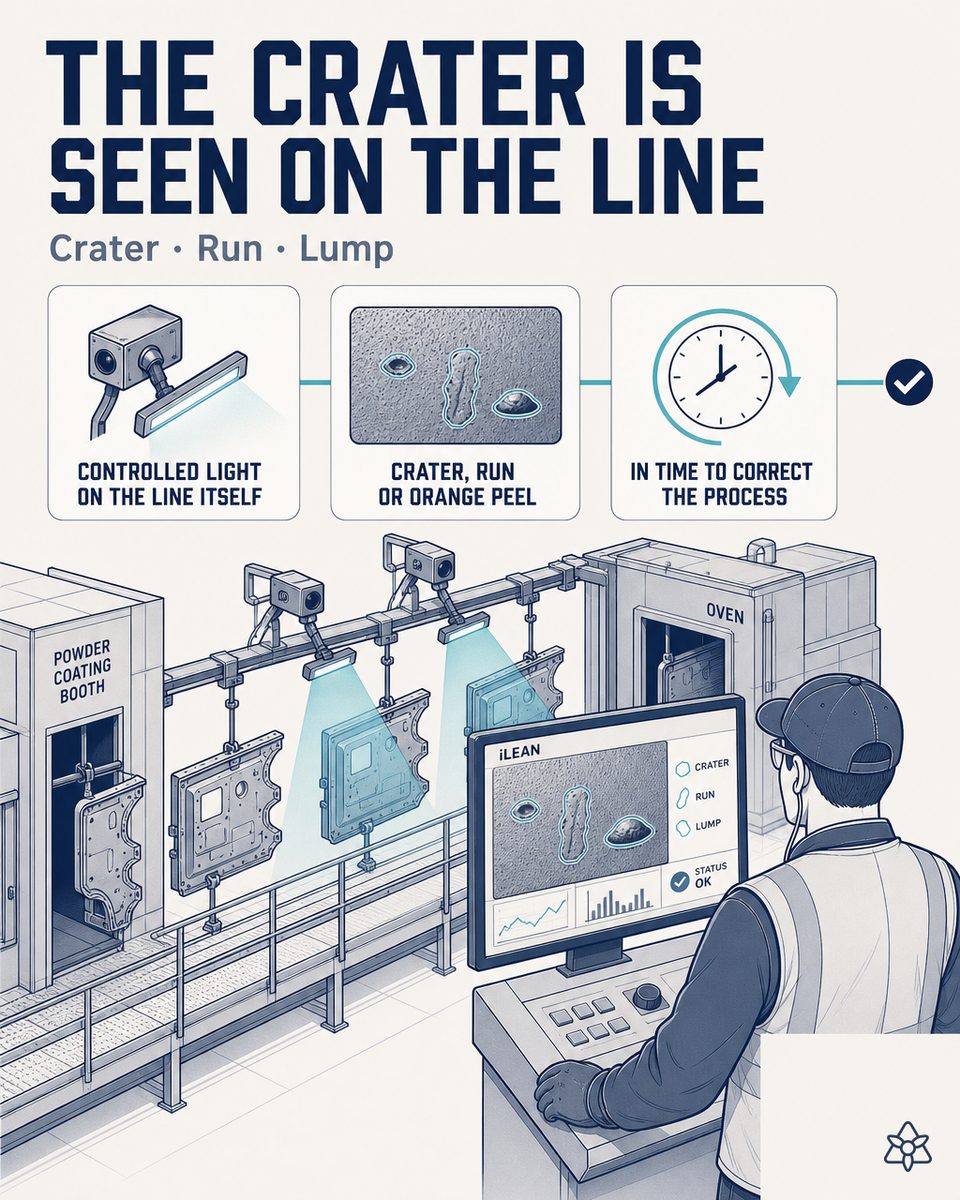
Coating quality only shows at the end — and at the end it can no longer be fixed.
Classic quality control on a tier-1 powder coating line works like this: the operator at the end looks at the part under the inspection booth light, marks what they see, and it gets scrapped. The problem is that by then:
- The coating is already cured — before the oven the powder could be reclaimed, the part blown off and repainted. After the oven, neither the part nor the powder can be recovered: real scrap, in kilos and in euros.
- The defect may have been repeating for a while — dozens of parts can go by between the moment it starts and the moment it is seen. The root cause (a change in powder viscosity, dirt on the overhead conveyor, a drifting applicator parameter) is still active.
- The OEM demands 25 PPM — the automotive quality standard is in the order of 25 parts per million [1]. At that level of demand, every false positive costs and every false negative gets seen.
- The knowledge walks out with the veteran — the people who can read a part as it goes past are always one or two experienced operators. The day they retire, part of the control goes with them.
The quality manager knows it, the plant manager lives with it, the OEM's buyer bills for it. The classic setup — operator + controlled light + a trained eye — works 99% of the time. That 1% is what reaches the OEM, and at this level of demand that 1% is enough.
iLEAN Edge does not replace the veteran operator — it captures their eye as a permanent capability.
The problem with powder coating control is not information: it is the capacity to look at every part, all the time, with the same attention as in the first minute. And no person, however good, can sustain that. iLEAN acts as the putty that fills the gap between the veteran's expertise and full coverage of the line, without asking you to change your applicator, your oven or your PLC.
Edge sees the part before the oven and at the exit. Connect reads the old applicator without having to replace it. The agent cross-references root cause and work order. The person decides the corrective action. The warm bed: the shift walks in and finds everything already sorted.
The three iLEAN pieces applied to automotive powder coating:
- iLEAN Edge (Vision) — physical terminals with a CNN trained on your parts, installed before the oven and at the exit. They detect craters, sags, orange peel, seeds and coverage gaps. They fire an actuator in 45 ms (stack light, ejector, dry contact to the PLC). They work with no network: if the plant loses its internet connection, the critical detect-and-intervene cycle carries on for as long as the device has power.
- iLEAN Connect — reads the old applicator with no need to replace it (graded capture: manual, intermediate, integrated, depending on the age of the machine). And it captures what comes in from outside (a powder batch change from the supplier, a new technical data sheet, a WhatsApp from the maintenance tech) at second zero.
- iLEAN Agent — cross-references the detected defects with the applicator, the raw material, the overhead conveyor and the oven. When a pattern repeats (seeds every time powder viscosity drifts), it does not send an email at 10 p.m.: it prepares the work order for the maintenance tech and the adjustment proposal for the coating supervisor. The person signs — Agents have no hands on critical OT.
Manual end-of-line control vs. digital jidoka with iLEAN Edge
| Aspect | Manual control + final booth | With iLEAN Edge + Vision + Agent |
|---|---|---|
| When it is detected | End of line, coating already cured | Before the oven + at the exit, inside the cycle |
| Recovering part and powder | Impossible — part goes to scrap | Blow off and repaint before the oven |
| Coverage | 100% of the booth, real % lower through fatigue | 100% of every part, no fatigue |
| Root cause detection | Later analysis, days | Pattern cross-referenced with the applicator in real time |
| Operation with no network | n/a | Edge keeps detecting on panel power |
| Defect that reaches the OEM | Whatever slips through in the 1% — expensive | Drops to a defensible level — > 98% caught on the pilot line |
Impact estimate for your plant — to be validated with your numbers.
The block below is an estimate to be validated with the specific data of your line. We put it forward so the committee has an order of magnitude; we refine it during the diagnostic.
- Powder coating line for automotive parts (subframes, cross members, exhaust pipes, leaf springs), with defect scrap at 2-5% and an OEM requirement in the order of 25 PPM.
- Edge pilot before the oven + cameras at the exit + integration with the ejection actuator and the line PLC. First value expected within a few weeks: detection of the most frequent defects above 90%.
- Indicative payback between 3 and 6 months, depending on your current scrap cost, the cost of wasted powder and your exposure to an OEM complaint. The real pilot line closed at roughly 3 months; the wide range reflects plant-to-plant variability.
- A reduction in defects reaching the end of the line of ≥ 50% is achievable within 60 days; with root cause discipline from the coating team, it can reach > 95% as in the textbook case.
And the plant manager's reasonable doubt
“What if the AI gets it wrong and lets a serious defect through to the OEM?” — hallucination is a problem of free generation, not of anchored tasks. In tasks where the AI recontextualizes a piece of data (looking at a part and saying whether it has a crater), the best models brought error below 1.5% [2]. And even so, the operator is still there: Edge acts as a safety net, not as a replacement. The operator's warm bed is knowing that a hundred invisible agents secured the shift; theirs is the decision that matters.
[1] Symestic — automotive quality standard in the order of 25 PPM (parts per million).
[2] OpenAI paper “Why Language Models Hallucinate”, 2025 — on the reliability of AI in anchored tasks.
What people ask about detecting powder coating defects with AI
Which defects exactly does iLEAN Edge detect in powder coating?
The classic powder coating ones: craters (pinpoint cavities from contamination), sags (runs from bad application or poor viscosity), orange peel (uneven texture from curing or flow rate), seeds (foreign bodies or agglomerated powder), coverage gaps on edges and recesses, and visible thickness variation. iLEAN Edge covers the two moments when the defect is still recoverable: before the oven (when you can still blow the part off and reuse the powder) and at the oven exit (when you can still divert the part before it is assembled into the chassis).
Does it work on parts with complex geometry?
Yes. The CNN is trained on real samples of the specific part — chassis, subframe, cross member, leaf spring, exhaust pipe. Geometries with many edges, recesses or hidden areas are covered with multiple cameras oriented to sweep the critical points; the intelligence lies in knowing which point can or cannot fall outside the field of view, not in pretending to see everything. iLEAN explicitly flags the blind zones instead of inventing a data point — the system's honesty is part of the product. For new variants, training is measured in days, not weeks.
Does it tell color and metallic reflection apart?
Yes, with the right lighting. Automotive powder coating has a wide and sometimes metallic palette; the lighting has to control reflections so the CNN can tell a real defect from an optical artifact. iLEAN integrates lighting specific to each color/finish and the model is trained to discriminate — not everything shiny is a crater, not every shadow is a coverage gap. On the real powder coating line where we deployed the solution, having different colors coexist across batches was part of the problem solved, not an edge case.
How is a new defect trained?
Three steps: (1) iLEAN captures the parts with the defect as they appear — you do not wait for a complete dataset, it is enough for the operator or the quality manager to flag “this defect is new”; (2) the iLEAN team retrains the CNN with your material, not with generic samples — training is measured in hours to days depending on the variety; (3) the new model is validated in parallel with the current one before going into production, without stopping the line. The golden rule: the defect is learned from your samples, not from a closed catalog that does not match your process.
Does it integrate with the in-line rejecter?
Yes. iLEAN Edge triggers actuators (ejector, stack light, dry contact to the PLC) in milliseconds — on the real powder coating line, the actuator fired 45 ms after detection. What gets diverted depends on your line: part pulled out for repainting before the oven, part pulled out for rework after the oven, line stop if the pattern repeats. And if the plant loses the network, Edge keeps detecting and intervening, because the critical cycle does not depend on WiFi — what is critical in a plant can never depend on connectivity.
More cases in automotive
- OEM injection molded part control with AI — the sink mark the eye does not catch until the OEM assembles it.How iLEAN verifies geometry, sink marks and flash on the OEM injection molded part in line with Edge and…
- Predictive maintenance for the paint booth and the curing oven — the one bottleneck that, when it stops, stops the whole plant.iLEAN detects paint booth and oven drift — filters, fans, zone temperatures — and proposes when to…
- Automotive plastic injection with AI — the defect is not discovered, it is anticipated before the scrap piles up.How iLEAN detects flash, sink marks and streaks in automotive plastic injection before the defect piles…
- Radiator and heat exchanger control with AI — zero leaks reaching the OEM.How iLEAN cross-references Edge vision on tubes and fins, helium or pressure-decay leak testing and…
- REACH/ELV material traceability — an undeclared SVHC is not an incident, it is a suspended order.iLEAN links the supplier declaration, the BOM and the finished product to keep REACH and ELV covered on…
- AI control of seat belts — the failure does not show up until the day of the crash.iLEAN combines Edge vision over the webbing, load test data captured by Connect and VIN traceability,…
Tell us your case and in 48h we'll send you the estimated ROI of this AI project for your powder coating line.
We work on your line's real data, not ours. Diagnostic with no commitment.
Request estimated ROI in 48h See automotive