AI control of seat belts — the failure does not show up until the day of the crash.
A badly stitched belt or a retractor outside its window means a recall of millions of vehicles: the press has written that story many times. iLEAN brings together Edge vision over the stitching and the retractor, the load test bench data Connect captures, and batch-to-VIN traceability — and holds the unit before it ships when something does not add up. The person signs.
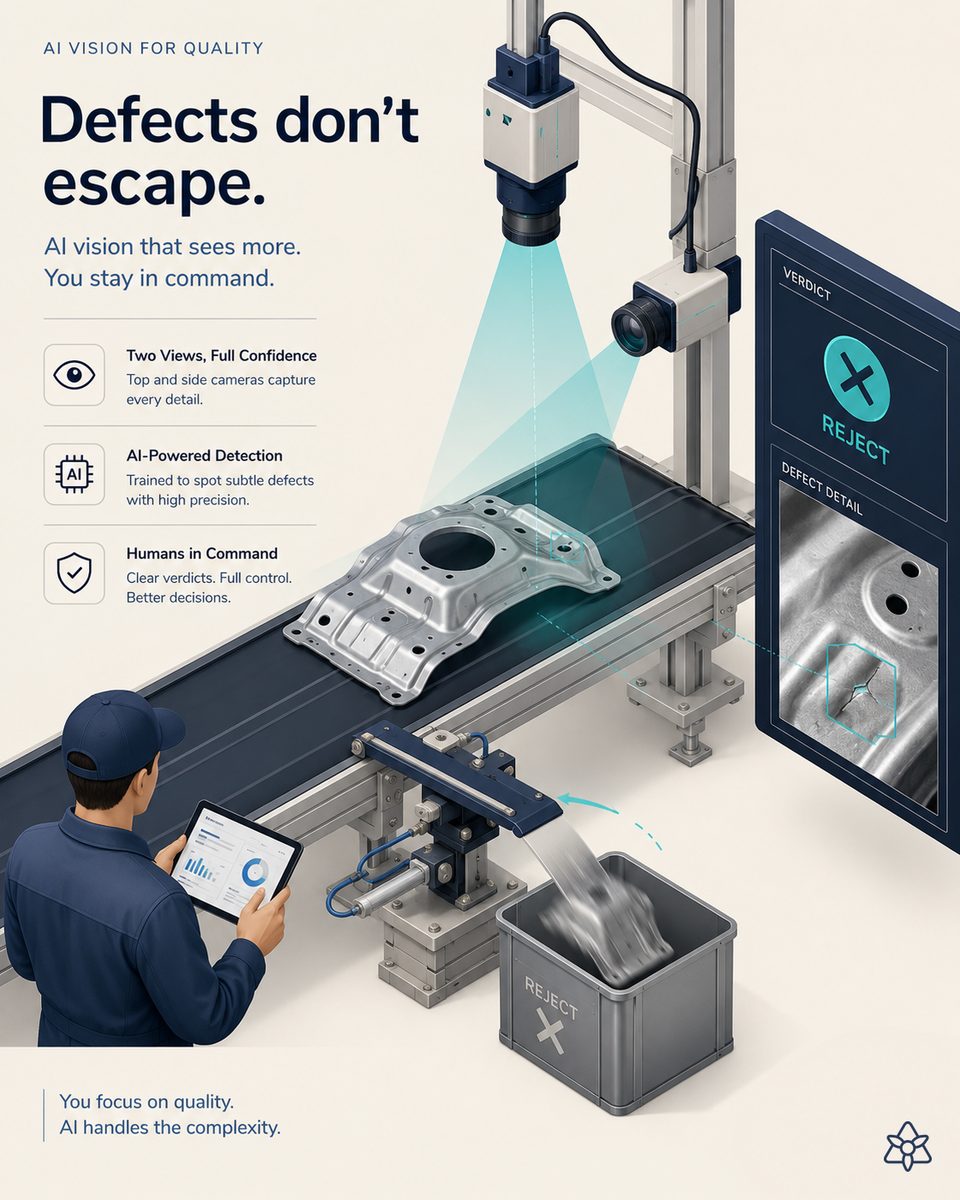
Four sources of failure, and every one of them lives in a different system.
A modern seat belt brings together four groups of components, and each one has its own defect pattern:
- The webbing — woven polyester, thread marking, end stitching. A skip in the weave or a dropped stitch changes the load curve.
- The retractor — spring, inertial sensor, pyrotechnic pretensioner. If the spring torque falls outside the window or the pretensioner carries a bad weld, nobody notices until the dynamic test (and sometimes not even there).
- The hardware and the anchorage — stamped sheet metal, spot welding, end riveting. A weld with porosity only shows up in the destructive test, and that test is sampled.
- The model recipe — adult webbing vs. child kit, length, color, OEM-specific connector. The SKU changeover is exactly when parts get mixed up.
The quality manager knows the dynamic bench at end of line is destructive and sampled. The static load test covers only a fraction. The classic system (bench + checklist + after-the-fact audit) works 99% of the time — and that 1% is what makes the evening news. Every mass seat belt recall started exactly like that.
iLEAN does not replace the bench — it puts 100% in-line control on top of it.
The seat belt problem is not a lack of a bench: it is information split into islands (the bench result on its own PC, the stitching logged by the sewing machine, the retractor torque in another window, the model recipe in the MES). At the critical moment — the unit leaving the line — those four sources are never cross-referenced. iLEAN acts as the putty that fills those gaps without touching the bench or the sewing machine.
Edge sees the webbing, the stitching and the retractor on the line. Connect captures the bench result and the model recipe. The agent cross-references against UNECE R16 and holds. The person signs — never the other way round.
The three iLEAN pieces applied to seat belt control:
- Edge — a terminal with machine vision (CNN) over the critical stations: image of the webbing (weave defects, marking thread), of the end stitching, of the riveted hardware and of the retractor marking. It fires the actuator (light stack, diverter) in milliseconds if something does not add up. It works without a network: if the plant loses WiFi, Edge keeps reading and holding units.
- Connect — captures the load test bench result (static and dynamic) whether it comes from a modern bus, from the bench's old PC, or read by a camera off the display. It also captures the retractor spring torque from the calibration machine and the model recipe from the ERP/MES. Whatever arrives from outside (an email from the pretensioner supplier flagging a suspect batch) enters at second zero.
- Agent — cross-references the Edge image, the bench result, the retractor torque, the pyrotechnic pretensioner batch, the destination VIN and the model recipe. If something does not add up, it holds the unit and alerts the quality manager on their own channel. The person validates and signs; the line never restarts on its own.
Sampled bench + audit vs. in-line control with iLEAN
| Aspect | Today (bench + checklist + after-the-fact audit) | With iLEAN Edge + Connect + Agent |
|---|---|---|
| Load test coverage | Sampled by batch, destructive | Bench kept + 100% in-line vision per unit |
| End stitching defects | Human eye, end of shift | CNN vision over the stitching, before winding |
| Retractor torque | Calibrated by batch, logged locally | Captured by Connect, linked to the serial number |
| Multi-model SKU changeover | Paper checklist, risk at the changeover | Edge validates the fitted part vs. the model recipe |
| Batch-to-VIN link | Rebuilt if there is an incident, weeks | Per-unit dossier, automatic, ready for PPAP/8D |
| Operation without a network | n/a | Edge keeps running on the panel's own light |
Impact estimate for your plant — to be validated with your numbers.
The block below is an estimate to be validated with the specific data of your plant. We put it forward so the committee has an order of magnitude; we refine it during the diagnostic.
- Multi-model seat belt assembly line (adult, child kit) with an end-stitching sewing machine, retractor calibration and a dynamic load bench at the end.
- Edge pilot on one line (camera over the stitching + camera over the retractor + integration with the bench). First value expected within a few weeks.
- Indicative payback between 4 and 9 months, depending on how often the OEM has raised PRR/8D in recent years.
- The hard lever is a single recall avoided: the cost of one passive safety workshop callback pays for the pilot and the rollout to the other lines.
And the quality manager's reasonable doubt
“What if the AI gets it wrong and lets a belt with defective stitching through?” — hallucination is a problem of free generation, not of anchored tasks. In tasks where the AI merely compares an image of the stitching against a learned pattern, the best models brought error below 1.5% [1]. And even so, what is critical is never decided alone: iLEAN holds the unit and the person signs. The automotive quality standard of the order of 25 PPM [2] is not sustained with sampling: it is sustained with vision on every part.
[1] OpenAI paper “Why Language Models Hallucinate”, 2025 — on the reliability of AI in anchored tasks.
[2] Symestic — automotive quality standard of the order of 25 PPM.
What people ask about AI control of seat belts
Which critical defects can vision + AI detect in a seat belt?
Webbing defects (skips in the polyester weave, a dropped stitch, a badly sewn marking thread), retractor defects (spring torque outside the window, a badly welded pyrotechnic pretensioner lock), hardware defects (riveting torque outside the window, porosity in the anchorage weld), and part mix-ups (adult webbing fitted into a child kit, wrong color for the vehicle version). iLEAN Edge sees all four groups on the assembly line; Connect captures the data from the load test bench; the agent cross-references it with the model recipe.
Why does a seat belt defect turn into a mass recall?
Because the belt is a passive safety component regulated piece by piece (UNECE R16) and validated against the dynamic load test. A failure in the pyrotechnic pretensioner, in the end stitching or in the retractor spring is only discovered at the moment of the crash — and that is why regulation forces you to notify and recall every unit built from the same suspect batch. The press has reported dozens of mass seat belt recalls. The classic control system (sampling + eye + checklist) lets the outlier through, and that outlier is the one that makes the evening news.
Can the existing load test bench be integrated without replacing it?
Yes. iLEAN Connect has a graded capture approach per machine: if the bench has a modern bus, direct integration; if it has an old, isolated local PC, Connect hooks in and extracts the data without touching the equipment; if the data only comes out on an old thermal printer, a camera reads it. We do not force you to change the bench — what changes is that the test result stops living on the bench's paper roll and enters the per-unit dossier at second zero.
How is each belt linked to the destination vehicle's VIN?
Edge reads the marking/label of the assembled belt and the agent cross-references it with the production order in the MES and the destination VIN. The per-unit dossier stays linked forever — ready for PPAP, for the OEM's 8D and to answer a possible call from the authorities without rebuilding anything. If a part is mixed up during an SKU changeover (for example, a child kit for the Comfort version vs. the Sport one), the agent holds the batch before it ships.
How much does an iLEAN seat belt control pilot cost?
The order of magnitude of an Edge pilot on a seat belt line is similar to that of any Edge pilot in automotive: vision terminals + integration with the load test bench + annual license. A reasonable payback to present to the committee is several months — the hard lever is a single recall avoided (the cost of a passive safety workshop callback, the potential penalty, the OEM brand damage that lands on the Tier 1). We ask for your plant's data and send you the estimated ROI in 48h, with your numbers, not ours.
More cases in automotive
- Powder coating defects with AI — a crater found late is scrap; found on the line, it is nothing.iLEAN Edge detects craters, sags and orange peel in powder coating on automotive parts as they come out…
- Radiator and heat exchanger control with AI — zero leaks reaching the OEM.How iLEAN cross-references Edge vision on tubes and fins, helium or pressure-decay leak testing and…
- REACH/ELV material traceability — an undeclared SVHC is not an incident, it is a suspended order.iLEAN links the supplier declaration, the BOM and the finished product to keep REACH and ELV covered on…
- Automotive seat manufacturing with AI — a silent module at end of line is a broken JIS sequence at the OEM.How iLEAN cross-references vision, tightening torque, electronic testing and traceability to build…
- Stamping dimensional control with 3D vision — die drift can be seen coming strokes ahead; finding it in the scrap bin is too late.iLEAN measures the critical dimensions of 100% of stamped parts in line with 3D vision and sees die…
- Coil-to-stamped-part traceability — without the link, you pay for the claim against the steel supplier yourself.iLEAN keeps the coil → stamped part link alive so claims against the steel supplier are covered.
Tell us your case and in 48h we'll send you the estimated ROI of this AI project for your seat belt line.
We work on your plant's real data, not ours. Diagnostic with no commitment.
Request estimated ROI in 48h See automotive