Automotive PCB defects — classic AOI does not learn the new component; iLEAN Vision does.
Traditional AOI lives on templates and rules, and falls short with every new component, every supplier change and every subtle defect (cold solder, false solder joint, a 5° rotation). iLEAN Vision adds a CNN that learns your line's defects from your own boards — with no recipe to reprogram every time — and cross-references them with the upstream root cause.
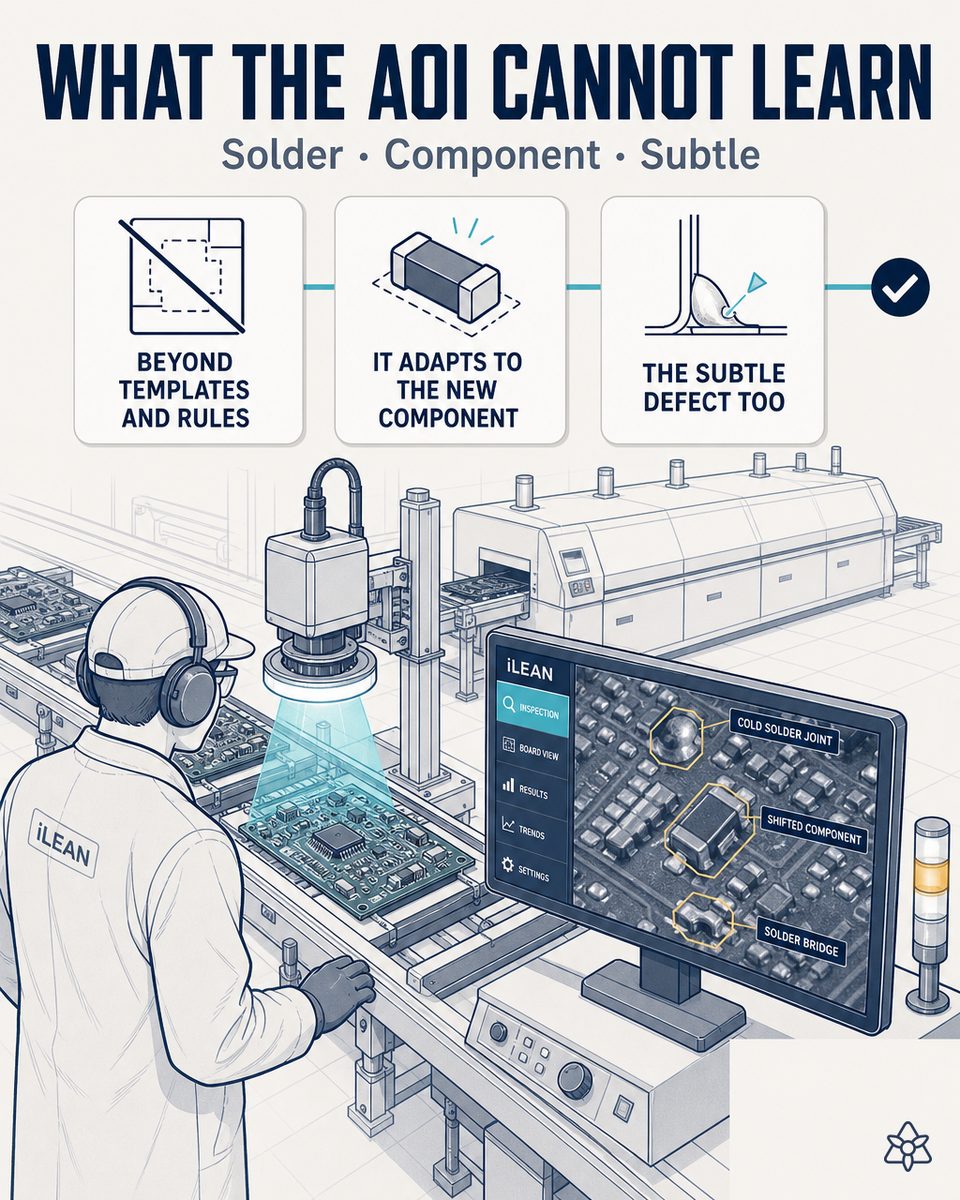
Classic AOI is excellent with what it knows; blind to what is new.
An SMT line for automotive electronics (BCM, ECU, ADAS systems, infotainment) has run classic AOI for decades — and run it well. The template- and rule-based system works for the defects the process engineer already knows and has coded. The problem is whatever has not been coded yet:
- New components with no validated recipe. Every NPI (new product introduction) means weeks of tuning the AOI recipe before it stops screaming.
- Supplier changes. A functionally equivalent MLCC with a different marking fires false positives for a week — and the team learns to ignore them. Until a real one slips through.
- Subtle defects — marginal cold solder, false solder joints, paste halo, a 5° rotation on an SOIC — that sit in the grey zone of the rules.
- New defects that appear because of an upstream change (new paste, new oven profile, new PCB batch) and that the old recipe was not looking for.
The classic outcome: the AOI produces a false positive rate that saturates the rework team (and teaches them to ignore it), or it gets tuned down until it goes quiet and then lets the subtle stuff through. In automotive, the subtle stuff reaches the customer's ECU and, one day, comes back as a warranty failure or, worse, as a safety recall.
iLEAN does not replace your AOI — it learns what your AOI cannot code and cross-references the root cause.
The problem is not the AOI; the problem is that the reality of the line changes (new component, new supplier, subtle defect) faster than a human can code rules. iLEAN acts as the putty that fills that gap with a CNN which learns from real examples from your plant, without asking you to throw the AOI away.
Classic AOI sees what has been coded. iLEAN Vision sees what is new, what is subtle and what changes. The agent cross-references both, notes the upstream root cause and proposes to the process engineer what to fine-tune.
The three iLEAN pieces applied to automotive PCB defects:
- Edge + Vision — a terminal with a CNN over the line (between the pick-and-place and final inspection, or as a second read after the classic AOI). It learns your process's defects from real flagged boards; retraining in hours, not weeks. It works with no network — inspection continues even if the plant loses WiFi.
- Connect — captures the classic AOI log, the X-ray output (if there is any), the oven recipe, the solder paste batch, the PCB part number and the supplier data from the ERP. And it captures what comes in from outside (an alert from the component supplier, a quality note from the customer) at second zero, with nothing to forward.
- Agents — cross-reference the optical verdict, the classic one and the process data; they correlate today's cold solder spike with yesterday's paste batch change and tell the engineer. They generate a per-panel dossier for a customer complaint. The person validates any change to the recipe — the line does not restart on its own after a hold.
Classic AOI alone vs. AOI + iLEAN Vision with root cause correlation
| Aspect | Classic AOI alone | AOI + iLEAN Vision + Connect + Agents |
|---|---|---|
| New component | Weeks tuning the recipe | Hours retraining with dozens of examples |
| Supplier change | False positives for days | The CNN learns both variants; the agent traces it to the batch |
| Cold solder / false solder joint | Grey zone, depends on thresholds | Learned from the real visual signature of your line |
| New defect (from upstream) | Slips through until a human codes it | The CNN detects it; the agent correlates it with the upstream change |
| Unified optical + X-ray verdict | Two systems, two sheets | One dossier per panel, cross-referenced |
| Operation with no network | n/a | Edge keeps inspecting locally |
Impact estimate for your plant — to be validated with your numbers.
The block below is an estimate to be validated with the specific data of your plant. We put it forward so the committee has an order of magnitude; we refine it during the immersion diagnostic.
- SMT line with a classic AOI installed, 8-15 active part numbers, frequent NPIs and recurring supplier changes.
- Edge + Vision pilot as a second read after the AOI on the part number with the most false positives or the most rejects. First value expected within a few weeks: false positives down and the subtle defect detected.
- Indicative payback between 4 and 9 months, depending on annual volume, rework cost, component scrap cost and the weight of warranty campaigns with “PCB defect” as root cause.
- Hard lever: a ≥ 30% reduction in false positives and a ≥ 30% reduction in the NPI time needed to get reliable AOI on a new part number (estimate to be validated). A single warranty campaign avoided because of cold solder pays for the pilot.
The standard that measures whoever audits you, and the CAIO's reasonable doubt
Automotive quality operates in the order of 25 PPM (parts per million) of admissible defects [1]. For automotive electronics with functional safety, that floor is a ceiling — and classic AOI only reaches it with long NPIs and hand-tuned templates. The CAIO's reasonable doubt (“what if the CNN hallucinates on a new component?”) is defused: AI here invents nothing — it classifies an image against real examples from your line. In tasks anchored to the source, the best models bring error below 1.5% [2]. And even so, what is critical is never decided alone: iLEAN holds the suspect panel, the person signs.
[1] The 25 PPM automotive quality standard — Symestic.
[2] OpenAI paper “Why Language Models Hallucinate”, 2025 — on the reliability of AI in anchored tasks.
What people ask about automotive PCB defects with AI
Does iLEAN Vision replace the classic AOI already installed?
Not by default. iLEAN's philosophy is putty — it seals the cracks between what you already have, it does not demolish it. Classic AOI (template- and rule-based) works well for repetitive, well-defined defects. iLEAN Vision complements it with a CNN trained for the cases where classic AOI falls short: new components with no validated recipe, marginal cold solder, subtly shifted placement, defects the process engineer had not yet coded. In plants that have run AOI for years, the two usually coexist; in new plants, it can run alone. Your line's defect Pareto decides.
Does it detect cold solder and false solder joints?
Yes. Cold solder and false solder joints are two of the defects that most often slip past classic AOI, because their visual signature is subtle — the look of the meniscus, the shine, the shape of the fillet. The iLEAN Vision CNN is trained on real examples from your line (the very boards flagged by the quality team) and learns the signature of that defect family in your specific process, with your solder paste and your oven profile. The difference from a rule-based AOI is that it does not need an engineer to code “what a cold solder looks like” — it learns it from photos.
How is the system trained for a new component?
With a handful of real boards (dozens, not thousands) flagged by the quality team or by the agent assisting the process engineer. Edge captures the images, Connect labels them semi-automatically with the operator's help by voice, and the model is retrained in hours, not weeks. The big difference from classic AOI: there is no new recipe to program — there is a new set of examples to add. When a new component from the supplier arrives, it is covered in a morning.
Does it work with BGA and components with hidden joints?
Optical vision has a clear physical limit with BGA and hidden balls — that is what X-ray inspection is for. iLEAN Vision complements it: the CNN inspects what is visible (marking orientation, presence, gap between component and board, visible paste halo) and leaves electrical/radiographic inspection where it belongs. If your line already has X-ray, Connect reads its output and the agent cross-references it with the optical inference to give a single verdict per board, instead of two systems that do not talk to each other.
What about the same component coming from a different supplier?
That is the most painful real-world case in automotive electronics: the component is functionally equivalent, but the batch from a different supplier has a marking in a slightly different typeface, a different shine or a pad size 0.1 mm off — and classic AOI fires false positives for a week. The iLEAN CNN learns that both variants are valid by being shown examples of each; the agent ties this to the batch and the supplier declared in the ERP through Connect, and leaves a signed record of the change. If the new supplier's batch really does carry a problem, it is the first to spot it — but it stops screaming about the typeface.
More cases in automotive
- iLEAN cases for Tier-2 automotive metal stamping plants12 real iLEAN cases for Tier-2 plants stamping suspension and seating parts: paperless orders, press…
- Artificial intelligence for automotive paint and component assembly plants12 industrial AI cases for automotive paintshops: FTQ, scrap, color changeovers, JIS sequence and IATF…
- Industrial AI in passive safety manufacturing plants12 real industrial AI cases in airbag, seat belt and steering wheel plants: unit traceability, in-line…
- Industrial AI for automotive plastic injection plantsHow iLEAN applies IRIS (Edge, Connect, Agents) to automotive plastic injection plants: traceability,…
- Industrial artificial intelligence for automotive plastic interior module plantsTwelve real cases of AI in injection molding and assembly plants for instrument panels, door trims and…
- SMED on presses with AI — every changeover minute you lose again is a production shift that never existed.iLEAN times every step of the die change by vision and proposes what to eliminate in the next shift.
Tell us your case and in 48h we'll send you the estimated ROI of this AI project for your SMT line.
We work on your plant's real data, not ours. Diagnostic with no commitment.
Request estimated ROI in 48h See automotive