Shift supervisor AI assistant — so the handover inherits context, not hallway rumors.
The supervisor spends the shift putting out fires and ends up filling in the report from memory, in a rush, at the last minute — so the shift's knowledge evaporates at the handover. With iLEAN they get an assistant that preps the shift start (what happened on the previous shift, which machines carry open alerts, which batches are running tight), structures the incidents they dictate while walking the floor, and at end of shift drafts the report from real data. The person reviews it and signs.
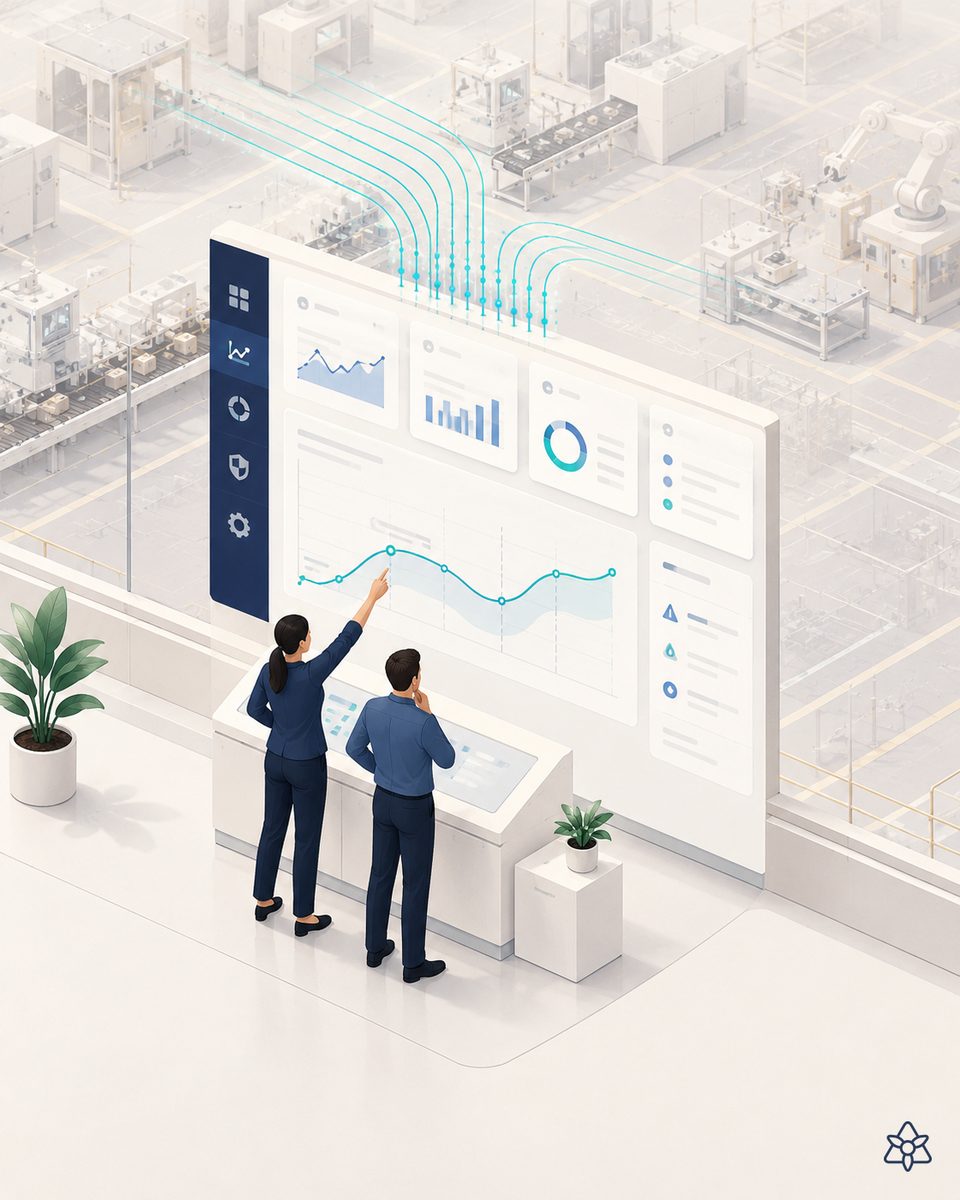
The supervisor is the plant's information system — and has nowhere to write it down while it happens.
Eight hours of a shift are eight hours of small, chained decisions: a machine making a different noise, a fill-in operator who has not mastered the format change, a batch running tight on its deadline, a temporary spare part holding out until Friday. The supervisor solves it all on foot. The problem is not how they solve it — it is that none of it gets written down at the moment it happens. Four consequences you feel every day:
- The report is filled in from memory, at the end. With the incoming shift already arriving, ten minutes are left to write up eight hours. The big things get noted and the nuance is lost — and the nuance is exactly what keeps the next shift from stumbling the same way.
- The shift start is reconstructed by asking around. The incoming supervisor spends the first forty minutes figuring out what state the plant is in: asking the outgoing supervisor, checking two screens, calling maintenance. That time is paid every day, at every handover.
- The handover travels by word of mouth. What matters gets told in the hallway. If the handover is rushed that day, if a different person comes in, or if the outgoing supervisor has already left, the context never arrives. What arrives is the rumor: “I think line 3 was acting up.”
- Already-solved incidents happen again. Because the fix that worked two shifts ago is not written anywhere searchable, today's shift diagnoses from scratch a problem the plant already knew how to solve.
It is the two-gaps syllogism applied to middle management: the data exists (the MES knows about the stoppage, the CMMS knows about the work order, the person knows the why), but it lives on islands — and above all, there was no way to capture the person's knowledge without stealing the time they need to be on the floor. The assistant does not replace the supervisor: it gives back the hours they now spend documenting what they already know.
iLEAN does not change how a shift is run — it changes the context you start with and the evidence you leave behind.
The lean standard always called for the shift handover to be a process, not an improvised conversation. The reason it almost never was is purely practical: it required writing while putting out fires. iLEAN solves that part. Connect is the putty that fills the cracks between the MES, the CMMS, the ERP, the SCADA and the machine's old panel; Edge contributes the data no system was capturing; and the agent takes care of the writing so the person can take care of the judgment.
The incoming supervisor no longer starts the shift asking what happened. They start deciding what to do with what they already know. The handover inherits context, not rumors.
The iLEAN pieces applied to the supervisor's shift:
- Edge — measures what actually happens on the line: micro-stoppages, cycles, process deviations, a photo of the part when needed. It works without a network.
- Connect — unifies the inherited state: orders and batches from MES/ERP, alerts and work orders from the CMMS, SCADA signals, assigned staff and cross-training records. Without this layer, the shift start is still asking around.
- Agents — the brain. They prepare the prioritized shift-start briefing, structure by voice the incidents the supervisor dictates while walking the floor, link every incident to its machine, its batch and its order, and draft the end-of-shift report from real data.
- Three safety rings — the report does not go out on its own, and no action on the plant executes by itself. The agent proposes; the supervisor reviews, corrects and signs. Responsibility keeps a first and last name.
Shift report from memory vs. an assisted shift with iLEAN
| Aspect | Shift without an assistant | Assisted shift with iLEAN |
|---|---|---|
| Shift start | 30–45 min asking around and checking screens | Prioritized briefing ready before walking in |
| Incident logging | At the end, from memory, if there is time | Dictated in the moment, structured by the agent |
| Shift report | Written by hand from what is remembered | Draft from real data, reviewed and signed by the person |
| Handover to the relief | Hallway conversation, the fine detail is lost | Context inherited in writing and searchable |
| Action traceability | Scattered across email, paper and memory | Incident tied to machine, batch, order and owner |
| Repeated incidents | Re-diagnosed from scratch every time | The agent retrieves how it was solved last time |
| Who decides and signs | The person | The person — no change |
Impact estimate for your plant — to be validated with your numbers.
The block below is an estimate to be validated with the specific data of your plant. We set it out so the committee has an order of magnitude; we refine it during the diagnostic.
- Plant with 2–3 shifts, a shift report written by hand at the end of every handover, and a mostly verbal handoff.
- Edge + Connect + Agents pilot on one building or one line, with a prepared shift start, incident dictation and an end-of-shift report. First value expected within a few weeks.
- Indicative payback between 3 and 8 months, from two levers: supervisor hours recovered (shift start and report writing) and fewer incidents lost at the handover.
- Recovery in the order of 0.5 to 1 hour per supervisor per shift between shift start and documentation close-out (conservative estimate), plus reduced rework from incidents that today get re-diagnosed on the next shift.
And the production manager's reasonable doubt
“What if the assistant makes up what happened during the shift?” — hallucination is a problem of free generation, not of anchored tasks. Drafting a shift report from measured stoppages, closed orders and sentences the supervisor has just dictated is an anchored task: every line of the draft hangs from a data point with an origin and a timestamp. On this kind of task the best models are below 1.5% error [1]. And even so, the report does not go out until the person reads it, corrects it and signs it. The three safety rings are there precisely for this.
[1] OpenAI paper “Why Language Models Hallucinate”, 2025 — on the reliability of AI in anchored tasks.
You may also be interested in: Multichannel incident capture with AI · Digital operator rounds with AI · OEE in a 24/7 three-shift plant
What people ask about the shift supervisor AI assistant
Why does shift knowledge get lost at the handover?
Because the shift is lived on the floor and documented at the end, from memory and in a hurry. The supervisor has solved twenty things on foot: a machine that made a strange noise at 11:20, a batch that came out just barely on weight, a fill-in operator who did not know the format change. None of it is written down while it happens. When report time comes there are ten minutes left, and only the big things get noted. The rest is told in the hallway to the next shift — and if the handover is rushed that day or someone else comes in, it is lost. The result is not an uninformed plant: it is a plant that repeats incidents it had already solved two shifts ago.
How does the assistant prepare the shift start?
Before the supervisor walks in, the agent has already read the previous shift and leaves the briefing on one screen: what happened on the previous shift and how each open incident ended, which machines come with alerts or pending maintenance, which batches are running tight on deadline or quality, which people are filling in and at which stations they have no registered cross-training. It is not a twenty-page report: it is the five or six things that change their decisions over the next eight hours, ranked by impact. The supervisor starts the shift knowing where to look, instead of reconstructing it by asking around.
Do incidents have to be typed, or can they be dictated?
They are dictated. The supervisor is walking the floor, wearing gloves, surrounded by noise, hands busy — asking them to type into a form is asking them not to do it. They speak the way they would to a colleague (“line 3 stopped for twenty minutes because of the head, maintenance came by, we left the temporary spare in until Friday”) and the agent turns it into a structured incident: machine, time, duration, cause, action taken, pending follow-up and owner. If something relevant is missing, it asks one single question. Logging stops being a separate job and becomes part of walking the plant.
Who signs the shift report, the assistant or the person?
The person, always. At end of shift the agent drafts the report from the system's real data (stoppages measured by Edge, production and batches from MES/ERP, incidents dictated during the shift) instead of from what is remembered at the last minute. The supervisor reads it, corrects whatever they want to qualify, adds the judgment only they have, and signs. That draft goes to no one until it is signed: it is iLEAN's third safety ring applied to the report. The system proposes; the person reviews and signs.
How does it integrate with the MES, ERP and CMMS we already have?
On top of them, not instead of them. iLEAN Connect reads what already exists (MES, ERP, CMMS, SCADA, a machine's old panel or even the lab's spreadsheet) and Edge contributes what no system was capturing: the real micro-stoppage, the spoken reason, the photo of the part. The signed report goes back into the plant's document system in the format you already use. No migration, no MES replacement, no double data entry: the integration is built against your existing systems and the pilot starts with whatever is already connected today.
More cases in lean manufacturing
- Predictive chiller maintenance with AI — when the chiller goes down, the plant goes down behind it.iLEAN combines vibration, motor current and modeled COP to predict industrial chiller failures and cut…
- Predictive quality with AI — knowing which batch will go wrong before you finish it, not after.Predictive quality anticipates which batch will go wrong before it finishes: iLEAN cross-references live…
- RCM with AI — reliability centered maintenance stops being a consultant's PDF.How iLEAN crosses failure modes, real asset history and criticality so RCM stops being a consultant's…
- Six Sigma: statistical process control with industrial AIiLEAN digitizes Six Sigma: live SPC, DMAIC boards, variation reduction — no Excel. 25 years applying…
- AI skills matrix for operators — the matrix that updates itself with what really happens on the floor.How iLEAN cross-checks training, certificates and per-operator performance so your skills matrix shows…
- SMED: AI-timed quick changeoveriLEAN times SMED changeovers with computer vision, auto-splits internal/external setup, cuts changeover…
Tell us how you run your handover today and within 48h we'll send back the estimated ROI of the shift assistant for your plant.
We work on your plant's real data, not on ours. Diagnostic with no commitment.
Request estimated ROI in 48h See Lean Manufacturing