Six Sigma: statistical process control with industrial AI
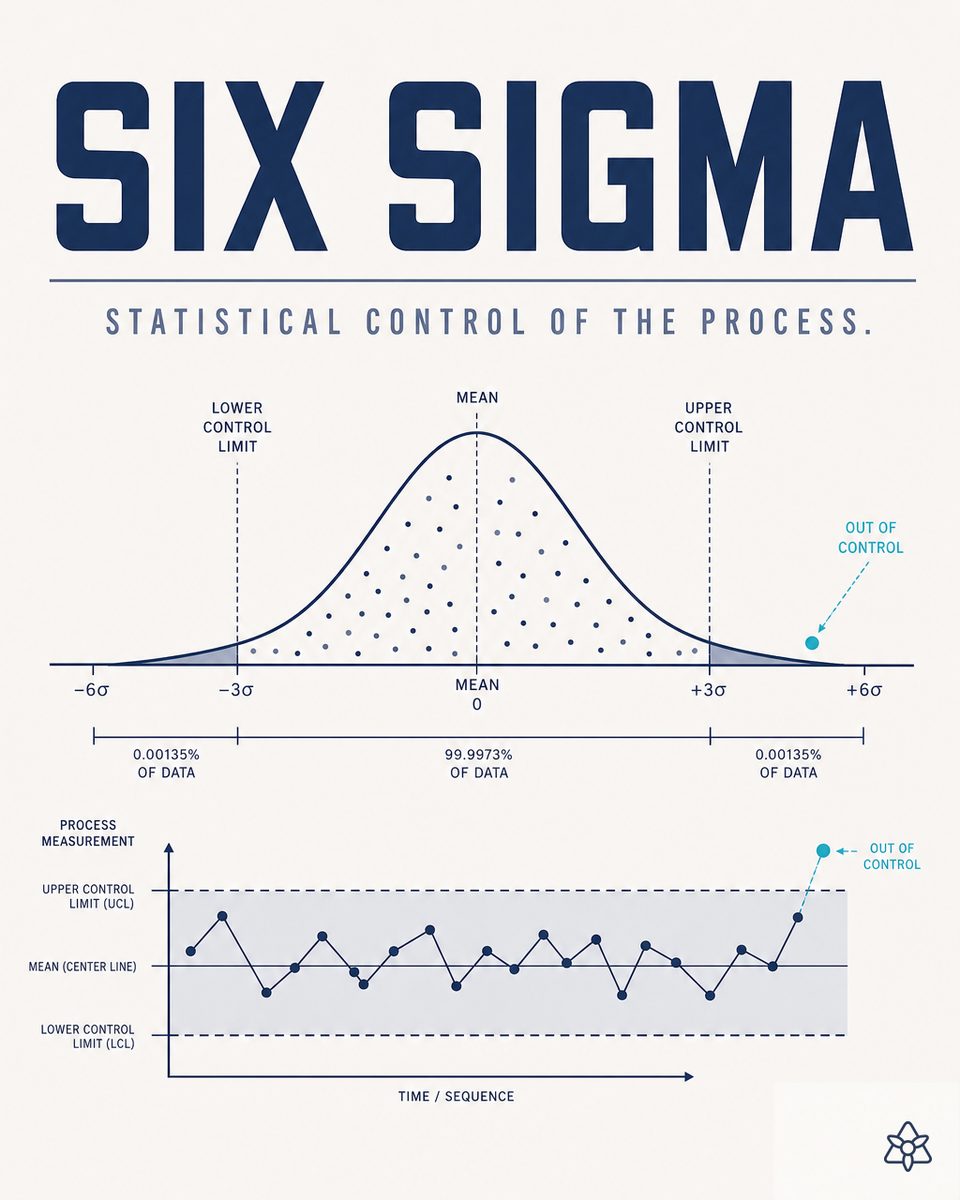
Six Sigma is the methodology that reduces process variation to fewer than 3.4 defects per million opportunities (DPMO) by structuring improvement in five phases: Define, Measure, Analyze, Improve, Control (DMAIC).
Fill in your fishbone diagram by hand; an AI agent does the rest
Not rolled out yet? Download our fishbone diagram template, fill it in by hand and snap a photo. Your company already has its own? Snap it anyway: the agent learns it from the first photo and reads it every time after.
What the agent does: Causes that repeat across diagrams, by 6M category, and which ones were confirmed when checked.
From statistics to method
Six Sigma was born at Motorola in the 1980s as an answer to a quantitative problem: how to make an industrial process so repeatable that its defects are measured in parts per million, not percentages. The key insight was realizing variation is the enemy — not the mean. A process with a perfect mean but high dispersion generates defects in the tails of the distribution.
The methodology combines two elements:
- Statistical Process Control (SPC): continuous measurement to detect when the process drifts out of control.
- DMAIC cycle: disciplined structure to solve variation problems.
iLEAN doesn't replace the method — it brings it into the 21st century.
Every Lean methodology was born to solve an information problem: where stock is, which machine is failing, what changed shift-to-shift. When information is paper, methods are rituals. When it's live data, they become the actual engine of the plant.
Classical method tells you what to measure. The IRIS system guarantees the measurement reaches whoever decides, the moment they decide — without anyone typing it in.
The three capture layers applied: Connect (photo, voice, email, WhatsApp), Edge (computer vision on the line) and Integrations (ERP/MES/SCADA/PLC). On top of that unified information, specialized agents serve the exact context to each person on the floor.
Classical Six Sigma vs. Six Sigma with AI
| Aspect | Classical Six Sigma | Six Sigma with iLEAN |
|---|---|---|
| Data collection | Notebook + manual Excel | Sensors + vision, automatic logging |
| SPC charts | Calculated weekly/monthly | Real-time, alert when out of control |
| Root cause detection | Black Belt analysis, weeks | AI agent correlates variables — suggests cause |
| DMAIC projects | Word doc + meeting | Live dashboard with each phase and metrics |
| Sustained control | Periodic audits | Continuous, alarm if variation rises |
What people ask about Six Sigma with AI
What is Six Sigma and what does '3.4 DPMO' mean?
Six Sigma is the methodology that aims to reduce process variation to 6 standard deviations (sigma) from spec limits, which equates to 3.4 defects per million opportunities. It's the world-class quality standard that sectors like automotive and pharma aspire to.
What's the difference between Lean and Six Sigma?
Lean attacks waste (time, motion, inventory). Six Sigma attacks variation (defects, dispersion). They're complementary: many companies apply Lean Six Sigma combining both — Lean for flow and speed, Six Sigma for quality and consistency.
How does iLEAN run DMAIC with real-time data, no Excel?
Each DMAIC phase runs on the iLEAN dashboard: Define selects the target process; Measure activates sensors; Analyze uses the AI agent to correlate variables; Improve documents and tests countermeasures; Control activates permanent SPC with alarms. No paper, no Excel, no projects that die in PowerPoint.
Do I need a Green/Black Belt certification to use Six Sigma with iLEAN?
To deeply understand the methodology, yes, it helps a lot. To execute DMAIC projects with iLEAN it's not required — the agent guides phases and templates. But a Green Belt or Black Belt on the team massively raises project quality.
In which industries does Six Sigma have the most impact?
Where variation costs money or lives: automotive (PPAP, IATF), pharma (cGMP), aerospace (AS9100), high-density electronics, food (recipe consistency). Less so: artisanal or low-volume production where variation is part of the product.
More cases in lean manufacturing
- Predictive quality with AI — knowing which batch will go wrong before you finish it, not after.Predictive quality anticipates which batch will go wrong before it finishes: iLEAN cross-references live…
- RCM with AI — reliability centered maintenance stops being a consultant's PDF.How iLEAN crosses failure modes, real asset history and criticality so RCM stops being a consultant's…
- Shift supervisor AI assistant — so the handover inherits context, not hallway rumors.With iLEAN the supervisor gets an assistant that preps the shift start, structures what they dictate and…
- AI skills matrix for operators — the matrix that updates itself with what really happens on the floor.How iLEAN cross-checks training, certificates and per-operator performance so your skills matrix shows…
- SMED: AI-timed quick changeoveriLEAN times SMED changeovers with computer vision, auto-splits internal/external setup, cuts changeover…
- Lean Manufacturing softwarethat doesn't ask you to learn it.Lean Manufacturing software with industrial AI: 5S, Kanban, TPM, SMED, Six Sigma digitized.…
Tell us about your plant. We'll tell you how we'd do it.
25 years applying Lean in real plants. Free diagnostic conversation.
Request demo See Lean Manufacturing