Predictive quality with AI — knowing which batch will go wrong before you finish it, not after.
Classic quality control catches the defect once it has already been made and paid for. iLEAN's predictive quality cross-references, in the central memory, the variables of the batch in progress — process curves, parameters, raw-material characteristics — with the history of good and bad batches. When the pattern starts to look like a batch that ended badly, it warns you with room to correct. The person decides the intervention.
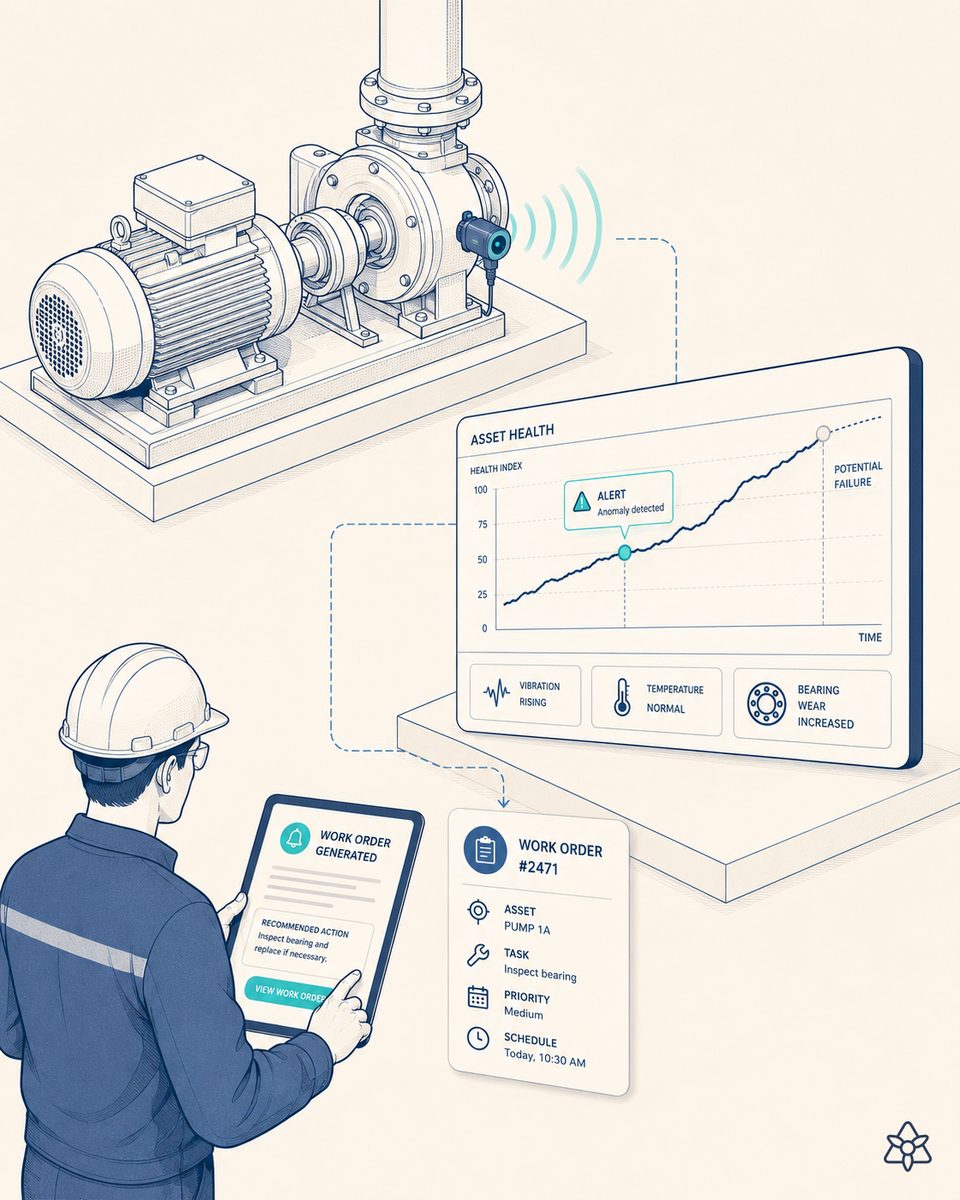
By the time the lab confirms the defect, the batch is already made.
Classic quality control is built on a simple idea: manufacture, measure and decide whether it passes. It works, and it will keep working — but it carries a structural cost that nobody books anywhere:
- The verdict arrives at the end — the sample comes out of the finished batch, the analysis takes hours or days, and by the time the result gets back to the floor you have already burned raw material, energy, machine hours and people hours on something that was going to fail from the third hour on.
- The cause is reconstructed backwards — when the batch is rejected, the investigation starts: reviewing records, comparing with earlier batches, hunting for the parameter that moved. Expensive work, done with incomplete memory and in a hurry.
- What you learn does not travel — the conclusion of that investigation ends up in a report. The night-shift operator who repeats the same curve profile three weeks later has no way of knowing.
- Raw material comes in as an unknown — two batches from different suppliers, both with a correct certificate, behave differently in the process. The classic approach only finds out at the end.
Real-time SPC already solves an important part: it moves the signal forward from the end of the shift to the moment a variable goes out of limits. Predictive quality solves the other part: warning when no variable is out of limits yet, but the whole picture looks dangerously like a batch that ended badly.
The central memory compares the batch in progress with everything the plant has already lived through.
Someone with twenty years on the line does this intuitively: they look at the curve, compare it mentally with the ones they have seen before and say “I don't like this one”. They are almost always right. The problem is that this comparison lives in a single head, covers only the batches that person remembers and is not available on the night shift. The central memory makes the same comparison across the whole history, on every shift, without missing a single batch.
This is not about replacing the veteran's judgment. It is about having that judgment available at three in the morning, on every batch, with the complete history behind it.
The iLEAN pieces applied to predictive quality:
- Edge — measures at the line what the process is doing right now: dimensions, appearance, sensor signals, raw data in milliseconds. It works without a network.
- Connect — the putty. It picks up the curve from process control, the record from the production management system, the lab result and the raw-material certificate, and puts them on the same timeline. Without that cross-referencing no prediction is possible: there are four sources that never spoke to each other.
- Central memory — the complete history of batches with their final result. It is the asset that makes everything else possible, and it is yours: every batch that goes through makes it better.
- Agents — compare the pattern of the batch in progress with the history, estimate the risk of deviation, identify which variables are driving that estimate and warn the manager on their own channel, with the correction window that is left.
- Three safety rings — no process correction is applied on its own. The agent proposes and explains; the person decides and signs.
When the process supports a stable reference profile per product, predictive quality naturally leans on the multi-product golden batch: the "good" pattern stops being a fuzzy average and becomes a concrete reference per product and format, which sharpens the prediction considerably.
Quality control at the end vs. predictive quality during the batch
| Aspect | Classic quality control | Predictive quality with iLEAN |
|---|---|---|
| When the verdict arrives | Batch finished, after lab analysis | During the batch, with room to correct |
| What is analyzed | Final result of the sample | Complete pattern of the process in progress |
| Raw material | Certificate filed away, never cross-referenced with the result | Incoming characteristic as a model variable |
| Learning | An investigation report per incident | Every closed batch retrains the criterion |
| Availability of the judgment | Only on the shift where the veteran works | Every shift, every batch |
| Cost of the failure | The whole batch: material, energy, hours | Partial correction or an early stop |
| Decision to intervene | Person | Person — the system only supplies the warning and the why |
Impact estimate for your plant — to be validated with your numbers.
The block below is an estimate to be validated with the specific data of your plant. We put it forward so the committee has an order of magnitude; we refine it during the diagnostic.
- A batch process whose quality result is known at the end (lab or finished-product inspection) and scrap or rework in the order of 1-5%.
- Edge + Connect + Agents pilot on one product family, recovering the existing history. First model running in silent mode within a few weeks.
- Indicative payback between 5 and 12 months, depending on your current scrap, the value of the batch and how much correction window the process allows.
- The more expensive the batch and the later the quality verdict arrives today, the higher up that return range you will land.
And the quality manager's reasonable doubt
“What if the model invents a risk that does not exist and we end up stopping good batches?” — it is the right objection, and it has two answers. The first is about design: hallucination is a problem of free generation, not of anchored tasks. Estimating the similarity between a curve in progress and a labeled history of good and bad batches is an anchored task: there is input data, there is a reference and there is an output you can check against the batch's real result. In this kind of task the best models sit below 1.5% error [1]. The second is about operation: the warning never stops the line on its own. It arrives as a reasoned suggestion to the manager, with the variables that triggered it and the window that is left, and it is the person who decides whether to intervene. The three safety rings exist precisely for this.
[1] OpenAI paper “Why Language Models Hallucinate”, 2025 — on the reliability of AI in anchored tasks.
You may also be interested in: Real-time SPC with AI · Multi-product golden batch with AI · DMAIC Six Sigma with AI statistical analysis
What people ask about predictive quality with AI
How is predictive quality different from classic quality control and from SPC?
They are three different moments of the same problem. Classic quality control measures the finished part or batch: it tells you whether it is good or bad once the cost has already been spent. Real-time SPC watches the process variable while it runs and warns when that variable moves outside its limits — it reacts fast, but it reacts to something that has already happened. Predictive quality goes one step further: it does not wait for a variable to cross a limit, it compares the complete pattern of the batch in progress (the shape of the curves, the combination of parameters, the characteristics of that batch's raw material) with the history of batches that ended well and batches that ended badly. When the pattern resembles the ones that ended badly, it warns — even though no variable is out of limits yet. It is the natural evolution of SPC, not its replacement: they live together.
What data does the model need to predict the quality of a batch?
Three families of data, and all three usually already exist in the plant even if they are scattered. (1) Live process variables: temperatures, pressures, speeds, consumption, the duration of each phase — the complete curve, not the average value. (2) Characteristics of the incoming batch: supplier, certificate of analysis, moisture, particle size, hardness, whatever applies to your product. (3) Final quality result of every historical batch: approved, reworked or rejected, and why. Connect is the piece that collects those three families from process control, from the production management system, from the lab and from the machine's old panel, and puts them on a single timeline. Without that cross-referencing there is no prediction: there are three files that never spoke to each other.
How much batch history do you need to get started?
It depends less on the total number of batches than on the number of documented bad batches: the model learns from contrast. As a practical order of magnitude, several hundred batches of the same product or family and a few dozen cases with a deviation are already enough for a first useful signal. If your plant has little digital history, the start happens in two stages: first you instrument and capture for a few weeks with the model in silent mode, and only when the signal is stable do you open the warning up to the team. And if the history exists but lives on paper or on loose sheets, you recover whatever is recoverable before writing off the project — there is usually more data than the plant thinks.
What does the operator do when a risk warning arrives?
The warning does not stop anything on its own. It reaches the manager's channel with three things: which batch is at risk, what pattern triggered it (which variables resemble those of the batches that ended badly) and how much room is left before the process reaches the point of no return. From there the person decides: correct a parameter, extend a phase, switch the raw-material batch, let it run and sample at the end, or do nothing because they know a cause the model cannot see. The system proposes and documents; the person decides and signs. iLEAN's three safety rings exist precisely so that this boundary is never crossed.
How do you avoid false alarms?
With four mechanisms combined. (1) An adjustable confidence threshold: the warning only fires when the similarity to the bad-batch pattern passes the level the quality manager has set, and that level is calibrated with your data, not with a number out of a brochure. (2) System noise filtering: planned stops, shift changes, recalibrations and start-ups are labeled as such and do not count as anomalies. (3) A silent-mode start: for the first few weeks the model predicts and is checked against the real result without bothering anybody; the warning is only opened up when the hit rate convinces the quality team. (4) Feedback: every warning is closed out with the batch's real result, and that answer retrains the criterion. An alert nobody believes switches itself off within two weeks — which is why the goal is not to warn a lot, but to warn rarely and be right.
More cases in lean manufacturing
- Poka-Yoke: error-proofing with computer visioniLEAN applies Poka-Yoke with computer vision: catches the defect before the next station. Operators…
- PPE management with AI vision — the prompt at second zero, not the sanction afterwards.How iLEAN Edge sees whether PPE is properly worn before the hazard zone and alerts the operator on the…
- Predictive chiller maintenance with AI — when the chiller goes down, the plant goes down behind it.iLEAN combines vibration, motor current and modeled COP to predict industrial chiller failures and cut…
- RCM with AI — reliability centered maintenance stops being a consultant's PDF.How iLEAN crosses failure modes, real asset history and criticality so RCM stops being a consultant's…
- Shift supervisor AI assistant — so the handover inherits context, not hallway rumors.With iLEAN the supervisor gets an assistant that preps the shift start, structures what they dictate and…
- Six Sigma: statistical process control with industrial AIiLEAN digitizes Six Sigma: live SPC, DMAIC boards, variation reduction — no Excel. 25 years applying…
Tell us about your case and within 48h we'll send you the estimated ROI of predictive quality for your plant.
We work on your plant's real data, not on ours. Diagnostic with no commitment.
Request estimated ROI in 48h See lean manufacturing