Predictive chiller maintenance with AI — when the chiller goes down, the plant goes down behind it.
A failed industrial chiller can stop a pharma line, a food plant or an entire data center. iLEAN combines vibration, motor current and modeled COP to anticipate the failure with days of margin and, along the way, to run the fleet close to its efficiency sweet spot. A person signs off on every intervention.
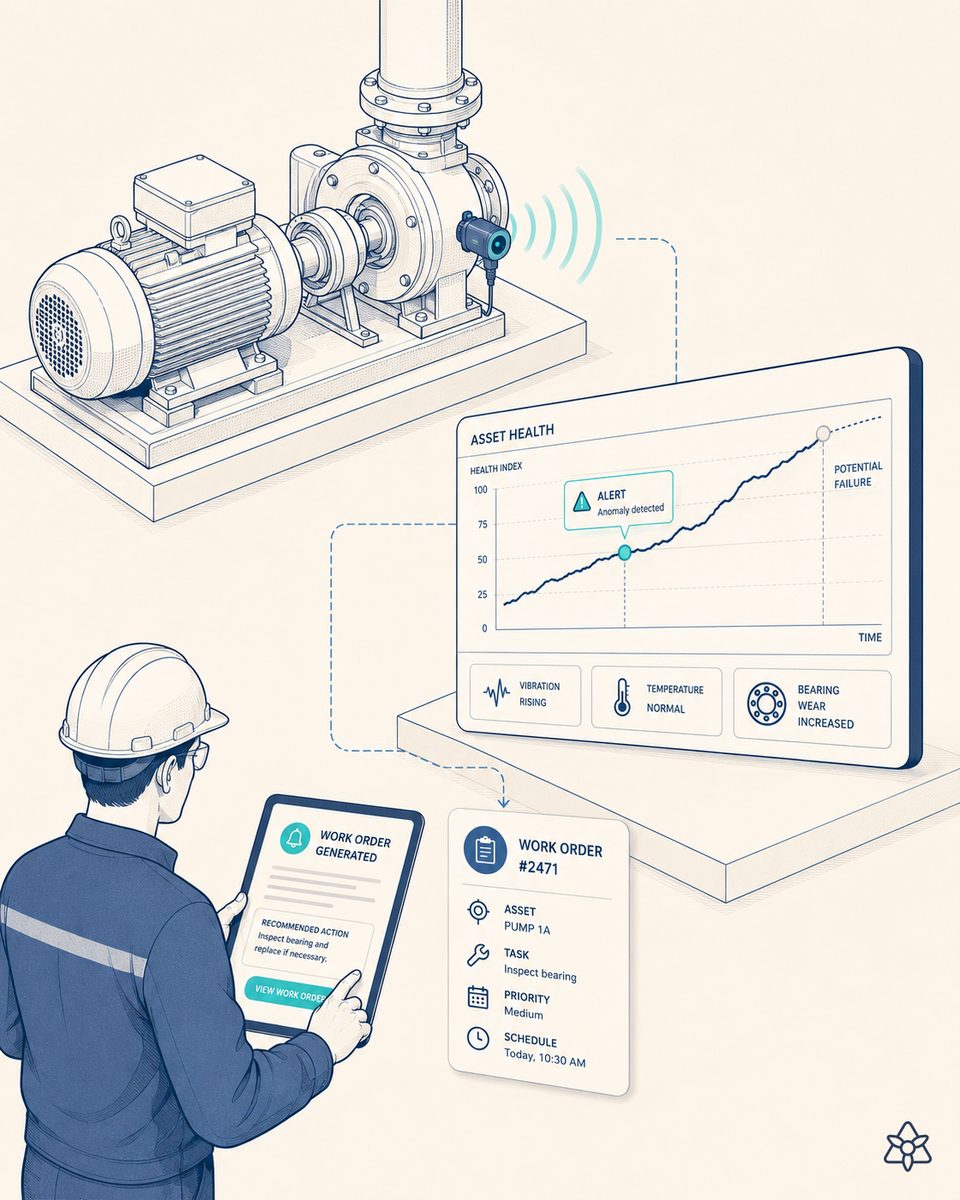
The chiller gives no warning until it's too late — and it drags the whole plant down with it.
An industrial chiller is a treacherous asset: it runs fine for months, loses efficiency little by little without anyone noticing, and then one bad day it goes down with everything on it. When it falls, it is not just the equipment: it is the pharma cleanroom losing its particle class, the food fermentation chamber climbing a degree, the data center server rack heating up. The downtime costs a fortune and, above all, it arrives with no warning.
The BMS knows almost everything, but never together: it has temperatures, pressures and consumption on separate screens, never cross-referenced. Compressor vibration, if it is measured at all, lives in a separate system that only gets reviewed when someone gets suspicious. And nobody has the real COP curve of each chiller against the expected one in their day-to-day. The fleet degrades silently: each unit loses a few points of efficiency that show up on no dashboard, but do show up on the electricity bill.
The maintenance manager knows this, but cannot cover everything. The classic system (hours-based preventive + corrective when it trips) works 95 % of the time. That 5 % is what stops the plant.
iLEAN doesn't add another dashboard — it seals the cracks between the ones you already have.
The problem with chiller prediction is not a lack of sensors: it is that the data lives on islands (vibration over here, current over there, BMS somewhere else, CMMS somewhere else again) and, when the first weak failure signal appears, no single system sees it. iLEAN acts as the filler that closes those gaps — without asking you to change BMS, SCADA or CMMS.
Edge reads vibration and current at the chiller. Connect captures the BMS and the service manual. The agent cross-references them with the expected COP curve and, when something drifts, opens a CMMS work order with the evidence right there.
The three iLEAN pieces applied to predictive chiller maintenance:
- Edge — a terminal with a CNN trained to recognize vibration signatures (bearings, imbalance, mechanical play) and to sample current and power factor at high resolution on the compressor motor. It works without a network. If the plant loses connectivity, the Edge keeps sampling and reacting locally.
- Connect — captures the BMS through whichever route applies (Modbus, BACnet, OPC-UA or reading an old panel), digitizes the manufacturer's service manual so the expected behavior is known, and absorbs whatever arrives from outside (an alert from the refrigerant supplier about a new batch, a manufacturer notice about a fault in a production series).
- Agent — cross-references the vibration signature, the current drift, the BMS pressures and the modeled COP. When the real curve moves away from the expected one, it opens a work order in the CMMS with a substantiated diagnosis and an estimated urgency. The person validates — the agent does not write to the chiller PLC; the safety rings exist for exactly this.
Hours-based preventive vs. predictive with iLEAN
| Aspect | Classic preventive + corrective | With iLEAN Edge + Connect + Agent |
|---|---|---|
| Diagnostic sources | BMS, manual vibration checks, manufacturer manual — never cross-referenced | Vibration + current + modeled COP, all cross-referenced on one board |
| Failure detection | When an alarm trips or an obvious symptom shows up | When the real curve drifts from the expected one — days of margin |
| Multi-brand fleet | Each chiller in its own software, each with its own dashboard | Every brand and generation — all on the same board |
| Silent degradation | Only visible on the bill, months later | 8-15 % COP loss detected as soon as it appears |
| CMMS work order | «Check chiller 3» — the diagnosis happens during the intervention | Order already carries the vibration curve, the drift and the diagnosis |
| Multi-chiller in cascade | Static BMS rules, never re-optimized | Dynamic sequencing based on each unit's real curve |
Impact estimate for your plant — to be validated with your numbers.
The block below is an estimate to be validated with the actual data from your plant. We lay it out so the steering committee has an order of magnitude; we refine it during the diagnostic.
- A fleet of 3-6 industrial chillers (pharma, food or data center), multi-brand, mixed-age, in cascade or redundancy.
- Edge pilot on one critical chiller (vibration sensors + current reading + BMS and CMMS integration). First value expected within a few weeks — the first anomalous vibration signature usually shows up early if the fleet has some age on it.
- Indicative payback between 4 and 9 months, depending on the cost of the last unanticipated shutdown and the fleet's current electricity consumption.
- Hard levers: a single unplanned shutdown avoided (in pharma or a data center that pays for the pilot on its own) + a consumption reduction of the order of 8-15 % from running each chiller close to its optimal COP point.
And the maintenance manager's fair objection
«What if the AI gets it wrong and makes me open a work order on a false alarm?» — hallucination is a problem of free generation, not of anchored tasks. Comparing a real vibration signature against the one in the service manual, or a measured COP curve against the one expected for those conditions, are anchored tasks. On that kind of task, the best models brought the error rate below 1.5 % [1]. And even so, the order does not execute itself: the agent proposes it with the evidence in plain view; the person validates and signs. The three safety rings exist precisely for this — the agent does not write to the chiller PLC; anything critical belongs to the person.
[1] OpenAI paper "Why Language Models Hallucinate", 2025 — on the reliability of AI in anchored tasks.
What people ask about predictive chiller maintenance with AI
Which signals are combined to predict a chiller failure?
Three families that almost never get cross-referenced: vibration on compressor and motor (bearing signature, imbalance, mechanical play), current and power factor of the compressor motor (consumption drift at the same load = efficiency loss) and modeled COP in real time, crossing chilled-water supply and return temperature, condensing conditions and flow. The agent compares the real curve against the curve expected from that chiller under those thermal-load and ambient conditions — when the gap moves away from normal behavior, it anticipates the most likely failure mode and proposes the intervention before the unit stops the pharma line, the food line or the cleanroom.
Does it work with a multi-brand, mixed-age chiller fleet?
Yes. iLEAN Edge connects through whichever route each chiller allows: if the unit is modern with a Modbus/BACnet interface, it integrates directly; if it is fifteen years old with a proprietary panel, Connect reads the local panel; if the information only exists on an analog gauge, a person photographs it with a phone and it enters the system. That graduated capture is what lets you govern a mixed fleet of different brands and generations without replacing anything. Each chiller enters the system through the door it has, and the agent cross-references them all on the same board.
Does it integrate with the existing BMS / SCADA / CMMS?
Yes, in both directions. iLEAN reads setpoints, control targets and the history you already have from the BMS — and writes to the CMMS the preventive work orders the agent proposes, with the evidence (vibration curve, current drift, COP drop) embedded in the order. The maintenance manager opens a work order that already carries a substantiated diagnosis, not a «check chiller 3». The agent's autonomy to write to the CMMS is configured plant by plant — from proposing a draft to opening the order with automatic sign-off, depending on criticality.
How much can the energy cost of a chiller fleet be reduced?
The energy lever has two components: running each chiller close to its optimal COP point (fine-tuning setpoints to the real thermal load) and preventing silent degradation (when a chiller loses 10-15 % efficiency to condenser fouling, evaporator fouling or an incorrect refrigerant charge, the BMS does not see it — the electricity bill does). In sectors where chillers are a continuous critical service (data center, pharma, food), a consumption reduction of the order of 8-15 % is a conservative target, to be validated against your own fleet. The exact figure depends on the starting point — if it has never been measured chiller by chiller, the margin is usually larger.
What if I have several chillers in cascade or in redundancy?
That is where it adds the most value. In a multi-chiller plant the agent not only predicts failures, it orchestrates which chillers to start and at what load to cover thermal demand with the lowest total consumption — and to avoid always cycling the same unit, which accelerates its wear. Optimal multi-chiller sequencing is a classic problem the BMS solves with static rules; the agent solves it with each unit's real curve at each moment, anticipating maintenance on those approaching their intervention window. The person validates the strategy; the agent executes it inside the safety rings.
More cases in lean manufacturing
- PDCA: the Plan-Do-Check-Act cycle, digitizediLEAN digitizes the PDCA cycle: every Plan hypothesis is tested on the floor (Do), verified with live…
- Poka-Yoke: error-proofing with computer visioniLEAN applies Poka-Yoke with computer vision: catches the defect before the next station. Operators…
- PPE management with AI vision — the prompt at second zero, not the sanction afterwards.How iLEAN Edge sees whether PPE is properly worn before the hazard zone and alerts the operator on the…
- Predictive quality with AI — knowing which batch will go wrong before you finish it, not after.Predictive quality anticipates which batch will go wrong before it finishes: iLEAN cross-references live…
- RCM with AI — reliability centered maintenance stops being a consultant's PDF.How iLEAN crosses failure modes, real asset history and criticality so RCM stops being a consultant's…
- Shift supervisor AI assistant — so the handover inherits context, not hallway rumors.With iLEAN the supervisor gets an assistant that preps the shift start, structures what they dictate and…
Tell us about your case and in 48h we'll send you the estimated ROI of predictive chiller maintenance for your plant.
We work on the real data from your fleet, not on ours. Free diagnostic, no commitment.
Request estimated ROI in 48h See Lean Manufacturing