PDCA: the Plan-Do-Check-Act cycle, digitized
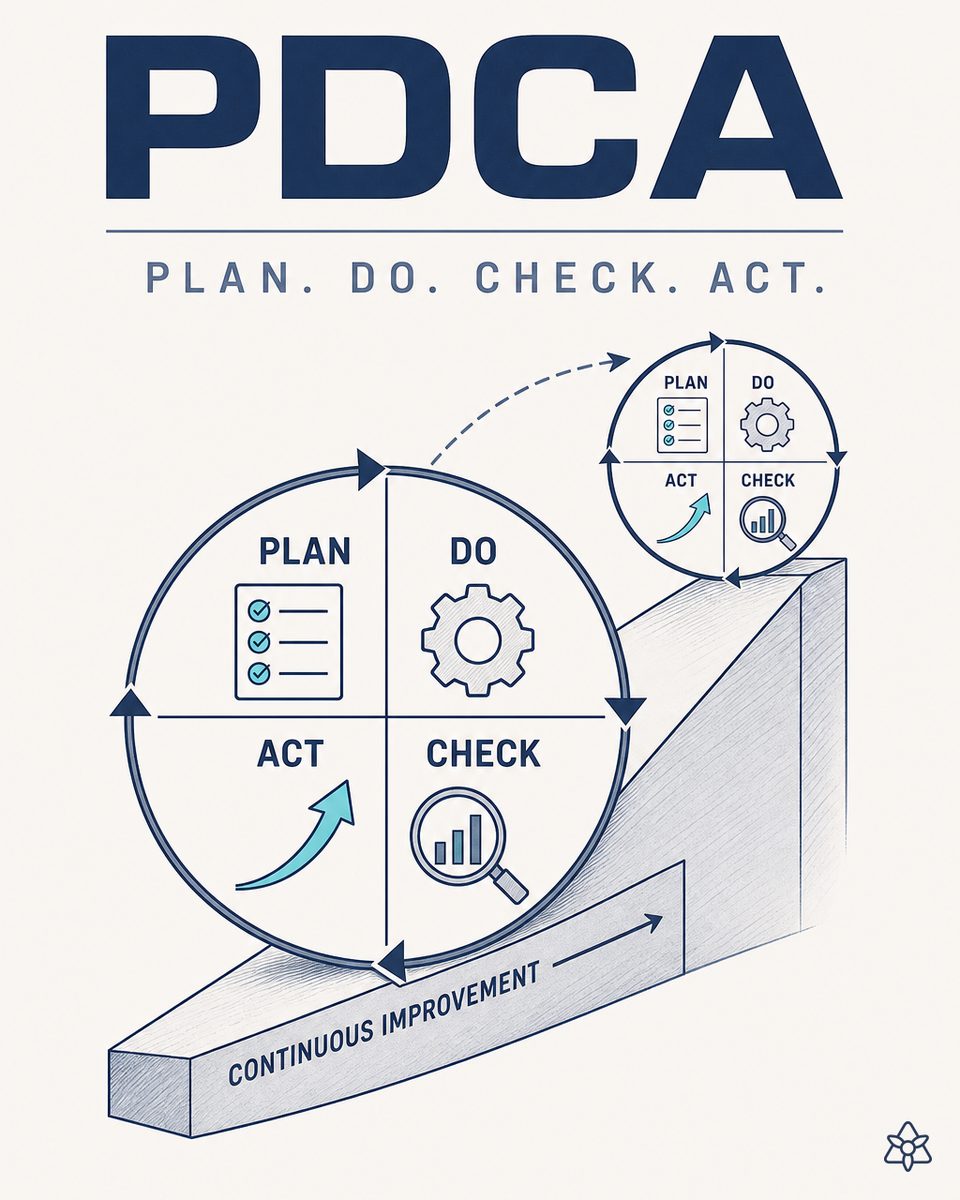
PDCA (Plan-Do-Check-Act) is the continuous improvement cycle popularized by W. Edwards Deming: you plan a change based on a hypothesis (Plan), implement it small-scale (Do), verify results with data (Check) and, if it works, standardize it (Act). It's the foundation of all Lean improvement.
Why PDCA isn't just an acronym
The PDCA cycle was created by Walter Shewhart at Bell Labs in the 1930s and popularized by W. Edwards Deming in Japan in the 1950s. It's the scientific method applied to industrial improvement:
- Plan: formulate a hypothesis on how to improve something. If I change X, do I expect Y to improve by Z%?
- Do: implement the change small-scale — one shift, one cell, one week.
- Check: measure the result. Does the hypothesis hold up with data?
- Act: if it works, standardize the change across the plant. If not, return to Plan with what was learned.
The most common trap is skipping "Check": changes are made without measuring effect, and a year later no one knows what worked and what didn't.
iLEAN doesn't replace the method — it brings it into the 21st century.
Every Lean methodology was born to solve an information problem: where stock is, which machine is failing, what changed shift-to-shift. When information is paper, methods are rituals. When it's live data, they become the actual engine of the plant.
Classical method tells you what to measure. The IRIS system guarantees the measurement reaches whoever decides, the moment they decide — without anyone typing it in.
The three capture layers applied: Connect (photo, voice, email, WhatsApp), Edge (computer vision on the line) and Integrations (ERP/MES/SCADA/PLC). On top of that unified information, specialized agents serve the exact context to each person on the floor.
PDCA in Excel vs. digital PDCA
| Phase | PDCA in Excel | PDCA with iLEAN |
|---|---|---|
| Plan | Word doc with hypothesis | Digital template + target indicator |
| Do | Email to owner + dates | Assigned in board, with deadline |
| Check | Monthly follow-up meeting | Live data — alert when met/not met |
| Act | Standardization PowerPoint | Updated procedure + tracked training |
| Cycle history | Folder lost in drive | Queryable database + organizational learning |
What people ask about PDCA
What is the PDCA cycle and where does it come from?
PDCA = Plan-Do-Check-Act. It's the continuous improvement cycle created by Walter Shewhart (Bell Labs, 1930s) and popularized by W. Edwards Deming in Japan. It's the scientific method applied to industrial improvement — hypothesis, experiment, measurement, standardization.
What's the difference between PDCA and PDSA?
PDCA: Plan-Do-Check-Act (classical version). PDSA: Plan-Do-Study-Act (Deming's preferred version). The change from 'Check' to 'Study' emphasizes that the measurement phase isn't just verification, it's learning. Industrial practice uses PDCA; healthcare and academic process improvement use PDSA.
How does iLEAN digitize the PDCA cycle on the floor without Excel?
Each PDCA cycle is managed as a project in iLEAN: the hypothesis is documented, the experiment is assigned to an owner with a date, live data confirms or refutes, and standardization triggers procedure update and training. No Excel, no extra meetings, queryable history.
How does PDCA differ from DMAIC?
PDCA: light, fast, for daily continuous improvement. 4 phases. DMAIC (Define-Measure-Analyze-Improve-Control): more structured, for multi-month Six Sigma projects. 5 phases with exit criteria per phase. PDCA is for everyone; DMAIC for complex problems.
How often is a PDCA cycle repeated?
A typical plant PDCA cycle lasts 2-8 weeks. Mature Lean plants have several simultaneous PDCA cycles in different cells, each with its owner and metrics. The pace isn't 'one per quarter' — it's 'always active'.
Tell us about your plant. We'll tell you how we'd do it.
25 years applying Lean in real plants. Free diagnostic conversation.
Request demo See Lean Manufacturing