RCM with AI — reliability centered maintenance stops being a consultant's PDF.
RCM is a solid method — the problem is that the analysis ends up buried in a PDF while the plant changes faster than the document. iLEAN crosses the RCM failure modes with the asset's real history and the early symptoms Edge sees, and keeps the plan alive. The maintenance person signs off — the system takes away the dumb work of maintaining the document.
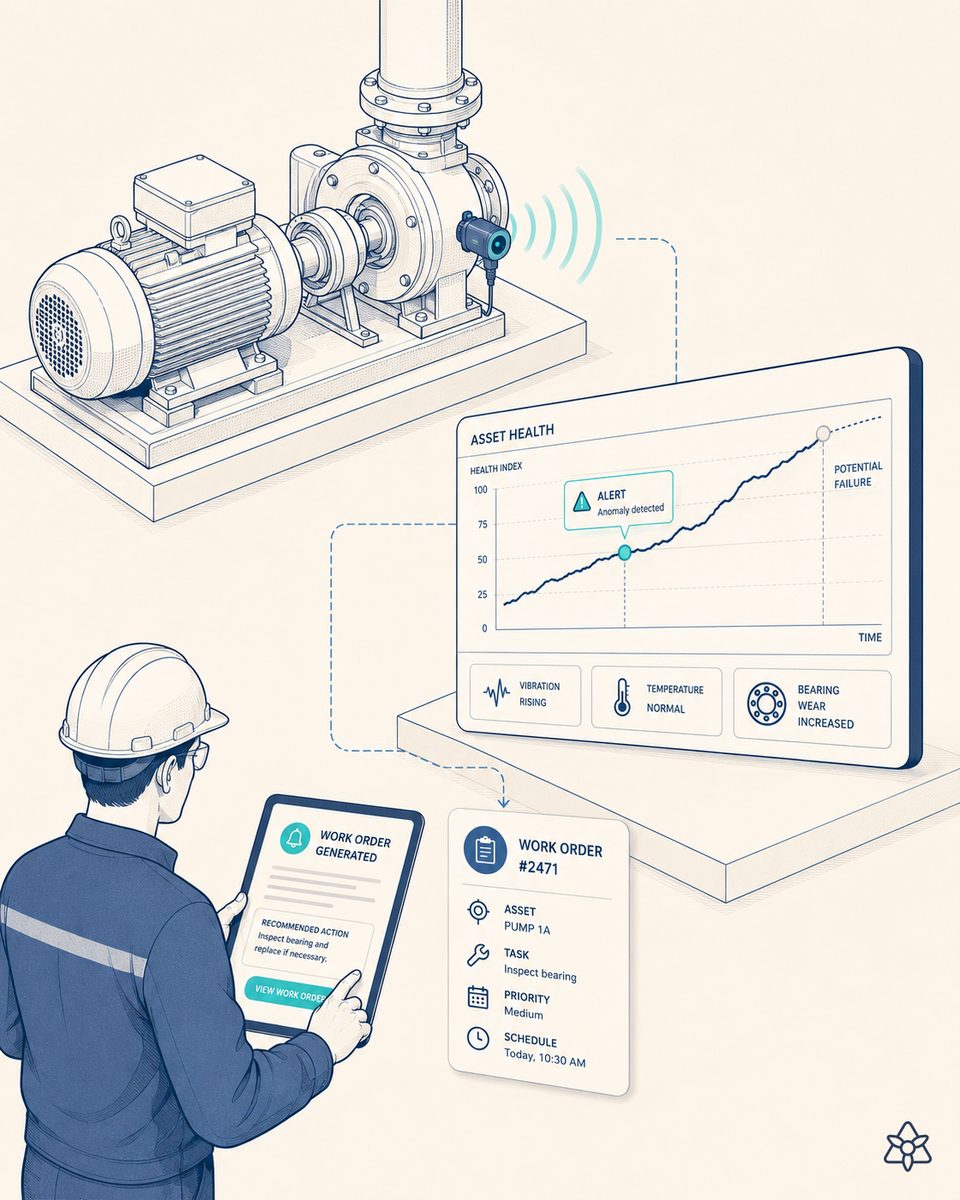
RCM does not fail because of the method — it fails because of the operating model.
Almost nobody disputes the RCM method: identify the asset's functions, its failure modes, their consequences, and decide the maintenance that applies. The problem is not the what — it is how it is sustained over time.
- The analysis is done once. A consultancy comes in for three weeks, interviews the team, looks at the critical assets and delivers a 400-page document with the maintenance plan. The day the delivery is signed off is the last day the document is up to date.
- The plant changes faster than the PDF. An asset is modernized, a spare-parts supplier is swapped, a new failure mode is discovered. None of that finds its way back into the analysis — because updating it by hand costs weeks nobody has.
- The real history is never crossed with the analysis. The CMMS accumulates breakdown reports, the maintenance manager keeps a parallel spreadsheet, and the veteran knows the odd symptoms by heart. But that knowledge is never compared with the theoretical plan. The plant runs two maintenance programmes in parallel: the one the PDF describes and the one people actually do.
The outcome is predictable: the RCM plan becomes corporate folklore, real maintenance gets decided day by day, and critical assets keep breaking down through failure modes that were described in the analysis but that nobody ever crossed with what the CMMS was already seeing.
iLEAN does not redo your RCM — it connects it to the reality of the asset.
A well-built RCM already exists in many plants. What is missing is the filler between that analysis and daily operations: Connect captures the history wherever it lives, the Agents cross that history with the RCM failure modes, and Edge watches for the early symptom before it becomes a breakdown. iLEAN does not ask you to change CMMS or redo the RCM. It connects it.
Connect captures the asset's history. The agent crosses it with the described failure mode. Edge sees the symptom on the line. The maintenance person decides and signs off — the plan stays alive.
The three iLEAN pieces applied to a living RCM:
- Connect — reads the modern CMMS, the legacy CMMS, the maintenance manager's parallel spreadsheet, the paper breakdown reports the supervisor photographs, and the veteran's knowledge dictated by voice into an earpiece. Everything enters at second zero as usable data.
- Agents — cross the failure modes of the RCM analysis with the real history. They flag the ones that behave as predicted, the ones that show up at a different frequency, and the new failure modes the original RCM never considered. They propose an update to the plan; the maintenance manager decides.
- Edge — a terminal with computer vision and sensor inputs on the critical asset. It detects the early symptom (out-of-pattern vibration, thermal halo, leak, abnormal noise), crosses it with the expected failure mode, and alerts through Connect. When it triggers, it does so in milliseconds and with no network needed.
RCM in a PDF vs. living RCM with iLEAN
| Aspect | Classical RCM (consultancy + PDF) | RCM with iLEAN Edge + Connect + Agents |
|---|---|---|
| Validity of the analysis | Valid on delivery day; goes stale on its own | Living plan, updated against real history |
| New failure modes | Do not enter the plan until the next project | The agent detects them and proposes their inclusion |
| Asset history | In the CMMS + parallel spreadsheet + the veteran's head | Unified and crossed with the expected failure mode |
| Early symptom | Operator's visual round; depends on who walks by | Edge watches the critical asset constantly |
| Operation without a network | n/a (a PDF needs no network) | Edge keeps watching as long as the panel has power |
| The veteran's knowledge | Walks out the door the day they retire | Captured by voice and turned into an asset pattern |
Impact estimate for your plant — to be validated with your numbers.
The block below is an estimate to be validated with your plant's data. We lay it out so the steering committee has an order of magnitude; we refine it during the diagnostic.
- Mid-sized industrial plant, RCM done at some point with a consultancy, outdated today. Critical assets identified: 10-15 according to the Pareto.
- Pilot on the 2-3 most critical assets: Connect against the CMMS + spreadsheet + voice, Agents crossing with the RCM failure modes, Edge on the most critical of the three. First value expected within a few weeks.
- Indicative payback between 4 and 9 months depending on the criticality and stoppage cost of the chosen asset. A single unplanned stoppage avoided on a critical asset pays for the pilot.
- Expected reduction in unplanned downtime hours on the pilot assets in the order of ≥30% after the first learning cycle.
And the maintenance manager's reasonable doubt
"What if the agent proposes a wrong update to my RCM plan?" — hallucination is a problem of free generation, not of anchored tasks. Here the agent does not invent the plan: it crosses the real history with the failure mode described in the analysis. In tasks of this type (recontextualizing a data point from one system to another, comparing against a known pattern), the best models brought error below 1.5% [1]. And even so, what is critical is never decided alone: the agent proposes, the person signs off. The three safety rings exist precisely for this.
[1] OpenAI paper "Why Language Models Hallucinate", 2025 — on the reliability of AI in anchored tasks.
What people ask about RCM with AI
What is RCM (Reliability Centered Maintenance) and why does it fail so often on the plant floor?
RCM is a method for deciding what maintenance each asset needs, based on its failure modes, their consequences and criticality. It usually fails not because of the method, but because of how it is operated: the analysis is done once with a consultancy, ends up as a 400-page PDF, and a year later the plant has changed, assets have been modified and nobody updates the document. The plan lives on paper; the plant lives somewhere else.
How does iLEAN connect an RCM analysis with the asset's real failure history?
With Connect capturing the history wherever it lives: in the modern CMMS, in the maintenance manager's spreadsheet, in handwritten breakdown reports the supervisor photographs, or in the veteran's knowledge dictated by voice into an earpiece. The Agents cross the failure modes of the RCM analysis with that reality and flag where the theoretical plan does not match what is actually happening — so the maintenance manager decides whether to adjust the plan or investigate the root cause.
Do you need a new CMMS to roll out RCM with AI?
No. iLEAN acts as filler between the CMMS you already have (whichever it is) and the reality of the plant. It does not ask you to change systems — it captures from yours, crosses it with the RCM, and returns enriched work orders and an updatable maintenance plan. If there is no CMMS at all, Connect captures from spreadsheets and voice while you decide whether to implement one.
Can iLEAN Edge detect early failure symptoms on a critical asset?
Yes. Edge is a terminal with computer vision and sensor inputs installed next to the asset, and it detects the symptom before it becomes a breakdown: an oil leak, abnormal vibration, a thermal halo, out-of-pattern noise. It crosses that with the failure mode described in the RCM analysis and, if it triggers, alerts the maintenance technician through Connect at second zero. It works without a network: if the plant loses WiFi, Edge keeps watching and recording, because what is critical cannot depend on connectivity.
How long before an RCM with AI project shows a return?
The first value usually appears within a few weeks — not by redoing the full RCM analysis, but by applying what already exists to the 2-3 most critical assets in the Pareto. With a living plan connected to the real history, the hard lever is avoiding a single unplanned stoppage on a critical asset — that alone usually pays for the pilot. Indicative payback runs between 4 and 9 months depending on the criticality of the assets chosen. We send you the estimated ROI within 48h using your data.
Related methods: TPM (Total Productive Maintenance) · OEE · PDCA
More cases in lean manufacturing
- PPE management with AI vision — the prompt at second zero, not the sanction afterwards.How iLEAN Edge sees whether PPE is properly worn before the hazard zone and alerts the operator on the…
- Predictive chiller maintenance with AI — when the chiller goes down, the plant goes down behind it.iLEAN combines vibration, motor current and modeled COP to predict industrial chiller failures and cut…
- Predictive quality with AI — knowing which batch will go wrong before you finish it, not after.Predictive quality anticipates which batch will go wrong before it finishes: iLEAN cross-references live…
- Shift supervisor AI assistant — so the handover inherits context, not hallway rumors.With iLEAN the supervisor gets an assistant that preps the shift start, structures what they dictate and…
- Six Sigma: statistical process control with industrial AIiLEAN digitizes Six Sigma: live SPC, DMAIC boards, variation reduction — no Excel. 25 years applying…
- AI skills matrix for operators — the matrix that updates itself with what really happens on the floor.How iLEAN cross-checks training, certificates and per-operator performance so your skills matrix shows…
Tell us about your case and within 48h we'll send you the estimated ROI of putting your RCM to work with AI.
We work on your plant's real data, not ours. Diagnostic with no commitment.
Request estimated ROI in 48h See Lean Manufacturing