TPM: Total Productive Maintenance with predictive AI
TPM (Total Productive Maintenance) is the Lean methodology that makes maintenance everyone's responsibility — not just the maintenance department's — so unplanned downtime disappears and OEE is maximized.
Fill in your daily inspection checklist by hand; an AI agent does the rest
Not rolled out yet? Download our daily inspection checklist template, fill it in by hand and snap a photo. Your company already has its own? Snap it anyway: the agent learns it from the first photo and reads it every time after.
What the agent does: Which equipment fails the check, which item fails most and who skipped the shift check.
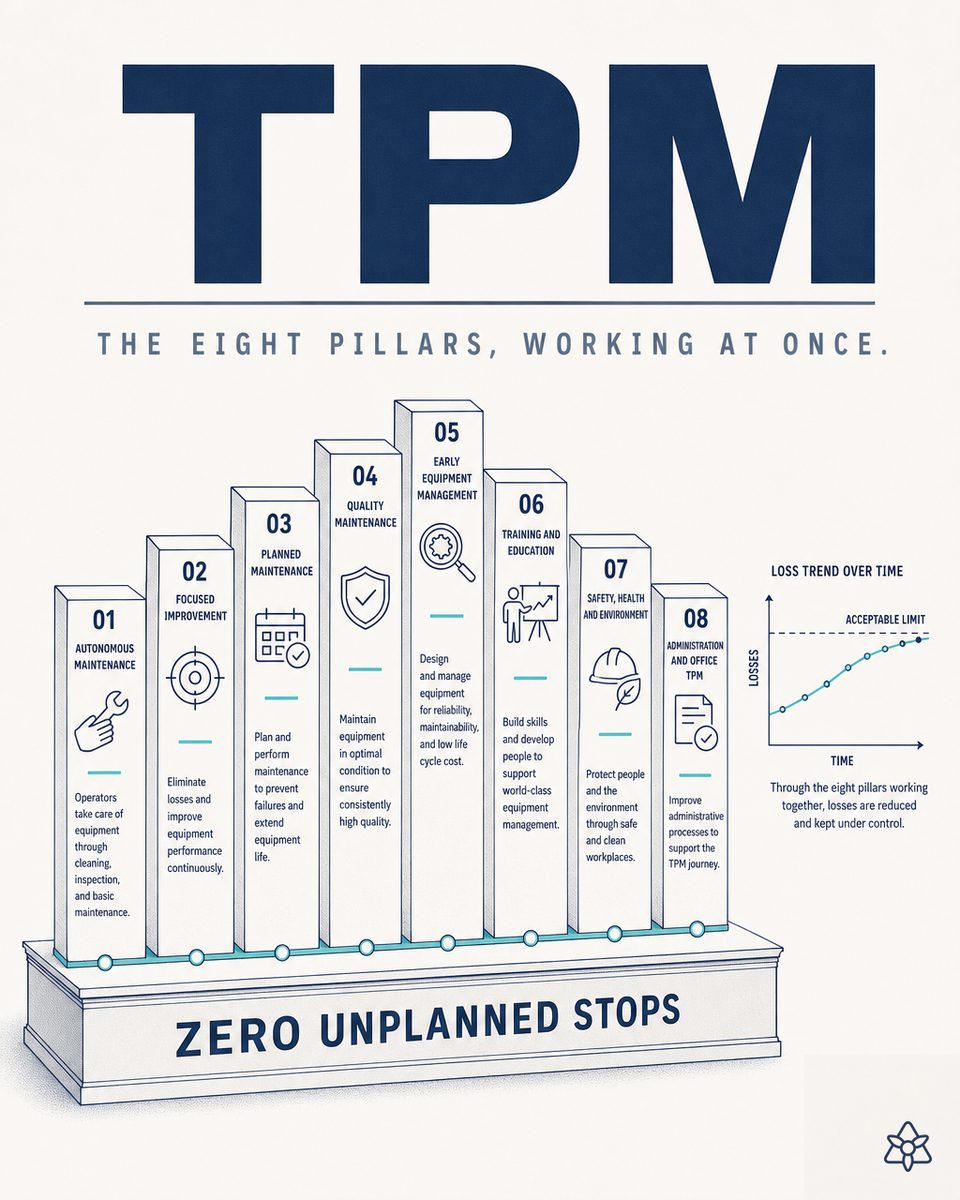
The 6 pillars of TPM
TPM was born in Japan in the 1970s as an evolution of preventive maintenance. Its thesis: the operator is the first eye on the machine every day, so they must participate in its care. Maintenance stops being a separate department and becomes a cross-functional responsibility.
- Autonomous maintenance: the operator handles daily cleaning, lubrication and inspection.
- Planned maintenance: the technical team handles scheduled complex interventions.
- Focused improvement: kaizen teams attack chronic problems.
- Education and training: team knowledge is transmitted and grown.
- Quality maintenance: the machine is tuned not to generate defects, not just not to stop.
- Early management: lessons feed back into the design of the next machines.
iLEAN doesn't replace the method — it brings it into the 21st century.
Every Lean methodology was born to solve an information problem: where stock is, which machine is failing, what changed shift-to-shift. When information is paper, methods are rituals. When it's live data, they become the actual engine of the plant.
Classical method tells you what to measure. The IRIS system guarantees the measurement reaches whoever decides, the moment they decide — without anyone typing it in.
The three capture layers applied: Connect (photo, voice, email, WhatsApp), Edge (computer vision on the line) and Integrations (ERP/MES/SCADA/PLC). On top of that unified information, specialized agents serve the exact context to each person on the floor.
Classical TPM vs. TPM with predictive AI
| Aspect | Classical TPM | TPM with iLEAN |
|---|---|---|
| OEE | Calculated end-of-shift in Excel | Real-time, per machine and shift |
| Autonomous inspection | Paper checklist | Mobile app with photo + voice; instant alarms |
| Breakdown prediction | Fixed calendar frequency | AI learns patterns — alerts before failure |
| Technical knowledge | In the veteran's head | Database with every intervention |
| Intervention plan | Whiteboard and email | Live dashboard, prioritized by OEE impact |
What people ask about TPM with AI
What is TPM and what problems does it solve?
TPM (Total Productive Maintenance) is the Lean methodology that spreads maintenance responsibility between operators and technicians to reduce unplanned downtime. Its goal is to maximize OEE (Overall Equipment Effectiveness): availability × performance × quality.
What are the 6 pillars of TPM?
Autonomous maintenance (operator), planned maintenance (technician), focused improvement (kaizen teams), education, quality maintenance, and early management (feeding lessons into the design of new machines).
How does iLEAN digitize TPM with predictive AI?
The Edge layer captures vibration, temperature and electrical consumption from critical machines. An AI agent learns normal patterns and detects anomalous drift before it causes a breakdown. The operator receives the alert with days of warning — not hours.
Do I need new sensors or does my existing equipment work?
Existing equipment works in most cases. iLEAN integrates with existing SCADA and PLC to extract available signals. If your machine is old and uninstrumented, we install non-invasive sensors (vibration, current, temperature) that don't require modifying the machine.
How long does it take to see TPM results with iLEAN?
Real-time OEE shows from day one. Reduction of unplanned downtime typically appears in 8-12 weeks — the time the AI agent needs to learn each machine's normal behavior.
More cases in lean manufacturing
- Root cause analysis template: free, and an AI agent that makes sure the actions get closedFree printable root cause analysis template: event, contributing causes with evidence, root cause and…
- Time study template: free, and an AI agent that reads every stopwatch reading for youFree printable time study template: 12 elements, 8 cycles, average, rating and standard time. Snap it…
- Toyota Production System — the origin of Lean ManufacturingThe Toyota Production System (TPS) is the foundation of modern Lean. Its two pillars — Jidoka and…
- Shopfloor TV visual management with AI — from the dead board to the board the operator looks at again.Your shopfloor screens are dead boards showing yesterday's data. iLEAN connects every TV to live shift…
- VSM — Value Stream Mapping with live dataiLEAN turns your Value Stream Map into a live tool: real cycle time, measured lead time, Muda/Mura/Muri…
- What is iLEAN?Industrial AI &Lean 4.0 platform.iLEAN is an industrial AI platform that digitizes Lean Manufacturing and unifies your whole plant's…
Tell us about your plant. We'll tell you how we'd do it.
25 years applying Lean in real plants. Free diagnostic conversation.
Request demo See Lean Manufacturing