Toyota Production System — the origin of Lean Manufacturing
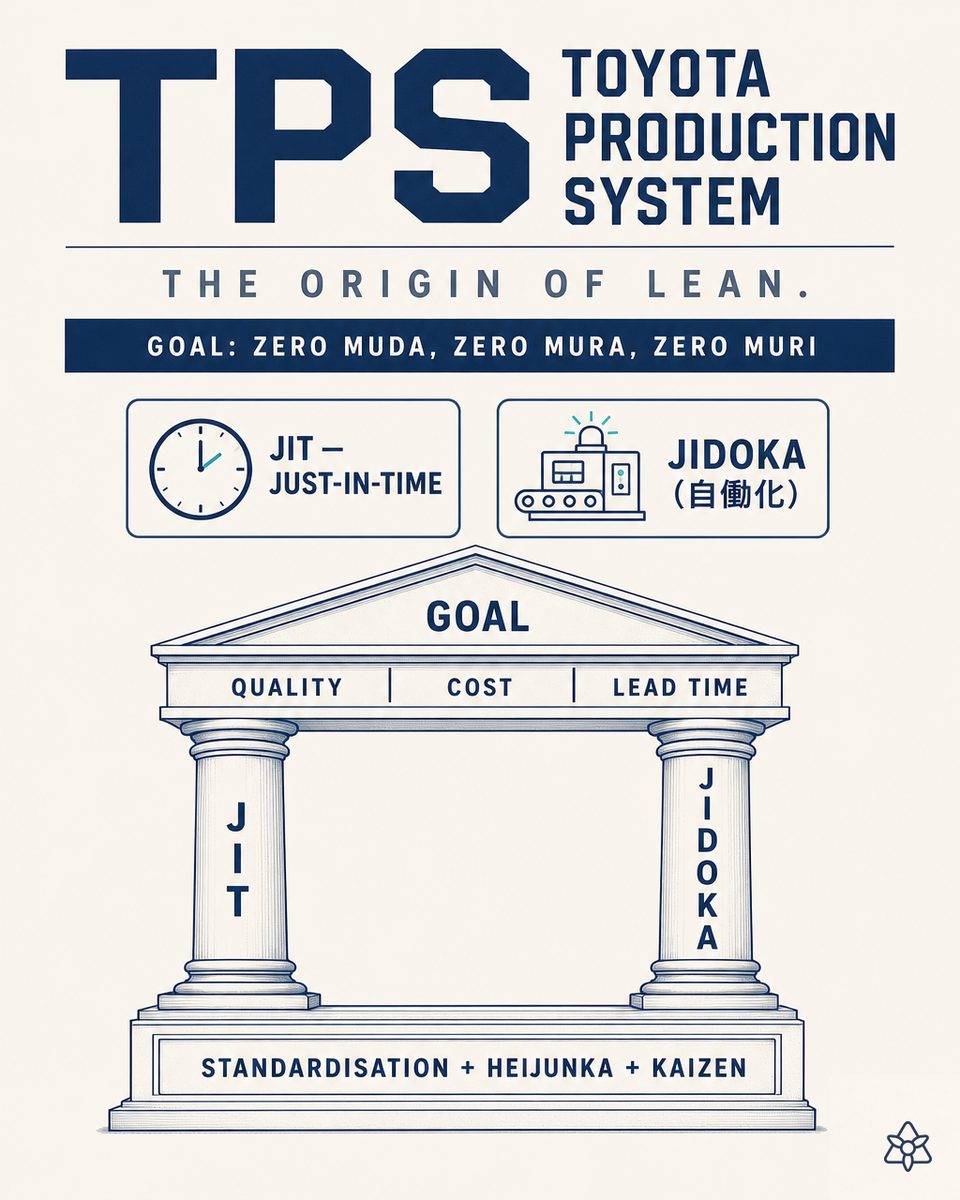
The Toyota Production System (TPS) is the production system Toyota developed after WWII that gave rise to modern Lean Manufacturing. It rests on two pillars: Just-in-Time (produce only what's needed when it's needed) and Jidoka (autonomation: the machine detects its own error).
Tracking it on paper? Snap a photo and see it digitized
Whatever the sheet —a log, an audit, a shift report— the AI agent learns its boxes from the first photo, reads it and stores it in your plant memory, where you can ask it questions from your phone.
The Toyota house — more than a diagram
TPS is visually represented as a "house": the roof is the goals (best quality, lowest cost, shortest lead time), the two pillars are Just-in-Time and Jidoka, and the foundation is standardized work, Heijunka and Kaizen.
The architectural metaphor isn't accidental: a house without foundations falls. Western plants that tried to copy JIT without first installing the culture of standardized work and Kaizen discipline usually fail — the pillars stand on the foundation, they don't float.
TPS gave rise to everything later called "Lean Manufacturing", "World Class Manufacturing", "Industry 4.0" and other labels. The concepts change name every decade; the fundamental principles are the same since 1950.
iLEAN doesn't replace the method — it brings it into the 21st century.
Every Lean methodology was born to solve an information problem: where stock is, which machine is failing, what changed shift-to-shift. When information is paper, methods are rituals. When it's live data, they become the actual engine of the plant.
Classical method tells you what to measure. The IRIS system guarantees the measurement reaches whoever decides, the moment they decide — without anyone typing it in.
The three capture layers applied: Connect (photo, voice, email, WhatsApp), Edge (computer vision on the line) and Integrations (ERP/MES/SCADA/PLC). On top of that unified information, specialized agents serve the exact context to each person on the floor.
Anatomy of the Toyota Production System
| Layer | Element | Function |
|---|---|---|
| Roof | Best Quality · Lowest Cost · Shortest Lead Time | The system goals |
| Left pillar | Jidoka (autonomation) | Quality built into the process, not inspected at the end |
| Right pillar | Just-in-Time | Continuous flow based on real demand (pull) |
| Foundation | Standardized Work · Heijunka · Kaizen | Cultural and operational stability |
| Center | People | TPS without trained and respected operators doesn't work |
What people ask about TPS
What is the Toyota Production System?
TPS is the production system Toyota developed between 1948 and 1975 under Taiichi Ohno and Shigeo Shingo. It's the origin of modern Lean Manufacturing. Its essence: produce only what's needed, when it's needed, with quality built into the process.
What are the two pillars of TPS and what does 'Jidoka' mean?
Just-in-Time: produce when there's real demand, not before or after. Jidoka (自働化): autonomation, the idea that the machine must stop itself upon detecting a problem and alert the operator, instead of continuing to produce defects.
How does TPS differ from Lean Manufacturing?
TPS is the original Toyota-specific name. Lean Manufacturing is the academic generalization popularized by James Womack in the 1990s — the same principles extracted from TPS applied to any industry. In practice they're the same.
How does iLEAN apply TPS principles today with industrial AI?
iLEAN doesn't invent anything new in terms of principles — it takes TPS principles and makes them executable with AI: Jidoka with vision Poka-Yoke, JIT with digital supplier coordination, Kaizen with voice and photo capture, Heijunka with sequence optimization, SMED with AI vision timing. The IRIS system = digitized TPS.
Who created TPS and when?
The key names are Taiichi Ohno (Jidoka, JIT) and Shigeo Shingo (SMED, Poka-Yoke), working at Toyota between 1948 and 1975. The system was popularized internationally after Ohno's book 'The Toyota Production System' (1978).
Tell us about your plant. We'll tell you how we'd do it.
25 years applying Lean in real plants. Free diagnostic conversation.
Request demo See Lean Manufacturing