AI skills matrix for operators — the matrix that updates itself with what really happens on the floor.
A skills matrix is only useful if it reflects who you have today and what they can do today. iLEAN Connect captures every training session, certificate and shift cover wherever it happens, and the Agents cross-check them with real performance per operator and per line. The matrix stops being a forgotten spreadsheet and starts flagging the gaps before someone is missing — a person signs.
Tracking it on paper? Snap a photo and see it digitized
Whatever the sheet —a log, an audit, a shift report— the AI agent learns its boxes from the first photo, reads it and stores it in your plant memory, where you can ask it questions from your phone.
The matrix that is already lying by the time you print it.
Every supervisor knows it: the skills matrix is only useful when a fast decision has to be made — covering an absence, planning a SKU changeover, moving someone to a new line. And that is exactly the moment when they discover that the matrix does not reflect reality:
- The new hire on line 3 has spent two months covering shifts on line 1 and already knows the job — but nobody wrote it down.
- Pedro's forklift certificate expired six weeks ago — the spreadsheet does not warn anyone.
- Marta learned to run the dispensing machine by watching the veteran, and in fact does it better than three officially autonomous operators — but she is not listed.
- Line 4 changed machines and the five operators certified as autonomous are certified on the old one, not the new one.
The result: the matrix gets updated whenever there is time, which means after the problem. By the time you check it, it is no longer true. The plant carries two kinds of invisible cost — the overspend of over-staffing because nobody trusts the matrix, and the day the veteran retires and half the know-how walks out with them, never recorded.
iLEAN does not add another HR system — it seals the crack between the one you have and what happens on the floor.
The problem with the skills matrix is not a lack of tools: there are HR modules in the ERP, there is vertical software, there are free spreadsheet templates everywhere. The problem is that training lives in one place, per-operator performance in another, and between the two there is a person acting as a bridge with copy and paste. iLEAN works as the filler that fills that joint — it does not demolish what you have, it only seals the crack. See the full IRIS architecture →.
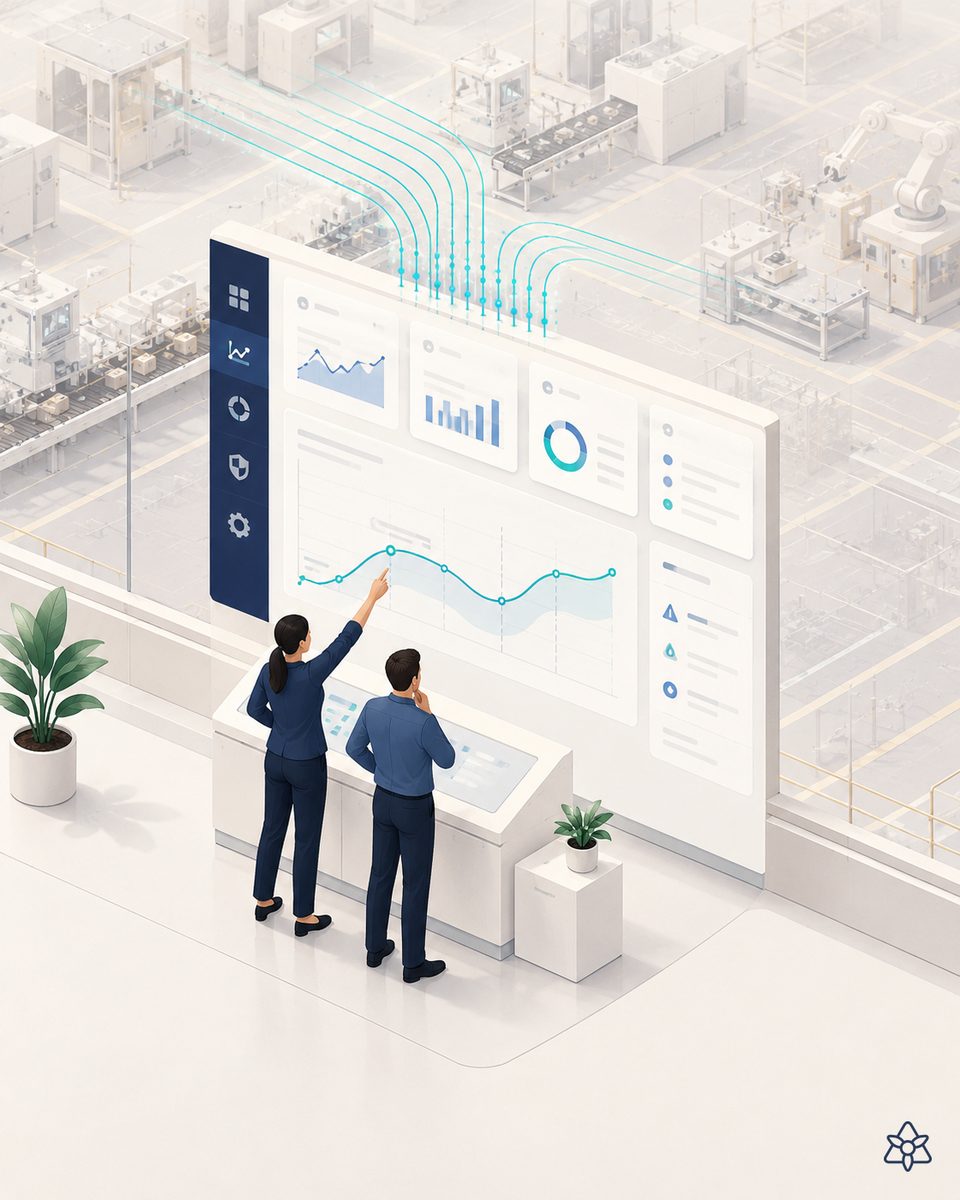
Connect captures training wherever it comes from. Agents cross-check it with quality and OEE per operator. The matrix updates itself; the AI points at the gaps and the supervisor signs them off.
The iLEAN pieces applied to the skills matrix:
- Connect — captures the certificate the quality manager signed on a tablet, the PDF of an external course that landed in the HR inbox, the on-the-job training session the veteran dictated through an earpiece while teaching a newcomer. It also captures what arrives from outside: the email from the insurer with an operator's return-to-work clearance, the message from the shift leader reporting an improvised shift cover. Everything enters at second zero, with nobody forwarding anything.
- Agents — cross the captured training with the per-operator and per-line performance already coming out of the MES and iLEAN Edge: quality, scrap, cycle time, stoppages. The agent detects real gaps (an operator listed as autonomous on line 3 whose scrap is a step above the average — review) and coverage holes (if Pedro is out tomorrow, the matrix says two autonomous operators are available — but both are at external training that same day).
- Central — the supervisor gets the proposal on their dashboard every morning. It is not one more alert: it is the short list of gaps that matter this week, ranked by risk. The supervisor decides; the line does not reorganize itself.
Spreadsheet matrix vs. a live skills matrix with iLEAN
| Aspect | Spreadsheet matrix + manual updates | With iLEAN Connect + Agents |
|---|---|---|
| Update frequency | Whenever there is time (weeks, months) | Continuous, at second zero |
| Capturing an improvised shift cover | Lost if nobody writes it down | Connect records it as it happens |
| Expired certificates | Noticed by chance | The agent warns with lead time |
| Validating real skill | Because the veteran says so | Per-operator and per-workstation performance cross-checked with the MES |
| Covering absences and holidays | A plan in the supervisor's head | Agent proposal with gaps anticipated |
| Know-how of the retiring veteran | Leaves with them | On-the-job training captured and reusable by the next person |
Impact estimate for your plant — to be validated with your numbers.
Block flagged as an estimate to be validated. We put it forward so the steering committee has an order of magnitude; we refine it during the diagnostic.
- Plant with 60-120 operators, 4-8 lines, an ERP with a minimal HR module and a spreadsheet for versatility. First value (matrix reconciled with reality and first real gaps) in a few weeks.
- Indicative payback between 4 and 9 months. The hard levers are: fewer overtime hours for unplanned coverage, fewer shifts open without a certified operator, less scrap from a newcomer with no formal on-the-job training.
- Expected reduction in uncovered coverage incidents of ≥ 30% versus the baseline — always on the conservative side.
- The big one is saved the day a veteran retires with their know-how documented, not in their head.
The underlying fact
Research on why language models hallucinate points in one direction: a model is reliable when it is anchored to verifiable data and when a person signs the final decision [1]. A live skills matrix is precisely that kind of anchored task — the agent never invents who knows how to do what, it reads certificates, on-the-job training and plant performance, and puts the short list in front of the supervisor. That is what turns people's know-how into permanent plant capability instead of letting it burn away with every absence, every retirement, every shift change.
[1] OpenAI paper "Why Language Models Hallucinate", 2025 — on the reliability of AI in anchored tasks.
What people ask about an AI skills matrix
What is a skills matrix and why does it go out of date so fast?
A skills matrix (versatility matrix) maps operators against tasks or workstations and shows who is trained to what level (observer, assistant, autonomous, trainer). It goes out of date because it lives in a spreadsheet that HR or the shift leader updates whenever they can — and plant reality changes every week: a new part number, an operator who learned while covering for someone, a certificate that expired, a team member back from sick leave. By the time you need to check it (covering an absence, planning a SKU changeover), it no longer reflects reality.
How do you keep a skills matrix alive with AI?
iLEAN Connect captures everything that happens around training: the certificate the quality manager signs on a tablet, the on-the-job training session the veteran dictated through an earpiece, the external course whose PDF lands in the HR inbox. And the Agents cross that training with real per-operator and per-workstation performance (quality, OEE, scrap) coming from the MES and from iLEAN Edge. If an operator is flagged as autonomous on line 3 but their scrap runs above the team average, the agent raises it as a gap to review — not as a penalty, as a heads-up for the supervisor.
Does the AI decide whether to promote or reassign an operator?
No. The agent proposes — the manager decides. The operating rule is the same as everywhere else in the system: the Agents gather, cross-check, anticipate and propose; a person signs the decision. iLEAN is designed to strengthen the supervisor, not to replace them. What changes is that the supervisor no longer decides blind: they see who has done what and when, with plant data instead of last year's memory.
Does it work if the factory runs an ERP, a vertical HR tool or just a spreadsheet?
Yes. Connect was built for exactly that scenario: it captures training whether it comes from the HR module of the ERP, from the vertical HR software, or from the spreadsheet the plant manager updates every Monday in a shared folder. Connect is the filler that seals the cracks between systems. It does not force you to change anything you already have — it only stops the data from living on an island.
How long before the matrix is live in a mid-sized plant?
In the iLEAN methodology, first value (the matrix reconciled with plant reality and showing the first real gaps) appears within a few weeks. The full pilot (with operator-to-line performance cross-checking and active coverage proposals) closes in a few months, depending on the number of lines and the quality of the starting data. We measure it before we start (baseline) and we measure it every week — so the steering committee sees the improvement, not the invoice.
More cases in lean manufacturing
- RCM with AI — reliability centered maintenance stops being a consultant's PDF.How iLEAN crosses failure modes, real asset history and criticality so RCM stops being a consultant's…
- Shift supervisor AI assistant — so the handover inherits context, not hallway rumors.With iLEAN the supervisor gets an assistant that preps the shift start, structures what they dictate and…
- Six Sigma: statistical process control with industrial AIiLEAN digitizes Six Sigma: live SPC, DMAIC boards, variation reduction — no Excel. 25 years applying…
- SMED: AI-timed quick changeoveriLEAN times SMED changeovers with computer vision, auto-splits internal/external setup, cuts changeover…
- Lean Manufacturing softwarethat doesn't ask you to learn it.Lean Manufacturing software with industrial AI: 5S, Kanban, TPM, SMED, Six Sigma digitized.…
- Spaghetti diagram with AI vision — the operator's real route, not the one on the floor plan.How iLEAN builds the spaghetti diagram continuously with Edge vision plus Connect — no stopwatch, no…
Tell us about your case and within 48h we will send you the estimated ROI of a live skills matrix for your plant.
We work on your real workforce and MES data, not on ours. Diagnostic with no commitment.
Request estimated ROI in 48h See Lean Manufacturing