SMED: AI-timed quick changeover
SMED (Single-Minute Exchange of Die) is the Lean methodology that cuts changeover times to under 10 minutes by separating tasks that need the machine stopped (internal) from those that can be prepared while it runs (external).
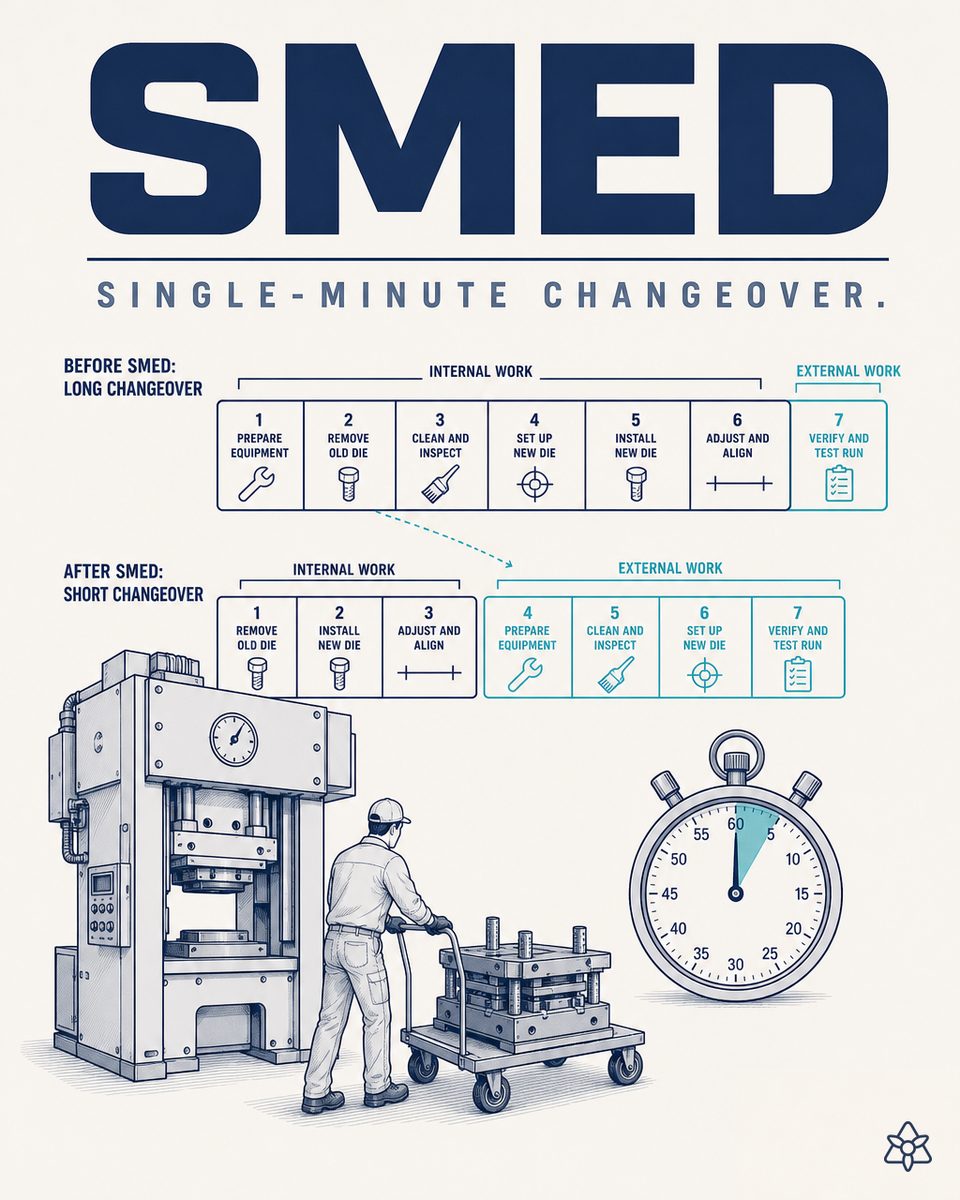
Fill in your SMED changeover sheet by hand; an AI agent does the rest
Not rolled out yet? Download our SMED changeover sheet template, fill it in by hand and snap a photo. Your company already has its own? Snap it anyway: the agent learns it from the first photo and reads it every time after.
What the agent does: Changeover time by machine, internal vs. external time and how it improves changeover after changeover.
Shigeo Shingo's idea
SMED was born at Toyota in the 1950s when Shigeo Shingo observed that changing a press die took hours. His analysis: most of the time the operator was doing things that didn't require the machine stopped — looking for tools, preparing the next die, carrying it over. But they did them with the machine stopped "because that's how we've always done it."
The SMED revolution is dividing the changeover into two categories:
- Internal setup: tasks that mandatorily require the machine stopped. E.g.: removing the old die, mounting the new, adjusting.
- External setup: tasks that can be done before stopping the machine. E.g.: preparing the new die, gathering tools, warming materials.
Reducing changeover time = moving tasks from internal to external + optimizing what's left as internal.
iLEAN doesn't replace the method — it brings it into the 21st century.
Every Lean methodology was born to solve an information problem: where stock is, which machine is failing, what changed shift-to-shift. When information is paper, methods are rituals. When it's live data, they become the actual engine of the plant.
Classical method tells you what to measure. The IRIS system guarantees the measurement reaches whoever decides, the moment they decide — without anyone typing it in.
The three capture layers applied: Connect (photo, voice, email, WhatsApp), Edge (computer vision on the line) and Integrations (ERP/MES/SCADA/PLC). On top of that unified information, specialized agents serve the exact context to each person on the floor.
Classical SMED vs. AI-timed SMED
| Aspect | Classical SMED | SMED with iLEAN |
|---|---|---|
| Timing | Manual stopwatch + observer | Computer vision times each subtask |
| Int/ext classification | Manual analysis on sheet | Auto-detection from operator movement |
| Waste identification | Video + post-mortem review | Automatic report after each changeover |
| Continuous improvement | Monthly meeting | Suggestion after each anomalous changeover |
| Changeover standard | Photo + text on board | Standard video + dynamic checklist |
What people ask about SMED
What does SMED stand for and where does it come from?
SMED = Single-Minute Exchange of Die = 'die change in a single-digit minute' (under 10 min). It was developed by Shigeo Shingo at Toyota in the 1950s when he saw that changing an industrial press die unnecessarily took hours.
How do I tell internal time from external time in a changeover?
Internal: only doable with the machine stopped (disassembly, adjustment). External: can be prepared beforehand (gathering tools, warming the new die). The SMED strategy is to move as much as possible from internal to external.
How does iLEAN time SMED changeovers without an operator with a stopwatch?
The Edge layer records the changeover with an industrial camera. Computer vision recognizes subtasks (disassembly, mounting, adjustment) and times each one. Auto-detection classifies each task as internal or external based on machine state. The operator doesn't stop to note anything.
What kind of machines does SMED work on?
Any machine with significant changeover times: presses, injection molders, packaging lines, ovens, machine tools. The biggest impact is where current changeover takes >30 minutes.
What changeover-time reduction is realistic to expect?
Reductions of 50-80% in the first 12 months are normal with well-implemented SMED. Companies starting from 4-hour changeovers typically drop to <60 minutes. The key isn't pure speed but moving work from internal to external.
Tell us about your plant. We'll tell you how we'd do it.
25 years applying Lean in real plants. Free diagnostic conversation.
Request demo See Lean Manufacturing