SMED in pharma packaging — the recipe changeover lasts as long as the cleaning validation, not as long as the stopwatch.
SMED in pharma demands cleaning validation between products. It is not a stopwatch problem: it is a paperwork and evidence problem. iLEAN times the changeover, sees the real state of the cleaning with Edge, captures the parameters with Connect and leaves the dossier ready for the QP to sign. The validated MES is never touched.
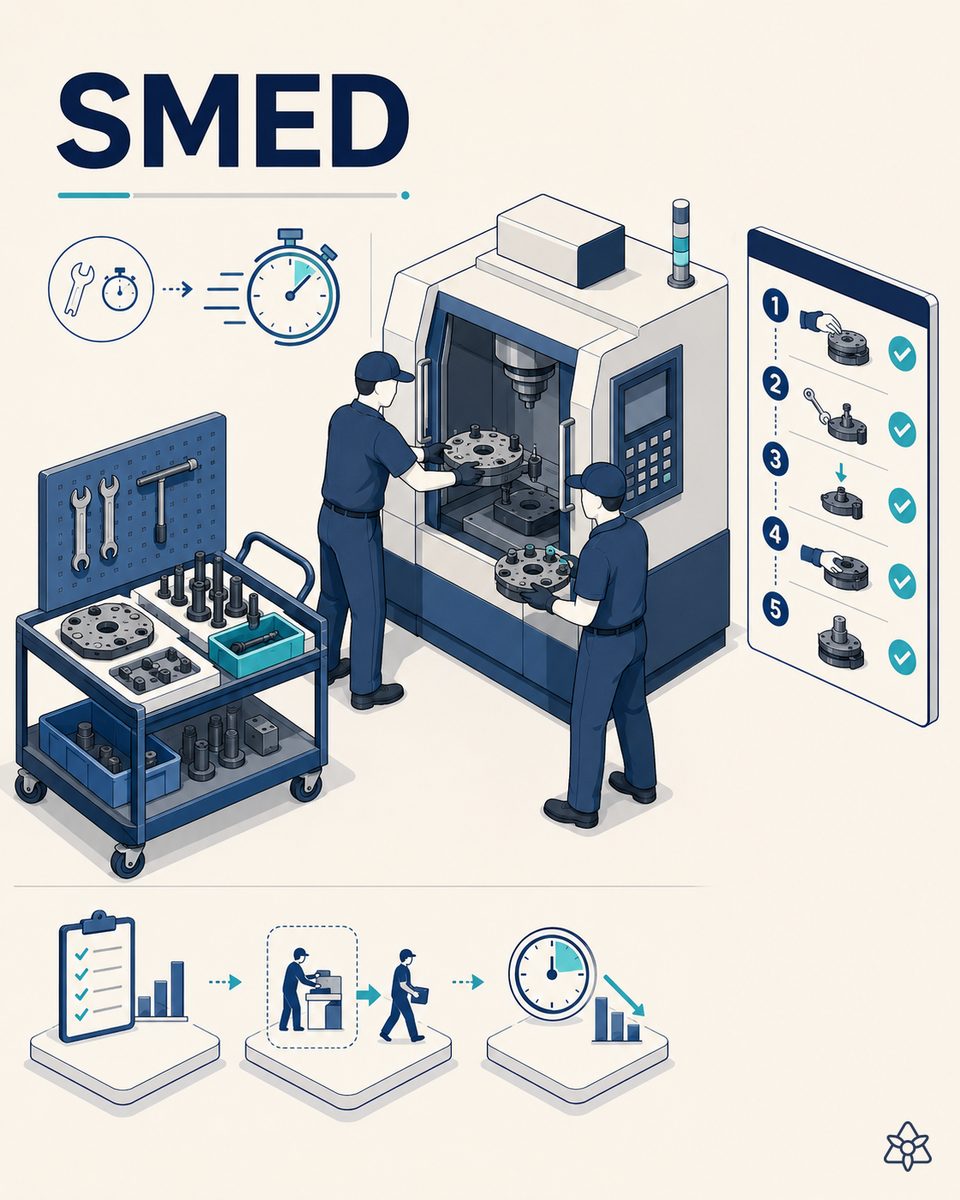
In pharma packaging the stopwatch is not in charge — the paperwork and the evidence are.
Any pharma packaging manager knows that a recipe changeover is not a problem of minutes on the machine: it is a problem of evidence. Before the new SKU can start you have to close the cleaning validation of the previous one, collect the CIP records, make sure no particles are left, settle the analytical challenge and complete the dossier for the QP. And all of that happens while the line is stopped, while the operator is doing twelve things at once and the quality manager is reconstructing the when and the how.
- Preparation runs in series instead of in parallel — formats, leaflets, labels, dossier and cleaning are done one after another because nobody has visibility of the real state of each step.
- The dossier is rebuilt by hand — photos of the record, signed sheets, PLC readings copied into a spreadsheet. Forty minutes of paperwork per changeover that the QP needs in order to release.
- The risk is not the time, it is the rework — a pack carrying the previous batch label, an incomplete dossier that delays release, a deviation that opens a CAPA. A single deviation costs more than a whole quarter of well-executed SMED.
The trap of traditional SMED consulting in pharma is to attack the stopwatch and leave the paperwork untouched. The stopwatch drops a little; the regulatory risk does not move at all.
iLEAN does not replace the validated MES — it seals the cracks between the line, the cleaning and the dossier.
The IRIS category (Industrial Reality Intelligence Systems) starts from a simple principle: the reality of the plant first, the report afterwards. In pharma packaging that means not inventing yet another validated system, but acting as filler between the three you already have — the validated MES, the line PLCs and the paper that still circulates out of convention. iLEAN signs that filler.
Edge sees the line clean. Connect captures the CIP parameters wherever they live. The agent prepares the complete changeover dossier for the QP to sign. The validated system is never touched.
The three iLEAN pieces applied to SMED in pharma packaging:
- Edge — a terminal with computer vision (CNN) over the critical area of the line (washer inlet, oven outlet, labelling belt). It reads the visible state of the cleaning, the reading of the washer display and the code of the format fitted. If anything does not match the declared SKU, it holds the line before start-up, not after.
- Connect — captures the CIP parameters (time, temperature, conductivity), the manufacturing order from the validated MES, the new recipe from the ERP and the emails and instant messages from the customer or auditor that arrive at second zero. No forwarding, no coordination meetings.
- Agent — cross-checks the three data sources and prepares the signable changeover dossier: previous order closed, cleaning validation with its evidence, new order prepared, format verified by Edge. It leaves it in the QP's inbox. The person signs — the line does not start on its own.
Classic recipe changeover vs. a changeover timed and verified with iLEAN
| Aspect | Classic SMED in pharma packaging | With iLEAN Edge + Connect + Agent |
|---|---|---|
| Changeover preparation | In series: formats, leaflet, dossier, cleaning, one after another | In parallel: agents prepare dossier and format while the line finishes the batch |
| Cleaning validation | Operator + checklist + supervisor sign-off | Edge sees residue + Connect captures CIP parameters + dossier ready |
| Reading parameters from the validated MES | Print and sign | Automatic capture (without touching the MES, only reading its output) |
| Verification of the format fitted | Operator's visual check during the changeover | Edge verifies the format code against the SKU |
| Dossier for the QP | Rebuilt by hand after the changeover | Signable dossier prepared as the previous batch closes |
| Changeover traceability | Changeover sheet filed on paper | Evidence with photo, timestamp and electronic signature |
Impact estimate for your plant — to be validated with your own numbers.
The block below is an estimate to be validated with the specific data of your plant. We put it forward so the committee has an order of magnitude; we refine it during the diagnostic.
- Blister or vial line, multi-SKU, several changeovers a day, a validated MES in production and automated CIP.
- Edge + Connect + Agent pilot on one line: cleaning camera + reading of the washer display + MES capture + dossier agent. First value expected within a few weeks (automatic dossier capture already saves paperwork from day one).
- Reduction of total changeover time in the first quarter of around 30%-45% (estimate to be validated). Reduction of changeover deviations (pack with the previous label, incomplete dossier) of a similar order.
- Indicative payback between 4 and 9 months. The hard lever is not only time: it is the deviation avoided, which costs more than a whole quarter of SMED.
And the reasonable doubt from QA
"What if the AI gets it wrong and releases a batch with incomplete cleaning?" — hallucination is a problem of free generation, not of anchored tasks. On tasks where the AI merely recontextualizes a piece of data from one system into another (reading the CIP parameter and comparing it with the recipe), the best models brought the error below 1.5% [1]. And even so, nothing critical is decided alone: iLEAN prepares the dossier, the QP signs. The three safety rings are there precisely for this — the validated OT network stays behind the armoured mailbox, receiving no inbound connections.
[1] OpenAI paper "Why Language Models Hallucinate", 2025 — on the reliability of AI in anchored tasks.
What people ask about SMED in pharma packaging with AI
What about cleaning validation? Can AI touch a GMP-validated process?
iLEAN does not replace cleaning validation or the validated MES: it complements them. Edge watches the line (visible residue, CIP-complete indicator, reading of the washer display), Connect captures the cleaning parameters (time, temperature, conductivity) wherever they live — in the validated MES or in the PLC. The agent cross-checks the three data sources and prepares the changeover dossier signed by the quality manager before the new batch starts. The QP is still the one who signs the release; what the system does is save them 40 minutes of paperwork and give them visual evidence of the real state of the line.
What before-and-after times do you see on a pharma packaging recipe changeover?
As an order of magnitude — and always to be validated with the real data from your plant — a recipe changeover in pharma packaging usually runs between 2 and 6 hours, with cleaning validation and the analytical challenge taking the bulk of the time. After a SMED pilot with iLEAN, the estimate to be validated points to a reduction of around 30%-45% in total changeover time in the first quarter — above all by converting internal operations into external ones (preparing tooling, formats, labels and dossiers in parallel, not in series) and by removing the dead time of paperwork.
Does it work with a validated MES or a proprietary GMP system?
Yes. iLEAN sits on top of the MES — it neither replaces nor modifies it. It reads what the MES exposes (via API, ODBC, or by reading the log if the MES is closed) and deposits the changeover information as one more event in the MES or as an attached dossier. The GMP validation of the MES is not touched. iLEAN acts as an orchestration and capture layer, without writing into the validated system except where the customer and their QA approve it. The three-ring architecture protects the OT network and the validated process.
What real improvement can you expect?
No magic promises: what moves the needle most in pharma packaging is not the changeover stopwatch but the elimination of rework caused by changeover deviations (packs carrying the previous batch label, mixed formats, an incomplete dossier that delays release). An estimate to be validated: payback between 4 and 9 months, with the first value visible within a few weeks (typically the automatic capture of the changeover dossier, which QA no longer has to rebuild by hand). The serious calculation is done with your data during the diagnostic.
What about the difference between blister and vial? Does the system serve both?
Yes, and the method is the same even though the line changes. On blister the bottleneck is usually the format (mould change, thermoforming calibration, seal integrity test) and the OCR reading of the leaflet. On vial it is the cleaning validation of the filler, the fill-level calibration and particle control in the closure. Edge adapts with a different CNN for each case, Connect reads the parameters wherever they live, and the agent delivers the same changeover dossier. The safety rings and the human signature are identical in both cases.
Tell us about your case and within 48h we will send you the estimated ROI of an AI-driven SMED for your pharma packaging line.
We work on the real data of your plant, not on ours. No-obligation diagnostic, without touching the validated MES.
Request estimated ROI in 48h See Lean Manufacturing