Poka-Yoke: error-proofing with computer vision
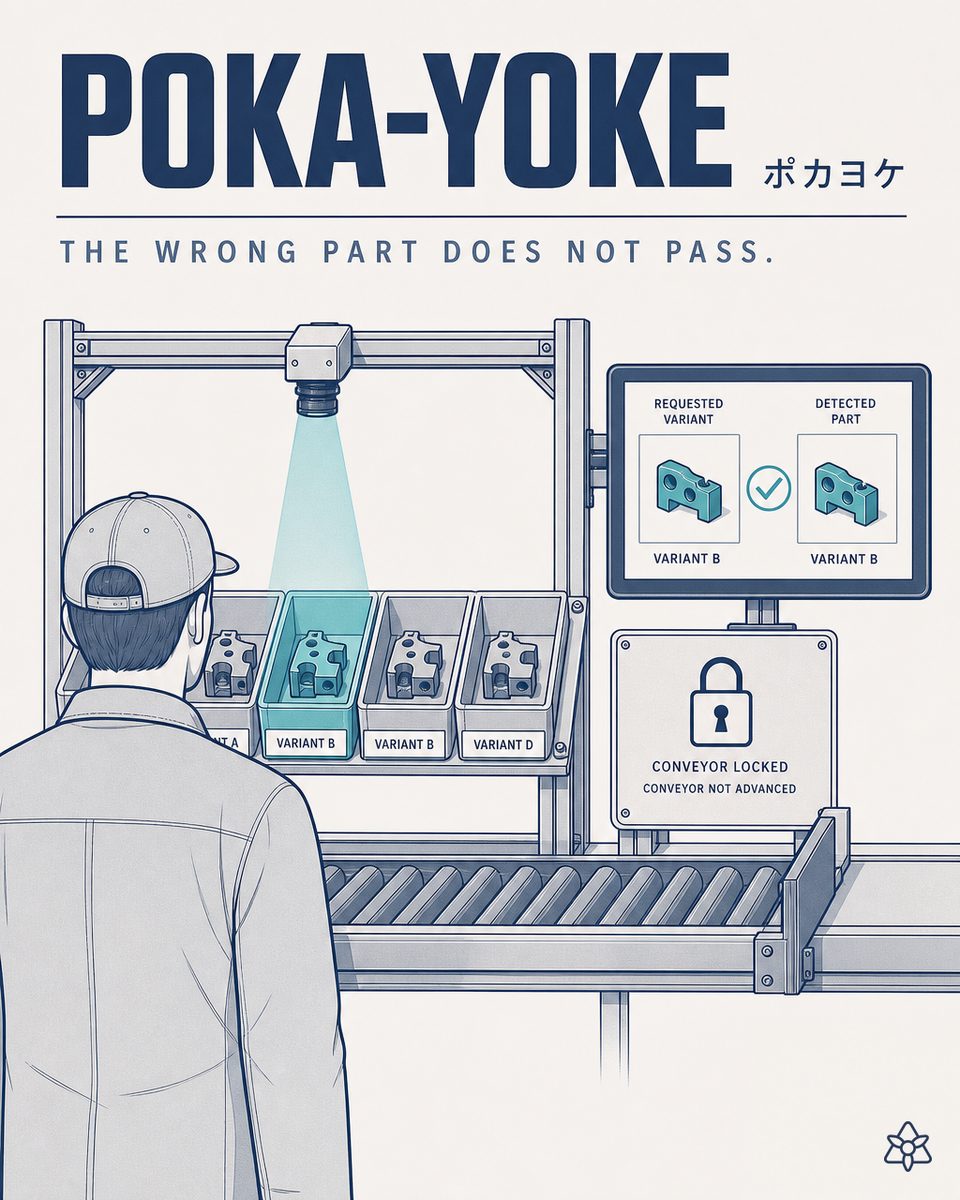
Poka-Yoke is the Lean methodology that designs the process, machine or tool so that the error is impossible to make — or, if made, it's instantly caught before it affects the next step.
Fill in your defect check sheet by hand; an AI agent does the rest
Not rolled out yet? Download our defect check sheet template, fill it in by hand and snap a photo. Your company already has its own? Snap it anyway: the agent learns it from the first photo and reads it every time after.
What the agent does: Top defects by day, shift and part, with the Pareto chart built for you.
Shigeo Shingo's principle
Shigeo Shingo formalized the concept at Toyota in the 1960s. His thesis: people make errors — that's inevitable — but resulting defects are avoidable if the system is designed to detect or prevent them. Responsibility transfers from the operator to the design.
There are two types of Poka-Yoke:
- Control Poka-Yoke: the machine doesn't let you proceed if the error is present. E.g.: a fit that only goes in one orientation.
- Warning Poka-Yoke: the machine alerts the operator but lets them decide. E.g.: a light that turns on if a component is missing.
iLEAN doesn't replace the method — it brings it into the 21st century.
Every Lean methodology was born to solve an information problem: where stock is, which machine is failing, what changed shift-to-shift. When information is paper, methods are rituals. When it's live data, they become the actual engine of the plant.
Classical method tells you what to measure. The IRIS system guarantees the measurement reaches whoever decides, the moment they decide — without anyone typing it in.
The three capture layers applied: Connect (photo, voice, email, WhatsApp), Edge (computer vision on the line) and Integrations (ERP/MES/SCADA/PLC). On top of that unified information, specialized agents serve the exact context to each person on the floor.
Classical Poka-Yoke vs. with computer vision
| Aspect | Classical Poka-Yoke | Poka-Yoke with iLEAN |
|---|---|---|
| Error detection | Dedicated mechanical sensor | Multi-purpose computer vision |
| Versatility | One poka-yoke = one error | One camera = multiple configurable errors |
| Adapting to new product | Mechanism redesign | Re-train AI model with photos |
| Incident logging | If operator writes it down | Each defect photographed and dated |
| Post analysis | Manual | Defect patterns detected by AI |
What people ask about Poka-Yoke
What is Poka-Yoke and where does it come from?
Poka-Yoke (ポカヨケ) literally means 'error-proofing' in Japanese. It was formalized by Shigeo Shingo at Toyota — the idea of designing the process so the error is impossible or instantly caught, instead of depending on operator attention.
What's the difference between control Poka-Yoke and warning Poka-Yoke?
Control: the machine/system physically blocks and doesn't allow continuation (e.g., a connector that only fits one way). Warning: the machine detects the error and alerts the operator, who decides to stop or continue (e.g., red light when a component is missing).
How does iLEAN apply Poka-Yoke with industrial computer vision?
The Edge layer installs industrial cameras at critical points. An AI model trained with photos of valid and invalid parts classifies each passing piece. If it detects a defect, it triggers an Andon alarm, stops the line, or segregates the part. The operator just confirms.
Do I need to modify my machines to add Poka-Yoke?
Generally no. iLEAN vision cameras install externally without touching the machine. The operator keeps working the same way; we just add an extra eye that verifies. If your Poka-Yoke requires physical blocking, modification is needed — but most modern cases are solved with vision.
In which industries does Poka-Yoke work best?
Where the defect is expensive: automotive (a mis-assembled component is found at the customer), pharma (labeling and dosing), electronics (reversed components), food (allergen presence in packaging). I.e., almost all of modern industry.
Tell us about your plant. We'll tell you how we'd do it.
25 years applying Lean in real plants. Free diagnostic conversation.
Request demo See Lean Manufacturing