AI vision poka-yoke — human assembly errors are not prevented by a poster.
Posters, checklists and training videos reduce human error in assembly; they do not eliminate it. iLEAN Vision sees every step at the station, compares it with the correct sequence for the SKU being built, and warns the operator before the next step if something does not fit. The part does not move on with the fault; it is corrected where it is born. The person signs off.
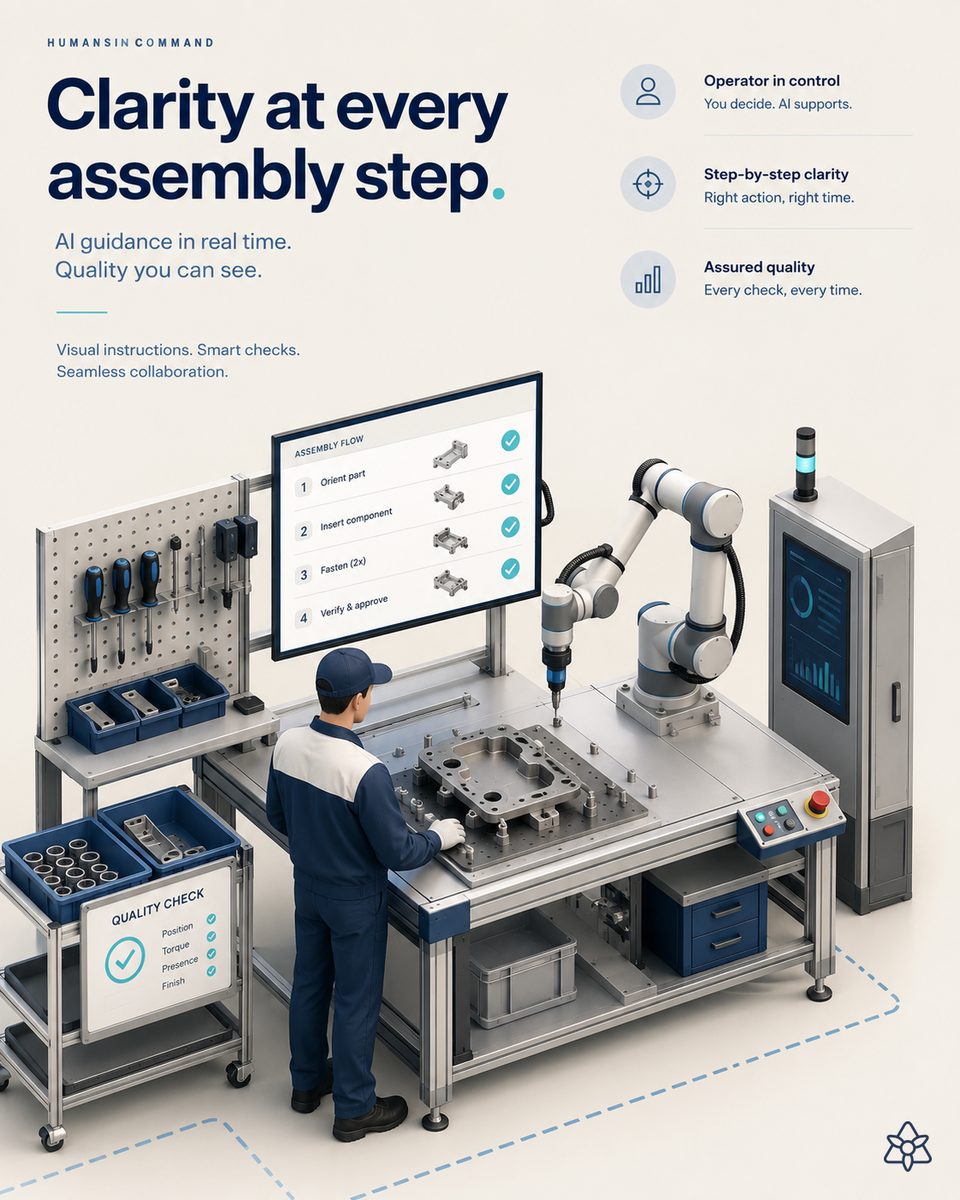
Human error in assembly does not belong to the person who makes it — it belongs to the system that allows it.
Poka-yoke (mistake-proofing) is one of the pillars of jidoka: making it physically impossible for an error to reach the next step. It works perfectly when you can design a mechanical fit that only goes in one way. But in multi-variant manual assembly, where every SKU has a different BOM and the same station builds version A today and version C tomorrow, mechanical poka-yoke becomes impossible or prohibitively expensive — and what lands on the operator instead is posters, checklists and Monday-morning training.
And the operator does it right. 99.8% of the time. But the remaining 0.2% is what reaches final inspection, the customer, or (worse) the field. In automotive the demanding standard is in the order of 25 PPM — every defect that slips through costs hard money and, above all, customer trust.
The acute problem shows up at the changes: SKU change, shift change, new operator. That is precisely when the poster on the wall is not enough. The classic answer is to add a downstream check, a rework loop, or an inspector. It is expensive and, worse, it arrives late — the defect has already been born.
iLEAN does not replace the operator — it gives them a safety net before the next step.
Vision poka-yoke is jidoka in two stages: first it detects the error at the moment it is born; then (as data accumulates) it anticipates the root cause so the error stops happening at all. The filler iLEAN brings seals the gap between the veteran operator's expertise and the new operator's risk, without asking you to redesign the workstation or add an inspector on the line.
The camera sees the step, the agent compares it with the sequence for that SKU, the operator gets the warning before moving on. The part does not slip through with the fault — and the person signs off when they have corrected it.
The iLEAN pieces applied to vision poka-yoke:
- iLEAN Vision (on Edge) — a physical terminal with a camera and a convolutional neural network (CNN) that sees every assembly step in milliseconds. It works without a network: if the plant loses WiFi, Edge keeps seeing, comparing and warning, because what is critical cannot depend on connectivity.
- Validated sequence per SKU — the system first reads the SKU being built (label, code, configuration) and loads the expected sequence. In multi-variant work this is what removes the “I built variant A with variant B's BOM” error.
- Feedback to the operator, not to the inspector — the warning goes to the station: green/red light, watch vibration, tone in the earpiece. The operator corrects where the error is born, not after the part has moved to the next station. The person signs off once they have corrected it and the part can move on.
- Capturing the veteran's know-how — training the sequence with the operator who performs it best leaves that knowledge as a permanent capability of the plant. The day they retire, the sequence lives on in the camera.
Classical poka-yoke vs. AI vision poka-yoke
| Aspect | Classical poka-yoke (poster + checklist) | With iLEAN Vision + Edge |
|---|---|---|
| Error detection | At final inspection or customer claim | At the station itself, before the next step |
| Multi-variant | Confusion at SKU changeover | Reads the SKU and loads the correct sequence |
| New operator | Learning curve paid in scrap | Safety net from day one |
| Shift handover | Context lost at the relay | Same criterion across every shift |
| Veteran's know-how | Walks out the day they retire | Captured as a permanent capability |
| Operation without network | n/a | Edge keeps running on panel power |
Impact estimate for your plant — to be validated with your numbers.
The block below is an estimate to be validated with the specific data of your plant. We set it out so the committee has an order of magnitude; we refine it during the diagnostic.
- Manual assembly line with 3–8 SKUs and different BOMs, a recurring defect caught at final inspection that originates at one specific station.
- Vision pilot at the critical station: camera, network trained with the veteran operator, local feedback to the operator. First value expected within a few weeks: the camera starts catching the first family of errors.
- Reduction of the defect generated at that station estimated at ≥ 30% over the first months. Indicative payback between 4 and 9 months, depending on the average cost of the defect and your current PPM.
- In automotive the demanding standard in the order of 25 PPM [2] is the hard lever: every PPM avoided is hard cost and, above all, reduced customer risk.
And the operator's reasonable doubt
“If the camera corrects me at every step, I'm going to assemble slower.” It is the right objection — and the answer is not theoretical, it is a design choice: feedback goes to the operator, not to the supervisor; it stays green by default and only switches to a warning if there is a deviation; and the integration with the station is built so as not to break the flow. What changes for the operator is that they start the shift with peace of mind — the camera is a net, not a whip. The warm bed: the previous shift went well because the camera secured every step.
And for the CAIO: hallucination is a problem of free generation, not of anchored tasks. Comparing an image against a validated sequence is the most anchored task there is — the best models brought the error below 1.5% [1]. And even so, the part does not move on by itself: the person signs off once they have corrected it.
[1] OpenAI paper “Why Language Models Hallucinate”, 2025 — on the reliability of AI in anchored tasks.
[2] Symestic — PPM quality standards in automotive.
What people ask about AI vision poka-yoke
What kind of errors does an AI vision poka-yoke catch?
The typical manual-assembly errors: missing part, part fitted the wrong way round, altered sequence, screw not torqued to spec, connector plugged into the wrong port, label not applied, incomplete packaging. Everything a poster on the wall or a paper checklist never quite prevents during a shift handover or on a new SKU. The camera sees each step; the agent compares it with the expected sequence for that SKU; the operator gets the warning before moving on.
How is the correct assembly sequence trained?
The learning process (FDE) means recording the correct sequence with the veteran operator who performs it best — a few iterations are enough for the vision neural network (CNN) to learn the key steps. The sequence is versioned per SKU; if the BOM changes, only the affected SKU is retrained. The veteran's know-how is captured as a permanent capability of the plant — it does not walk out the day they retire.
Does it work with multiple variants at the same station?
Yes — that is exactly the scenario it was designed for. Edge first reads the SKU (label, code, part configuration) and loads the correct sequence for that SKU. If the next unit is another variant, it reloads. The operator does not have to tell the camera what they are assembling; the camera sees it. At multi-variant stations (typical in automotive, industrial goods and consumer electronics) that removes the “I built variant A with variant B's BOM” error.
Can it keep up with high-cadence lines?
Yes. Edge is designed to react in milliseconds — in the automotive powder-coating case, the actuator fired at 45 ms. In manual assembly the operator cycle is far slower than that; vision inference has plenty of headroom. The constraint is not the speed of the AI — it is making sure the warning reaches the operator in a way that does not break their flow (green/red light at the station, watch vibration, tone in the earpiece).
How do you measure the ROI of an AI vision poka-yoke?
In automotive the demanding standard is in the order of 25 PPM (parts per million) — every defect that escapes is a hard cost (claim, rework, scrap) and a risk of losing the customer. The lever of a vision poka-yoke is to remove the defect at the moment of the error, not at final inspection. ROI is calculated on PPM avoided × average cost of the defect. Send us your figures and we will come back with the estimated ROI in 48h.
Tell us about your case and within 48h we'll send you the estimated ROI of an AI vision poka-yoke for your line.
We work on your real PPM and BOM data, not on ours. Diagnostic with no commitment.
Request estimated ROI in 48h See Lean Manufacturing