OEE in a 24/7 plant — the three shifts perform differently, and nobody knows why until Monday.
In a 24/7 plant, OEE varies from shift to shift and the conversation turns sour fast (“nights always run worse”). iLEAN measures OEE per shift with the same yardstick, identifies the weak shift without blaming anyone and prepares the handover between shifts. The operator walks into a warm start, not into the mess the previous shift left behind.
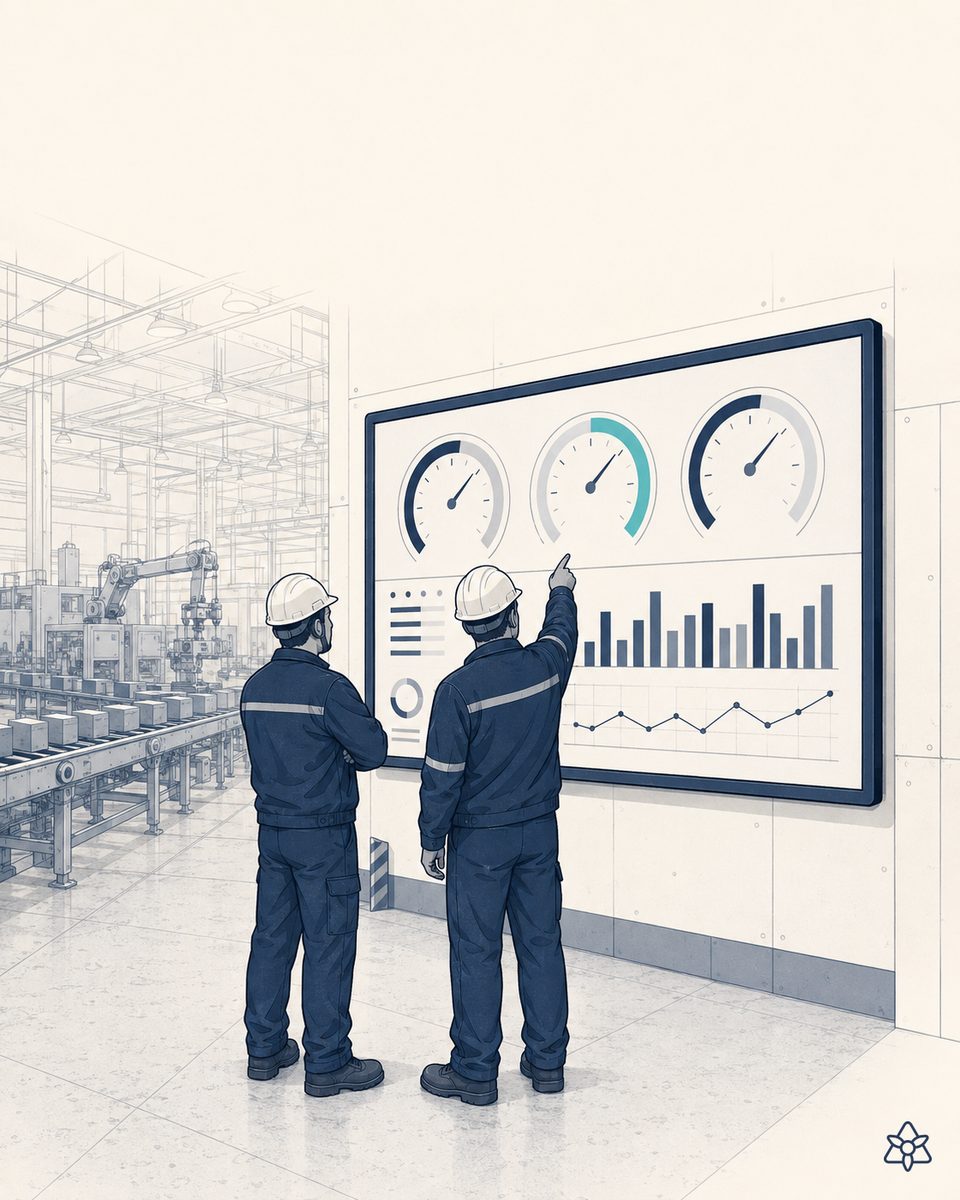
Three shifts, three realities — and an average OEE that hides what matters.
The operations director of a 24/7 plant knows the sentence by heart: “the average OEE looks fine, but nights drag it down”. And they know the next chapter too: the Monday meeting where the night shift leader says nights always run short-staffed, the afternoon leader says the line is handed over badly loaded, and the morning leader says they break records but pick up the worst of the SKU changeover. Everyone is partly right and nobody holds the full truth, because each one measures their own way.
- Each shift reports however it can — mornings on a screen, afternoons on paper, nights in a spreadsheet filled in at the end. The micro-stops (the ones that weigh most on real OEE) get reported in none of the three.
- The verbal handover loses 80% of the context — the incoming shift inherits a line whose last state nobody described in full. It starts at 22:00 by working out what happened at 21:50.
- The weak shift becomes chronic — with no comparable data, the problem gets attributed to people (“the night team is lazy”). The team then goes on the defensive, and the conversation turns sour.
The classic anti-pattern is measuring badly and arguing in the meeting. The argument does not build OEE — it builds distrust between shifts.
iLEAN does not add another dashboard — it captures each shift’s reality and passes it to the next.
The IRIS category (Industrial Reality Intelligence Systems) starts from one principle: capturing reality comes first, reports come after. Applied to OEE, that means not trusting manual reporting: Edge watches the line, Brain consolidates, the agent delivers what each shift needs to see. iLEAN acts as the filler between the three shifts and the systems you already run (MES, SCADA, ERP), without asking you to change them.
Edge measures the line with the same yardstick for all three shifts. Brain consolidates without blaming anyone. The agent prepares the handover. The warm start stops being a slogan.
The three iLEAN pieces applied to OEE in a 24/7 plant:
- Edge — a terminal with vision and sensors over the line that captures cycles, micro-stops and defects in real time. Without asking the operator to fill in a screen. It works without a network — if the plant loses WiFi, Edge keeps counting cycles and logging stops, because the shift’s data cannot depend on connectivity.
- Brain — consolidates data from the three shifts under the same OEE definition (availability × performance × quality). It shows the weak shift with data, not with opinion, and breaks it down by root cause (micro-stops, changeovers, scrap), not by person.
- Agent — prepares the automatic handover report for the incoming shift: what happened in the last two hours, what is still open, the adjustments they need to know about, the spare parts consumed. And it proposes actions for the weak shift based on the root-cause pattern, not on intuition.
Hand-reported OEE vs. captured OEE with an automatic handover
| Aspect | Classic OEE across 3 shifts | With iLEAN Edge + Brain + Agent |
|---|---|---|
| Data source | Manual report per shift, each with its own criteria | Edge captures cycle, micro-stops and defects on the line |
| Yardstick | Each shift has its own | The same for all three, comparable |
| Micro-stops | Not reported | Counted automatically |
| Handover between shifts | 5 verbal minutes, 80% of the context lost | Handover report ready on screen and in the earpiece |
| Identifying the weak shift | Argument in the Monday meeting | Weekly data with root cause, not with a culprit |
| Temporary staff / turnover | The veteran is the only safety net | Persistent context, delivered to whoever comes in |
Impact estimate for your plant — to be validated with your numbers.
The block below is an estimate to be validated against the concrete data of your plant. We put it forward so the committee has an order of magnitude; we refine it during the diagnostic.
- Continuous or discrete process plant, 24/7 across three shifts, current OEE between 55 and 70, with visible differences between shifts.
- Edge + Brain + Agent pilot on a single pilot line (the bottleneck, or the one with the largest gap between shifts). First value expected within a few weeks: as soon as Edge captures, the real OEE per shift appears and the conversation changes.
- Expected OEE improvement in the first year: +5 to +12 points on the pilot line (estimate to be validated), with the bulk of the jump coming from the weak shift levelling up.
- Indicative payback between 4 and 9 months. The hard lever is the sum of micro-losses eliminated, defects caught earlier and fewer stops caused by context lost in the handover.
And the works council’s reasonable doubt
“Is this to watch the operator?” — no. iLEAN sees the line, not the person: it is process verification, not people. The data is attributed to the shift, not to a name, and the conversation it opens is not disciplinary — it is collective improvement. What changes is that the operator no longer starts a shift asking “what did they leave me?”; they start warm, with the previous shift’s context already digested. Same person, same pay, a different working life.[1]
[1] OpenAI paper “Why Language Models Hallucinate”, 2025 — on the reliability of AI in anchored tasks.
What people ask about OEE in a 24/7 plant with AI
How do you measure OEE per shift when each one reports its own way?
By measuring where reality happens, not in the spreadsheet where it gets reported. iLEAN Edge captures real line stops (micro-stops the operator never reports because they happen a thousand times), effective cycle speed and defects detected by vision. The agent attributes every stop to the shift it happened in, without asking the operator to fill in a screen. Each shift’s OEE comes from the same data for all three, with the same yardstick — that is what makes the comparison honest.
What about the shift change? How do you pass the context without losing it?
The handover is usually a five-minute verbal act where the important things get told — and the important things get told badly or forgotten when the incoming shift is tired. iLEAN prepares an automatic handover report: critical stops from the outgoing shift, anomalies still unresolved, adjustments the next shift needs to know about, spare parts consumed. The agent leaves it on the incoming shift leader’s screen and in their earpiece if the group uses Connect. The operator no longer starts a shift asking “what did they leave me?” — they start with the context already digested.
Does it integrate with the MES we already use for OEE?
Yes. iLEAN does not replace the MES — it sits on top of it. If the MES already calculates an OEE, iLEAN reads it, cross-checks it against Edge’s real capture and shows where the MES was seeing less than the full picture (unreported stops, micro-losses, defects attributed to the wrong shift). If the MES does not calculate OEE, or only does so at a daily level, iLEAN builds it from the capture and deposits it into the MES as an additional data point. The three-ring rule protects the OT network; a validated or critical MES is never modified.
What typical OEE improvement can a 24/7 plant expect?
As an estimate to be validated against your plant’s real data: the first jump usually comes from the simple fact of measuring properly — when the three shifts share a yardstick the conversation changes and the weak shift starts correcting itself, because it can see where it deviates from the others. A conservative estimate points to +5 to +12 OEE points in the first year in plants starting between 55 and 70 OEE, with no magic promises. The hard levers: micro-losses eliminated, defects caught earlier and a handover with no context lost between shifts.
Does it work in a plant with temporary staff or high turnover?
That is precisely where it contributes most. In a plant with high turnover the knowledge leaves with whoever leaves, and the verbal handover transfers almost nothing. iLEAN turns the handover into persistent data: the temporary worker starting on Monday finds the process documentation in their earpiece, the previous shift’s critical points on their screen, the SKU changeover steps with photos. The veteran stops being the only safety net — the knowledge stays in the system and is handed to whoever comes in. That is the heart of IRIS: capturing reality so people work with the confidence of knowing the context is there.
Tell us about your case and within 48h we will send you the estimated ROI of properly measured OEE in your 24/7 plant.
We work on your line's real data, not on ours. Diagnostic with no commitment.
Request demo See Lean Manufacturing