Digital operator rounds — completing the round is not the goal. Capturing the deviation is.
Digitizing the checklist is the easy part — and the part that changes least. iLEAN turns the round into useful capture: the operator talks through the earpiece, Connect logs voice and photo, the agent cross-checks against the asset's normal pattern and, if something does not add up, it says so before it becomes a breakdown. And the audit pack builds itself. A person signs off — always.
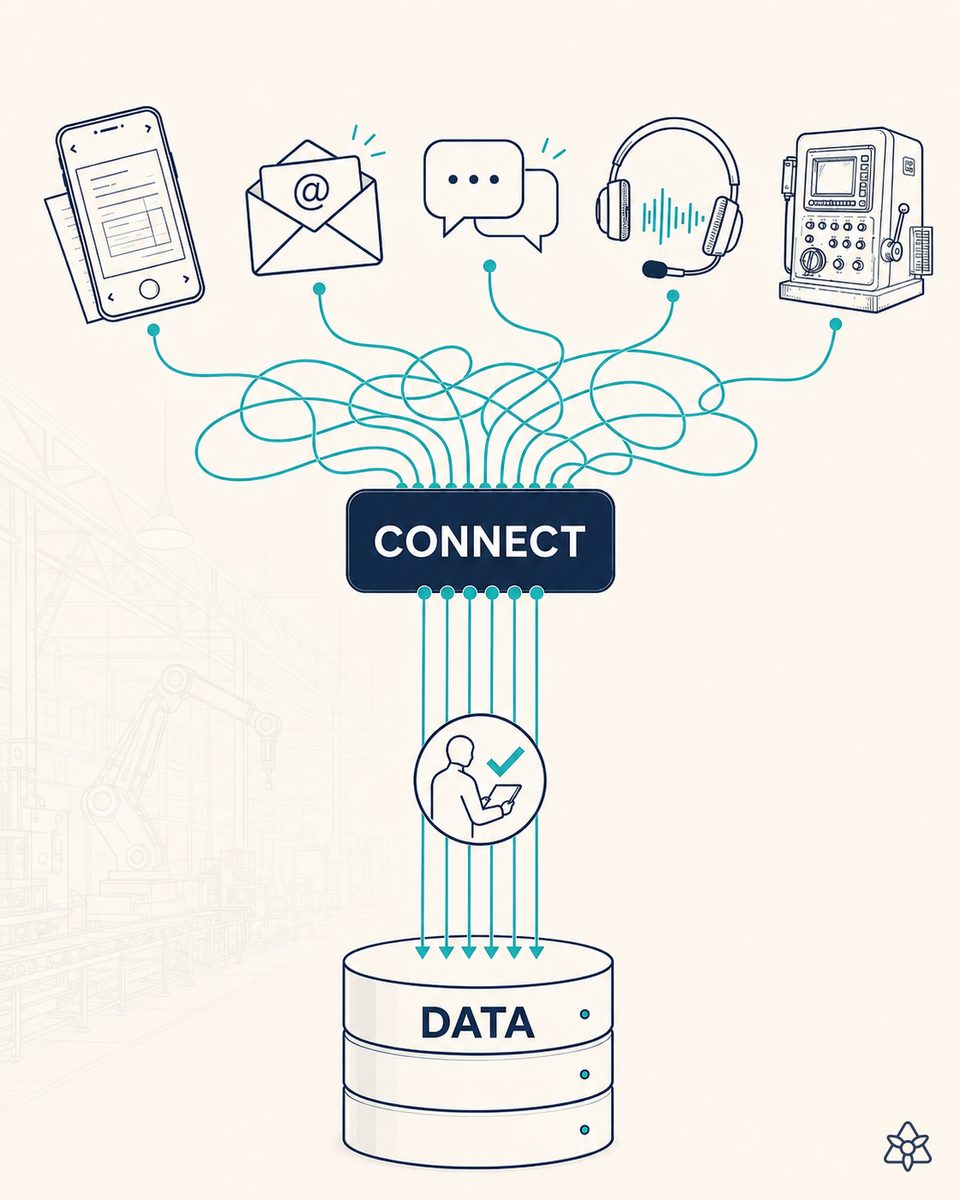
The digital checklist gets ticked down the list — and the round stops detecting anything.
The operator round was born so that someone with judgement would look at the critical asset every so often and raise the alarm before something broke. Digitizing the checklist solved traceability — but it did operations a poisoned favour:
- The operator has 20 checkpoints in 25 minutes. If the system only asks for «OK / NOK», they tick OK down the list to finish on time. They work that way because their manager asks for the round on schedule, not for the deviation detected.
- The deviation travels through parallel channels. If they see something odd, they send a message to the shift manager with a photo and keep walking. The checklist stays OK; the message gets lost.
- The operator's knowledge never enters the system. «The motor makes a strange noise when it revs to 3,000 rpm», «there is a different smell in room 3» — these are the early symptoms the checklist misses because it has no field for them. And they are exactly the ones that matter.
- The audit gets a PDF full of OKs. It complies, but it tells no story. The day an incident happens, the auditor will ask why the round did not catch it. The answer will be: because the system never asked about that.
The result: the round becomes an administrative stamp. Plant reality goes back to living in the operator's head and in messages that never reach the system. The day that operator retires or changes shift, that information disappears.
iLEAN changes the unit of the round — from «click» to «voice + photo + measured reading».
The problem was never doing the round; it was the format. iLEAN acts as the filler between what the operator has in their head and what the system needs: the operator speaks, the system captures, the agent cross-checks against the normal pattern, and the audit pack builds itself. The round stops being paperwork and goes back to being early detection.
Connect captures voice and photo during the round. Edge confirms the measured reading on the line. The agent cross-checks against the asset's normal pattern and alerts the supervisor if something drifts. A person signs off — the audit pack builds itself.
The iLEAN pieces applied to digital rounds:
- Connect — phone plus earpiece, on the line, full duplex. The operator walks and talks: «line 3 panel, temperature 47, pressure 2.8, noise normal». The agent formats it and logs it. If they dictate «the centrifuge vibrates oddly when it revs to 3,000», it is logged as an observation to investigate. No stopping, no typing. The level of capture adapts to each plant: earpiece, tablet, or a photo of the panel read by vision.
- Edge — for the Pareto's critical assets, the measured reading is closed by Edge: analogue gauge read by vision, temperature by thermography, vibration by sensor, whatever applies. The operator's round and the Edge reading are cross-checked — if they agree, fine; if they disagree, the agent says so.
- Agents — they cross-check the round against the asset's normal pattern (history, previous round, known failure modes). They detect early deviations («we have been seeing this vibration for 3 shifts»), propose a work order to the CMMS where appropriate, and prepare the audit pack with photo, transcribed voice, measured reading and the signatures of operator and supervisor. The «boring and concrete» part of the agent closes the loop.
Round with a digital checklist vs. round with iLEAN
| Aspect | Round with a digital checklist | Round with iLEAN Connect + Edge + Agents |
|---|---|---|
| Operator capture | OK / NOK on screen | Voice + photo + measured reading on the line |
| Early symptom («strange noise») | No field for it; it is lost | Captured by voice, formatted as an observation |
| Reading verification | Trust in the operator's reading | Edge confirms or disagrees using vision/sensor |
| Anti rubber-stamping | Hard — ticking OK is enough | Impossible patterns detected, supervisor supports |
| Veteran's knowledge | Leaves with them | Captured by voice, kept as the asset's pattern |
| Audit pack | A PDF of OKs per asset | A file with voice, photo, reading, signatures — automatic |
Impact estimate for your plant — to be validated with your numbers.
The block below is an estimate to be validated with your plant's data. We lay it out so the committee has an order of magnitude; we refine it during the diagnostic.
- Mid-sized industrial plant, rounds per shift across 3-5 critical zones, a digital checklist already running but with no voice capture. Trained operators; supervision by the shift manager.
- Pilot in one critical zone: Connect with earpiece or tablet, Edge on the zone's most critical asset, an agent that cross-checks the round against the normal pattern and prepares the pack. First value expected in a few weeks: the first early-symptom alert captured by voice that prevents a stoppage.
- Indicative payback between 4 and 9 months. Hard levers: one unplanned stoppage avoided, less administrative time for the operator, an audit pack prepared on its own (weeks of the quality manager's work saved on every audit).
- Expected reduction in the operator's administrative time during the round of the order of ≥30% by speaking instead of typing.
And the shift manager's reasonable doubt
«What if the AI misreads what the operator dictates?» — hallucination is a problem of free generation, not of anchored tasks. Here the agent invents nothing: it transcribes and formats against a known schema (assets, parameters, observation types). On anchored tasks of this kind, the best models brought error below 1.5% [1]. And even so, nothing critical is decided alone: the agent formats, the operator confirms with a yes, the supervisor signs the pack. The three safety rings exist precisely for this.
[1] OpenAI paper «Why Language Models Hallucinate», 2025 — on the reliability of AI in anchored tasks.
What people ask about digital operator rounds with AI
What are digital operator rounds and why have they become a plant standard?
The operator round is the periodic walk through critical assets (lines, machines, control panels, regulated warehouses) in which the operator verifies that everything is running as it should — temperatures, levels, noise, leaks, panel readings. Historically it was done with a paper checklist. The digital version replaces paper with a phone or tablet, but the real leap is not digitizing the checklist — it is turning the round into useful capture that feeds the system and triggers alerts when something drifts.
Why do digital checklists end up faster but just as poor in value?
Because the operator, pressed to finish the round, ticks «OK» down the list. The system piles up thousands of OKs that say very little — and the round becomes an administrative stamp, not a detection tool. iLEAN changes the model: instead of asking for a click, it captures the operator's voice («the motor on line 4 makes a strange noise»), the photo of the panel and the gauge reading through vision. The agent cross-checks that against the asset's normal pattern and, if something does not add up, it says so.
Does the operator need a specific app or a tablet in hand?
Not necessarily. iLEAN Connect works through any entry point: phone, tablet, or the hands-free earpiece on the line. The round is done walking and talking — the operator describes what they see, the agent formats it and logs it. If the plant bans phones in the production area, the tablet at the entrance or the earpiece remains. The hardware adapts to your safety rules, not the other way round.
Can iLEAN detect that an operator ran the round without looking (rubber-stamping)?
Yes — and this point is delicate. iLEAN does not aim to punish the operator; it aims to help them not tick without looking. The agent detects impossible patterns (a round completed in 2 minutes when it takes 20, identical readings day after day, systematically blurry photos) and asks the supervisor to support the operator — not to sanction them. The difference matters. What the system does guarantee is real traceability for audits, without turning the round into a verdict.
How long before a digital rounds pilot with AI shows a return?
The first value shows in a few weeks — not in digitizing the checklist (that is the easy part), but in the first deviation captured by voice that prevents a stoppage. Indicative payback between 4 and 9 months. The hard levers: an automatic audit pack for ISO/IATF/IFS-BRC, capture of the veteran's knowledge that used to leave with them, and less operator time spent on administrative tasks. We send you the estimated ROI in 48h using your data.
Related solutions: RCM with AI · AI-augmented CMMS · APM (Asset Performance Management)
More cases in lean manufacturing
- On-the-job training (OJT) with AI — the veteran teaches once, the plant learns forever.iLEAN turns the veteran's teaching into permanent capability: Connect captures the OJT session, Edge…
- One piece flow in electronics with AI — the single-piece flow your SMT line never managed to sustain.How iLEAN sustains one piece flow in high-mix SMT/PCB plants: Edge catches micro-stops, agents resync…
- Operator voice copilot — the person who knows the line best is the one who can never type.The operator dictates incidents and asks questions by voice through an earpiece: iLEAN answers instantly…
- PDCA: the Plan-Do-Check-Act cycle, digitizediLEAN digitizes the PDCA cycle: every Plan hypothesis is tested on the floor (Do), verified with live…
- Poka-Yoke: error-proofing with computer visioniLEAN applies Poka-Yoke with computer vision: catches the defect before the next station. Operators…
- PPE management with AI vision — the prompt at second zero, not the sanction afterwards.How iLEAN Edge sees whether PPE is properly worn before the hazard zone and alerts the operator on the…
Tell us your case and in 48h we'll send the estimated ROI of turning your rounds into useful capture.
We work on your plant's real data, not ours. Diagnostic with no strings attached.
Request estimated ROI in 48h See Lean Manufacturing