One piece flow in electronics with AI — the single-piece flow your SMT line never managed to sustain.
Single-piece flow is the Lean dream in electronics — and the practical nightmare of any high-mix SMT/PCB plant, because a 90-second micro-stop is enough for a WIP bin to appear between stations. iLEAN watches every station with Edge, cross-references the live BOM with Connect, and an agent flags the drift before flow breaks. The operator decides the adjustment — not the line on its own.
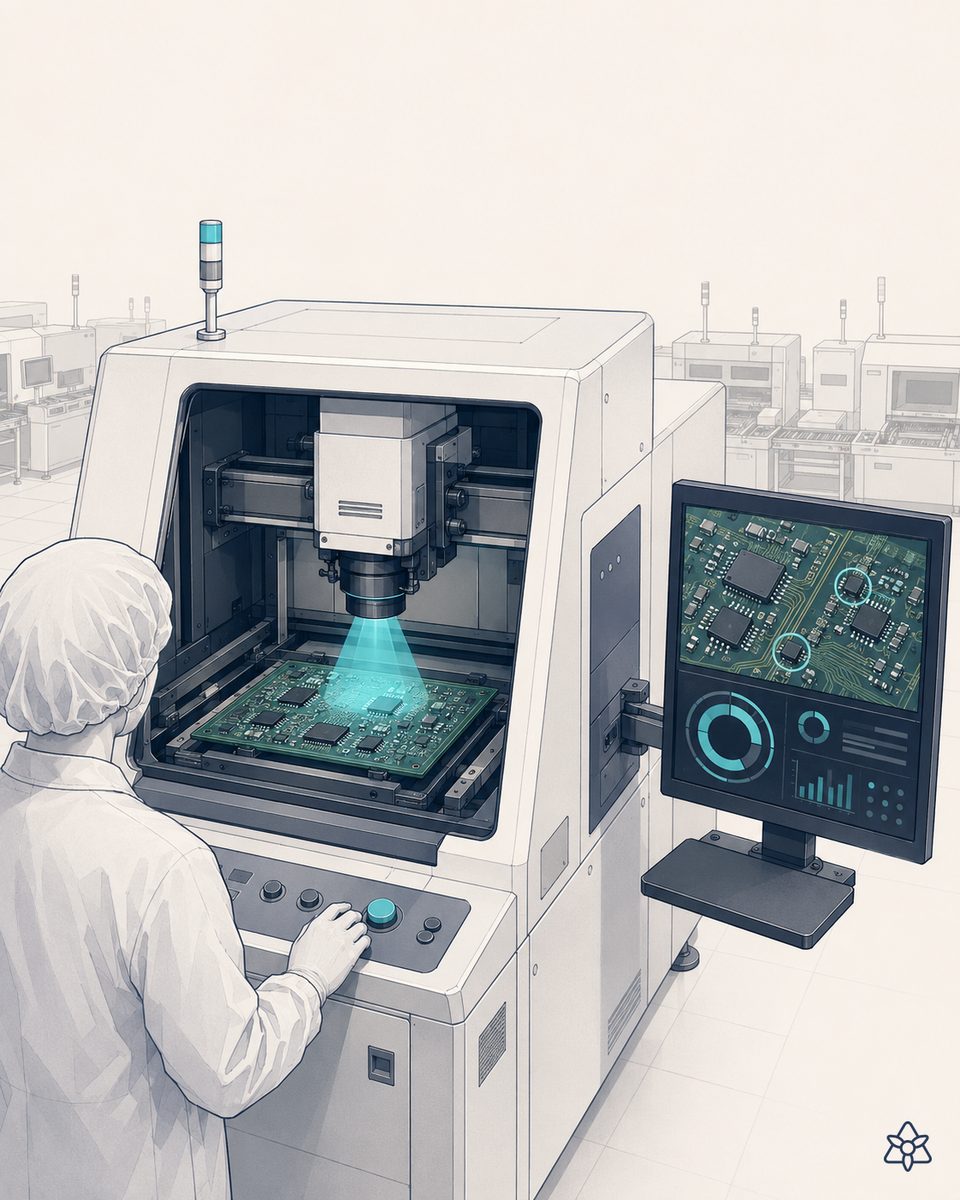
Single-piece flow does not forgive, and in high-mix electronics it breaks every single day.
One piece flow is the Lean principle by which a part moves from one station to the next one at a time, with no buffers between stations. It works in the book and rarely on a real SMT floor. The reasons:
- Micro-stops are invisible to the MES. The operator takes 90 seconds to swap a feeder, 40 to check the BOM of the new ECN, 2 minutes to ask quality to look at a solder joint. The MES still reads "in production" — flow is already broken.
- High mix multiplies changeovers. Ten part numbers a day means ten vulnerable windows at every station: component change, reflow program change, screen change. Every change is an opportunity to drift out of sync.
- WIP between stations is self-defence. When a station is left waiting because the one before it stopped, the operator builds work ahead and creates a private buffer. Nobody forces it: it is done to avoid standing idle. That is where the bin is born.
- And defects surface late. By the time AOI flags a defect in the batch, that component position already has 200 PCBs behind it. Rework is expensive and root-cause follow-up means digging through five screens.
It is exactly the two-gaps syllogism applied to SMT flow: the data exists (every station, every feeder, every AOI knows it), but it lives on islands; and even if you joined it all up, there was no agent operating it in real time to anticipate the drift. AI has just delivered both missing pieces.
iLEAN does not replace AOI or ICT — it glues them together and connects them to the live BOM.
The modern SMT plant is already full of good vertical software: AOI, ICT, an electronics MES, an ERP. Each does its own job well and almost none of them talk to the one next door in real time. iLEAN acts as the filler that seals those cracks, without asking you to replace any system.
Edge watches the station. Connect cross-references the live BOM and the day's ECN. The agent flags the drift before the bin forms. The person decides the adjustment — the line does not reorganize itself.
The three iLEAN pieces applied to one piece flow in SMT/PCB:
- Edge — a terminal with vision and/or signal reading at every critical station. It measures effective cycle, micro-stops and cosmetic defects ahead of AOI. It reads the operator screen when direct integration is not available. It works without a network: if the plant loses connectivity, Edge keeps logging cycles and resuming local synchronization.
- Connect — captures the live BOM from the MES, the ECNs arriving by email from the customer, the process owner's WhatsApp message with the reflow profile adjustment. A BOM change no longer reaches the station half an hour late through forwarded emails: it arrives at second zero.
- Agent — cross-references cycle per station with AOI, ICT, BOM and ECN. It detects the first station drifting and proposes an adjustment (relief, feeder change, program review). If AOI flags a recurring defect, it prepares a root-cause dossier with photo, chart and proposal. The engineer signs off — the agent does not stop the line.
Traditional one piece flow vs. one piece flow with iLEAN
| Aspect | Classical SMT line + AOI/ICT | With iLEAN Edge + Connect + Agent |
|---|---|---|
| Micro-stop detection | Only if the operator logs it by hand | Automatic per station, in milliseconds |
| Station-to-station synchronization | By the line leader's eye | Tracked continuously by the agent |
| Reaction to a new ECN | Email plus paperwork plus a per-shift update | Connect delivers it to every station in seconds |
| Recurring AOI defect | Digging through 5 screens for root cause | Per-batch dossier with photo, chart and proposal |
| WIP between stations | Operator self-defence — a permanent bin | Trending towards real single-piece flow |
| Traceability file per PCB | Rebuilt by hand if a claim arrives | Automatic, with feeder, ECN and AOI history |
Impact estimate for your plant — to be validated with your numbers.
The block below is an estimate to be validated against the actual data of your plant. We put it forward so the committee has an order of magnitude; we refine it during the diagnostic.
- SMT line with 6-10 critical stations, high mix (8-15 part numbers a day), AOI + ICT + electronics MES already installed.
- Edge pilot on the 2 bottleneck stations + Connect against BOM/ECN + a synchronization agent. First value expected within a few weeks: the first micro-stop map per station, already discussable with the process team.
- Work-in-process between stations cut ≥ 30% after the first quarter. Internal lead time cut ≥ 30% on the pilot line. Hard levers: working capital released plus delivery time to the customer.
- Indicative payback between 4 and 9 months, depending on the hourly cost of the bottleneck and on how critical lead time is for your end customer.
Why this works now
The quality bar in automotive-grade electronics is counted in parts per million, not in percentages, and it only holds up with in-line detection and a fast closing loop. An AI model asked to opine in the abstract will fill the gaps; the same model anchored to verifiable data — measured cycles per station, the live BOM, AOI and ICT results, real feeder history — stops guessing and starts answering [1]. iLEAN does not invent the standard: it makes it reachable with the AOI/ICT you already own, and leaves the new capability inside your process team.
[1] OpenAI paper "Why Language Models Hallucinate", 2025 — on the reliability of AI in anchored tasks.
What people ask about one piece flow in electronics with AI
What is one piece flow and why does it matter in electronics?
One piece flow is the Lean principle by which a part moves from one station to the next one at a time, without piling up in buffers between stations. It matters especially in electronics because work-in-process between stations in a high-mix line turns into long lead times, batch traceability that is hard to reconstruct and, above all, defects discovered late — when there are already 200 PCBs stacked behind the station that placed a resistor wrong. Single-piece flow is the Lean dream — and the nightmare of anyone who tried to roll it out without real-time data.
Why does almost nobody sustain one piece flow in high-mix electronics?
Because single-piece flow does not forgive micro-stops. If one station stops for 90 seconds to fetch a component, the station before it builds a buffer and the station after it runs dry. In high-mix SMT/PCB this happens all day long: a feeder change, a missing tape and reel, a solder joint that needs a visual check, an operator screen that never refreshed the BOM after an ECN. The line drifts out of sync and the WIP bin appears as self-defence. Flow breaks without anyone deciding it — it breaks because the classical system has no way of seeing it in real time.
How does iLEAN sustain one piece flow in SMT/PCB?
iLEAN Edge watches every station (with a CNN camera or by reading the station's own signals) and records effective cycles, micro-stops and deviations. Connect cross-references the live BOM, the day's ECN and feeder availability. The agent spots the first station that is drifting and flags it: “you will run out of tape and reel for component X in 7 minutes”, “station 4 has run three cycles above takt, check whether it needs relief”. Synchronization comes back before the WIP bin forms. The person decides the adjustment; the agent never stops the line on its own.
Does this work with the AOI and ICT test we already have?
Yes — and it makes the most of them. iLEAN does not replace AOI or ICT: it integrates them. Edge captures the data from every inspection and Connect cross-references it with the BOM, the ECN, the production order and the batch history. If AOI flags a recurring defect at one position, the agent knows what changed last on that line (component, feeder, reflow profile) and proposes a root cause to the engineer. What used to mean digging through five screens is now a per-batch dossier with photo, chart and proposal.
What does it cost to try one piece flow with AI on an SMT line?
The order of magnitude of an Edge + Connect pilot on an SMT line is comparable to any Edge pilot on the plant floor: an initial investment covering terminals, integration with AOI/ICT/MES and licensing, plus an annual layer. A reasonable payback is counted in months, and the hard levers are work-in-process between stations eliminated (working capital released), lead time cut for the end customer and solder-joint scrap caught before it reaches the reflow oven. Send us your line data and we send back the estimated ROI in 48 h, with your numbers, not ours.
Keep pulling the thread: Cellular manufacturing with AI · Jidoka high mix low volume · All Lean methods
More cases in lean manufacturing
- Near misses with AI — the warning the plant gives itself, captured before the hit.iLEAN Edge sees the near miss on the line, Connect captures it by voice and an agent classifies it to…
- Real-time OEE: availability × performance × qualityiLEAN measures OEE in real time: availability × performance × quality, by line, shift, product. The king…
- On-the-job training (OJT) with AI — the veteran teaches once, the plant learns forever.iLEAN turns the veteran's teaching into permanent capability: Connect captures the OJT session, Edge…
- Operator voice copilot — the person who knows the line best is the one who can never type.The operator dictates incidents and asks questions by voice through an earpiece: iLEAN answers instantly…
- Digital operator rounds — completing the round is not the goal. Capturing the deviation is.How iLEAN turns operator rounds into useful capture: hands-free voice and photo, an agent that spots…
- PDCA: the Plan-Do-Check-Act cycle, digitizediLEAN digitizes the PDCA cycle: every Plan hypothesis is tested on the floor (Do), verified with live…
Tell us your case and within 48 h we send you the estimated ROI of this AI project for your SMT line.
We work on your plant's real data, not on ours. Diagnostic with no strings attached.
Request estimated ROI in 48 h See Lean Manufacturing